

CRM Software for Rheumatologists: A Journey Toward Better Multi-Location Practice Management
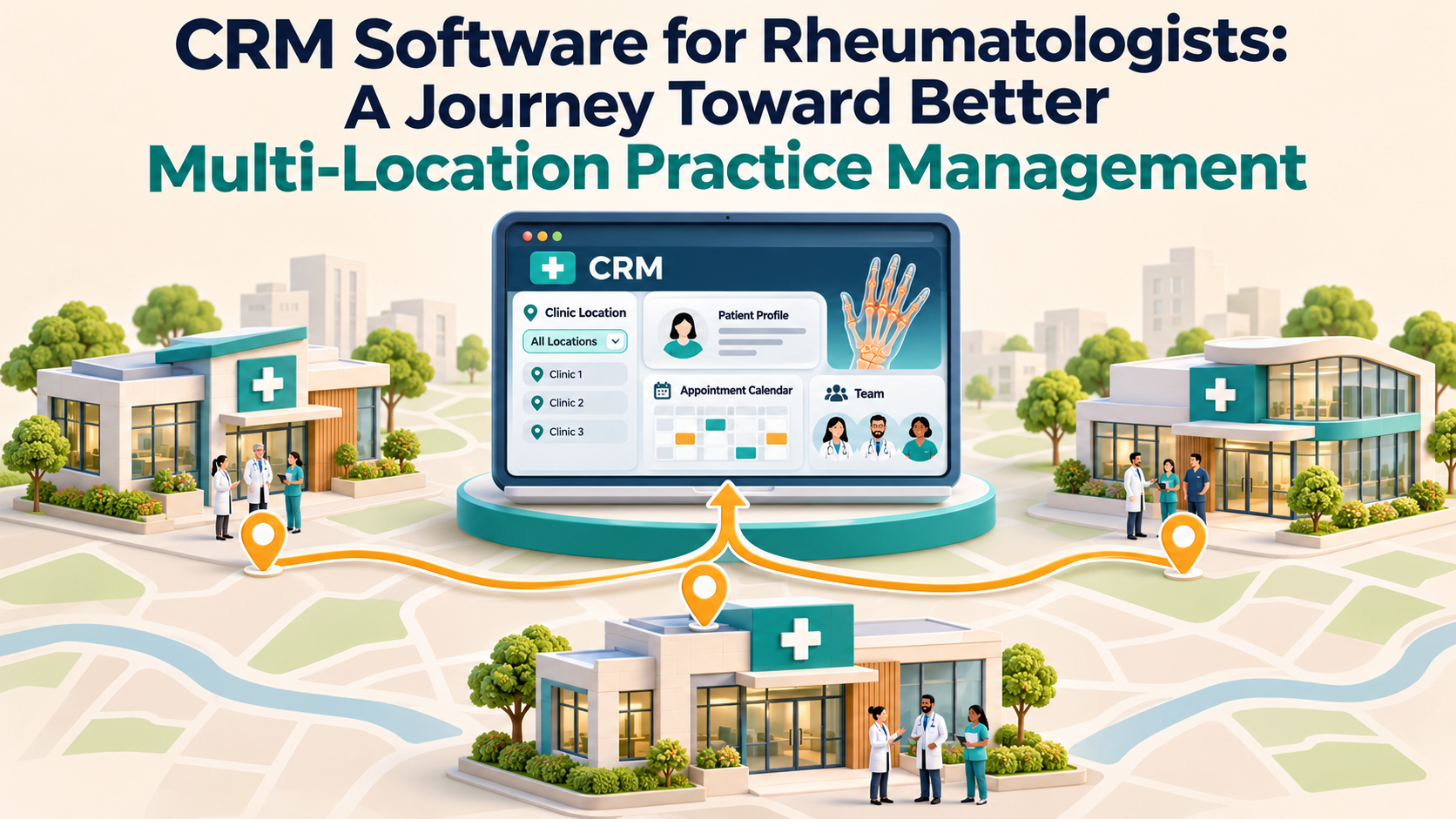
Imagine a rheumatology practice that has grown from one small clinic into a healthcare organization with multiple locations. The practice now has different reception teams, administrative staff, physicians, and patient service representatives working across several branches.
At first, this growth feels like a major achievement. More locations mean more opportunities to serve patients and expand the practice.
But as the organization grows, new challenges begin to appear.
One branch may use spreadsheets to manage patient inquiries, while another relies on email. A staff member at one location may not know whether a patient has already contacted another branch. Managers may struggle to understand which location needs additional support.
This is where CRM software for rheumatologists can make a meaningful difference.
A well-organized CRM system helps rheumatology practices manage communication, coordinate administrative activities, organize patient relationships, and maintain better visibility across multiple locations.
Let's follow a growing rheumatology practice through its journey and discover how CRM technology can support its daily operations.
Chapter 1: The Day One Rheumatology Clinic Becomes Three
Our story begins with a successful rheumatology clinic. The practice has built a strong patient base and established a reliable administrative process.
After several years, the owner decides to expand by opening two additional locations.
The first clinic continues operating as usual, but the new branches introduce more administrative responsibilities.
Each location needs to manage:
-
Patient inquiries and appointment requests
-
Administrative communication
-
Patient follow-up activities
-
Staff responsibilities
-
Contact information
-
Service-related questions
-
Patient feedback
Without a shared system, information can become scattered across different teams.
A CRM platform provides a centralized way to organize relevant patient relationship and administrative information. Authorized staff can access the information they need according to their roles and permissions.
Instead of treating every branch as a completely separate operation, the practice can establish more consistent administrative processes.
Chapter 2: Every Location Has a Different Daily Routine
A few weeks after expansion, the practice manager notices that each location handles communication differently.
At the first branch, receptionists record patient inquiries in spreadsheets. At the second branch, staff use email folders. At the third location, employees maintain handwritten notes.
These differences make it difficult to maintain consistent service.
For example, a patient might contact one branch to ask about an appointment and later call another location for the same information. If the teams cannot review previous interactions, the patient may need to explain everything again.
With CRM software for rheumatologists, the practice can establish a more consistent process for recording administrative interactions.
Depending on the platform, staff may be able to:
-
Record incoming patient inquiries
-
Maintain communication histories
-
Assign follow-up responsibilities
-
Organize contacts by location
-
Track unresolved requests
-
Review previous administrative interactions
The goal is not to make every branch identical. It is to make sure that important communication does not disappear between locations.
Chapter 3: The Patient Who Contacts Two Different Branches
One afternoon, a patient contacts the downtown clinic to ask about appointment availability. Later, the same patient calls another branch because it is closer to home.
Both receptionists receive similar questions, but neither knows about the earlier conversation.
This creates unnecessary repetition.
With a properly configured CRM system, authorized staff may be able to review relevant contact history and understand which administrative requests have already been handled.
The team can also record the patient's preferred location and assign follow-up activities where appropriate.
This helps the practice provide a more organized communication experience.
It is important to remember that a CRM should only display information that staff are authorized to access. Patient privacy, role-based permissions, and secure data handling must remain central to the system's design.
Chapter 4: The Practice Manager Needs a Clear View
As the organization grows, the practice manager faces another challenge: understanding what is happening across all locations.
Are patient inquiries being answered promptly? Which branch has a growing number of pending requests? Are administrative follow-ups being completed?
Without organized reporting, managers may need to contact every branch and collect information manually.
CRM reporting tools can provide a clearer operational picture.
Depending on the system, managers may review:
-
Patient inquiry volume by location
-
Outstanding administrative tasks
-
Communication activity
-
Follow-up completion
-
Appointment-related inquiries
-
Patient feedback trends
-
Staff task assignments
These reports can help managers identify areas that need attention.
For example, if one location consistently has a high number of unresolved inquiries, the manager can investigate whether the branch needs additional staff, improved processes, or better communication tools.
The CRM does not solve every operational problem automatically. It helps decision-makers understand where problems may be developing.
Chapter 5: Bringing New Staff Into the Organization
The practice continues expanding, and a new administrative employee joins the second branch.
During the first few days, the employee needs to learn how the organization communicates with patients, records inquiries, and handles follow-up responsibilities.
When processes are different at every location, training becomes more complicated.
A centralized CRM workflow can help standardize common administrative activities.
For example, the practice can establish guidelines for:
-
Recording a new patient inquiry.
-
Assigning the inquiry to the appropriate team.
-
Documenting communication.
-
Creating a follow-up task.
-
Updating the request status.
-
Escalating unresolved administrative issues.
New employees can learn a consistent process instead of trying to understand several unrelated systems.
This can also reduce the risk of important administrative tasks being overlooked when staff members change roles or locations.
Chapter 6: Connecting CRM With Rheumatology EHR Systems
As the practice becomes more organized, its leadership recognizes that patient relationships and clinical information must be managed appropriately.
CRM software and EHR systems have different responsibilities.
A CRM primarily supports relationship management, communication, contact organization, and administrative coordination. An EHR or EMR system manages clinical records, medical histories, diagnoses, treatment documentation, and other healthcare information.
For example, a rheumatology practice may use rheumatology EHR software for clinical documentation and patient record management alongside a CRM platform for administrative communication and relationship management.
When compatible systems are integrated, authorized information may be shared to support connected workflows.
Before implementing an integration, the practice should evaluate:
-
System compatibility
-
Data-sharing permissions
-
Security requirements
-
User access controls
-
Duplicate data entry risks
-
Vendor support
-
Applicable healthcare privacy regulations
The objective is to connect the right information without confusing administrative records with clinical documentation.
Chapter 7: Automating Repetitive Administrative Tasks
One Monday morning, the practice manager reviews the workload across all three locations.
Several administrative tasks are repeated every day. Staff need to acknowledge inquiries, assign follow-ups, update contact records, and send routine administrative messages.
These activities take time away from other responsibilities.
CRM workflow automation can help manage some repetitive processes.
Depending on the platform, automation may support:
-
Assigning inquiries to the appropriate location
-
Creating follow-up reminders
-
Sending approved appointment-related messages
-
Notifying staff about pending tasks
-
Updating administrative request statuses
-
Generating routine activity reports
For example, when a new inquiry is recorded, the system might assign it to the relevant branch and create a follow-up task for an authorized team member.
Automation should be configured carefully. Staff should review important communications, and automated processes should not replace clinical judgment or make treatment decisions.
Chapter 8: Understanding Patient Feedback Across Locations
A few months later, the organization wants to understand whether patients are receiving consistent service.
Some patients appreciate the communication at the first branch, while others report delays at another location.
Without a structured feedback process, these experiences may remain hidden in individual emails, phone conversations, or informal comments.
A CRM system with suitable feedback-management features can help organize patient comments and service-related concerns.
The practice may categorize feedback by location, identify recurring administrative issues, and assign follow-up responsibilities.
For example, repeated comments about difficulty reaching a particular branch may indicate a need to review its phone coverage or communication process.
Feedback should be handled respectfully, with appropriate privacy safeguards and a clear process for resolving complaints.
Chapter 9: The Practice Becomes More Connected
A year has passed since the organization opened its additional locations.
The practice still has busy schedules, administrative challenges, and patients who need support. However, its teams now have a more consistent approach to managing communication and administrative activities.
Staff can organize patient inquiries, managers can review operational reports, and follow-up responsibilities are easier to track.
The three branches continue serving their local communities while working within a more coordinated administrative structure.
This is the practical value of CRM software for rheumatologists: it helps growing practices maintain organized relationships and communication as their operations become more complex.
What Features Should a Multi-Location Rheumatology Practice Look For?
Not every CRM platform offers the same capabilities. Before selecting a system, a practice should identify its operational needs and compare available features.
| CRM Feature | Benefit for Multiple Locations |
|---|---|
| Centralized contact management | Organizes relevant contact information |
| Location-based organization | Helps separate and manage branch activities |
| Communication history | Makes previous interactions easier to review |
| Task assignment | Clarifies staff responsibilities |
| Workflow automation | Reduces repetitive administrative work |
| Reporting and analytics | Provides visibility into operational activity |
| User permissions | Controls access to sensitive information |
| EHR integration | Connects compatible administrative and clinical workflows |
| Feedback management | Helps organize patient service concerns |
Practices should also consider ease of use, implementation costs, staff training, scalability, technical support, and data security.
For organizations planning a broader digital transformation, EMR and EHR software solutions for healthcare practices can help address the clinical documentation side of their technology needs.
Conclusion: Growing Your Practice Without Losing Coordination
Expanding a rheumatology practice creates new opportunities, but it also introduces administrative complexity. Multiple locations, different staff teams, and increasing patient communication can make coordination difficult.
CRM software for rheumatologists helps bring important relationship-management activities into a more organized environment. It can support communication tracking, task assignments, workflow automation, feedback management, and operational reporting.
When combined with compatible EHR or EMR solutions, CRM technology can contribute to a more connected digital practice.
The most important lesson from our journey is simple: successful growth is not only about opening more locations. It is also about building systems that help every location work together.
Frequently Asked Questions
1. How does CRM software help multi-location rheumatology practices?
It helps organize communication, patient inquiries, administrative tasks, and contact information across different clinic locations.
2. Can CRM software manage multiple clinic branches?
Some CRM platforms support multiple locations through shared databases, location-based organization, user permissions, and reporting features. Capabilities vary by vendor.
3. Can different staff members access the same CRM?
Yes. Many platforms support multiple users with role-based permissions, allowing authorized employees to access relevant information according to their responsibilities.
4. Does CRM software replace rheumatology EHR systems?
No. CRM software focuses on relationship management and administrative communication, while EHR systems manage clinical records and healthcare documentation.
5. Can CRM software automate administrative tasks?
Depending on the platform, it can automate task assignments, reminders, notifications, and certain routine communication workflows.
6. What should a rheumatology practice consider before choosing a CRM?
The practice should evaluate its workflow requirements, number of locations, integration needs, security controls, pricing, scalability, and staff training requirements.

 Arabic
 French
 Spanish
 Portuguese
 Deutsch
 Turkish
 Dutch
 Italiano
 Russian
 Romaian
 Portuguese (Brazil)
 Greek