


mHealth Market Size Projected to Reach USD 648.2 Billion by 2034 with a CAGR of 18.80%
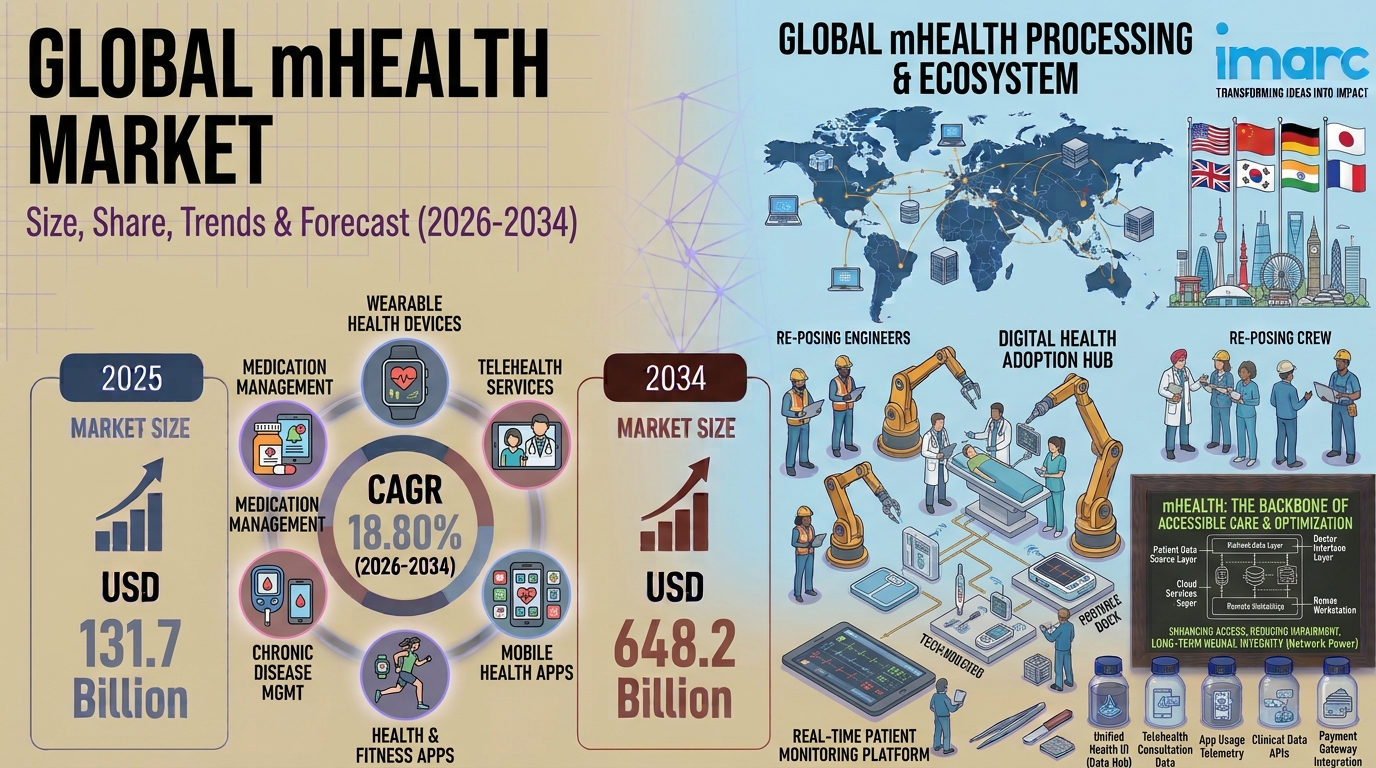
IMARC Group has recently released a new research study titled “mHealth Market Report by Component, Service, Participants, and Region, 2026-2034,” which offers a detailed analysis of the market drivers, segmentation, growth opportunities, trends and competitive landscape to understand the current and future market scenarios.
mHealth Market Size, Growth, and Forecast (2026-2034)
The mhealth market size reached USD 131.7 Billion in 2025 and is projected to reach USD 648.2 Billion by 2034, growing at a CAGR of 18.80% during 2026-2034. The rising dependence on mobile devices, increasing instances of chronic diseases such as diabetes and hypertension, and the integration of innovative technologies by key manufacturers are the primary factors driving the mhealth market.
Mobile health (mHealth) is a diversified branch of electronic health (eHealth) that collects patient data using mobile devices and wireless infrastructure. The collected data supports accurate diagnosis and treatment of several medical conditions, while also improving medication adherence and communication, enabling remote patient monitoring, and allowing patients to send secure messages, connect to service providers, and schedule appointments.
As a result, mHealth finds extensive application in healthcare supply chain management, diagnostic and treatment support, chronic disease monitoring and management, and increasing health awareness among people. The technology is also gaining popularity worldwide for home-based patient monitoring services among the geriatric population.
Explore Growth Opportunities in the mHealth Market - Grab Your Sample Report for Evaluation: https://www.imarcgroup.com/mhealth-market/requestsample
Key Trends Driving the mHealth Market
• Rising dependence on mobile devices: Mobile devices let individuals access healthcare-related services easily through wireless multimedia. mHealth solutions are user-friendly and efficient during emergencies, which is strengthening adoption among patients and healthcare providers alike.
• Increasing instances of chronic diseases: Growing cases of chronic conditions such as diabetes and hypertension are creating demand for continuous monitoring and management tools. Wearables such as blood pressure monitors, blood glucometers, and pulse oximeters, together with medical apps, allow patients and clinicians to track conditions outside traditional care settings.
• Integration of innovative technologies: Key manufacturers are integrating innovative technologies to support the healthcare industry. For instance, the U.S. Food and Drug Administration (FDA) launched CURE ID in December 2019, an internet-based repository that lets the clinical community report experiences of treating infectious diseases with existing FDA-approved drugs through smartphones, websites, or other mobile devices.
• Home-based monitoring for the geriatric population: mHealth technology is gaining popularity for remote, home-based patient monitoring among older adults, helping caregivers and providers track health status and respond earlier without requiring frequent clinic visits.
mHealth Market Report Segmentation:
The mHealth Market report provides a detailed segmentation analysis to help businesses identify key growth segments and evolving industry dynamics. The market is categorized based on component, service, and participants, offering comprehensive insights across the mhealth market.
Component Insights:
• Wearables: Wearables include blood pressure monitors, blood glucometers, pulse oximeters, neurological monitors, and other devices that capture patient data continuously and transmit it wirelessly for monitoring and diagnosis.
• mHealth Apps: mHealth apps are divided into medical apps and fitness apps, supporting medication adherence, appointment scheduling, secure communication with providers, and health awareness among users.
Service Insights:
- Monitoring Services and Diagnosis Services: Monitoring services enable remote tracking of patient conditions, while diagnosis services use mobile-collected data to support accurate and timely identification of medical conditions.
- Healthcare Systems Strengthening Services, Treatment Services, and Others: These services extend mHealth into healthcare supply chain management, treatment support, and broader health system improvement.
Participants Insights:
- mHealth Application Companies and Pharmaceuticals Companies: mHealth application companies develop the platforms that connect patients with care, while pharmaceutical companies use mobile tools to support medication adherence and patient engagement.
- Hospitals, Health Insurance Companies, and Others: Hospitals use mHealth for remote monitoring and care coordination, and health insurance companies adopt it to support preventive care and chronic disease management among members.
Regional Insights:
- Global Coverage: The report analyzes the mhealth market across North America, Asia-Pacific, Europe, Latin America, and the Middle East and Africa, with country-level coverage of the United States, Canada, China, Japan, India, South Korea, Australia, Indonesia, Germany, France, the United Kingdom, Italy, Spain, Russia, Brazil, and Mexico.
mHealth Market: Recent News and Developments
- September 2025: The U.S. FDA cleared Apple’s hypertension notification feature for Apple Watch, which uses the optical heart sensor to analyze how blood vessels respond to heartbeats and reviews data over 30-day periods. Apple said the feature would be available in more than 150 countries and regions and expects it to notify over 1 million people with undiagnosed hypertension within the first year.
Challenges Impacting the mHealth Market
Protecting sensitive patient data collected through mobile devices and wireless networks is a central concern for providers and technology companies, as privacy and cybersecurity expectations rise alongside adoption. Compliance with varying regulatory requirements across countries can also slow the rollout of new features, since some markets require clearance from their own health agencies.
Clinical accuracy and validation of consumer-grade wearables and apps remain important, as healthcare providers need reliable data before incorporating it into diagnosis and treatment decisions. Integrating mHealth data with existing hospital and health system platforms adds further complexity.
Investment Opportunities in the mHealth Market
The mhealth market presents compelling investment opportunities supported by its projected growth from USD 131.7 Billion in 2025 to USD 648.2 Billion by 2034, an incremental expansion of more than USD 500 Billion. Wearable monitoring devices, medical apps for chronic disease management, and remote monitoring services for the geriatric population are among the most attractive areas.
Partnerships between mHealth application companies, pharmaceutical companies, hospitals, and health insurers can open new revenue streams in monitoring, diagnosis, and treatment support services. Companies that combine clinically validated devices with secure, user-friendly platforms can build strong competitive positions.
Outlook of the mHealth Market (2026-2034)
The outlook for the mhealth market is positive, supported by growing mobile device dependence, chronic disease prevalence, and continued technology integration by manufacturers. The market is projected to grow from USD 131.7 Billion in 2025 to USD 648.2 Billion by 2034 at a CAGR of 18.80%.
Wearable-based monitoring, mHealth apps for diagnosis and treatment support, and home-based care for the geriatric population will be the defining trends shaping the mhealth market through 2034.
Key Players in the mHealth Market
The mhealth market is served by a mix of consumer technology companies, medical device makers, healthcare IT providers, and pharmaceutical companies. Key participants include Airstrip Technologies Inc., Allscripts Healthcare Solutions Inc., Apple Inc., Bayer Aktiengesellschaft, Boston Scientific Corporation, Koninklijke Philips N.V., Masimo Corporation, Omron HealthCare Inc. (OMRON Corporation), Qualcomm Incorporated, Samsung Electronics Co. Ltd., and Sanofi S.A.
- Apple Inc.: A global consumer technology leader, Apple expanded its health capabilities on Apple Watch with a hypertension notification feature cleared by the U.S. FDA in September 2025, available on Apple Watch Series 9 and later and Ultra 2 and later models, reinforcing its role in wearable-based health monitoring.
- Omron HealthCare Inc. (OMRON Corporation): A well-known maker of home health monitoring devices, Omron HealthCare is recognized for its blood pressure monitors, a core wearable category in the mhealth market, supporting patients and clinicians in remote tracking of cardiovascular health.
Frequently Asked Questions (FAQs): mHealth Market
1. What is the current mhealth market size?
The mhealth market size reached USD 131.7 Billion in 2025 and is projected to reach USD 648.2 Billion by 2034, growing at a CAGR of 18.80% during 2026-2034.
2. What is mobile health (mHealth)?
Mobile health is a diversified branch of electronic health (eHealth) that collects patient data using mobile devices and wireless infrastructure, supporting diagnosis, treatment, remote patient monitoring, medication adherence, and communication between patients and providers.
3. What are the key drivers of the mhealth market?
Key drivers include the rising dependence on mobile devices, increasing instances of chronic diseases such as diabetes and hypertension, user-friendly mHealth solutions, and the integration of innovative technologies by key manufacturers.
4. What are the key segments of the mhealth market?
The mhealth market is segmented by component (wearables and mHealth apps), service (monitoring, diagnosis, healthcare systems strengthening, treatment, and others), participants (mHealth application companies, pharmaceutical companies, hospitals, health insurance companies, and others), and region.
5. Who are the key players in the mhealth market?
Key players in the mhealth market include Airstrip Technologies Inc., Allscripts Healthcare Solutions Inc., Apple Inc., Bayer Aktiengesellschaft, Boston Scientific Corporation, Koninklijke Philips N.V., Masimo Corporation, Omron HealthCare Inc., Qualcomm Incorporated, Samsung Electronics Co. Ltd., and Sanofi S.A.
Author IMARC Group
IMARC Group is a global management consulting firm that helps the world's most ambitious changemakers to create a lasting impact. The company provide a comprehensive suite of market entry and expansion services. IMARC offerings include thorough market assessment, feasibility studies, company incorporation assistance, factory setup support, regulatory approvals and licensing navigation, branding, marketing and sales strategies, competitive landscape and benchmarking analyses, pricing and cost research, and procurement research.
Contact Us
IMARC Group,
134 N 4th St. Brooklyn, NY 11249, USA,
Email: [email protected],
United States: +1-201971-6302

 English
 Arabic
 French
 Spanish
 Portuguese
 Deutsch
 Turkish
 Italiano
 Russian
 Romaian
 Portuguese (Brazil)
 Greek