


MIPS Reporting Without the Confusion: What Small Practices Need to Know
A small internal medicine group finds a line on its Medicare remittances showing a payment adjustment it did not expect. After some digging, the office manager learns the adjustment traces back to a reporting year two years earlier, when the practice submitted incomplete quality data during a staffing change. The penalty was modest, but it applied to every Medicare Part B claim for a full year.
The Merit-based Incentive Payment System is easy to put off because its consequences arrive so much later. This article explains how MIPS works, who has to participate, and how practices can manage reporting without letting it take over operations.
Where MIPS Fits
MIPS is one of two tracks in the Quality Payment Program created by the Medicare Access and CHIP Reauthorization Act of 2015, commonly called MACRA. The other track is Advanced Alternative Payment Models. Clinicians who participate sufficiently in an Advanced APM may qualify for that track instead of MIPS.
Under MIPS, eligible clinicians receive a final score based on performance in a given year. That score determines a positive, neutral, or negative adjustment to their Medicare Part B payments two years later. The 2025 performance year, for example, affects 2027 payments.
Not every clinician must participate. CMS sets a low-volume threshold based on Medicare Part B allowed charges, the number of Medicare patients seen, and the number of covered services. Clinicians below the threshold are generally excluded, though some can opt in. Eligibility can be checked each year using the QPP Participation Status Tool on the CMS Quality Payment Program website. This overview of how MIPS and MACRA affect billing gives additional background.
The Four Performance Categories
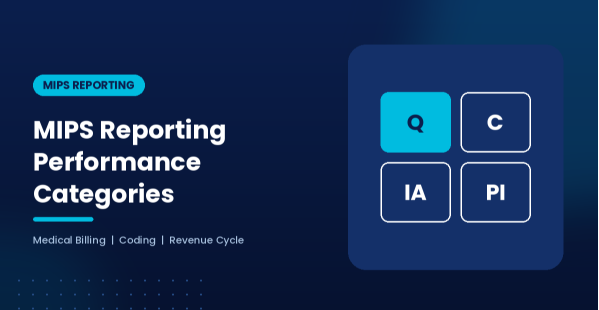
A MIPS final score is built from four categories, each weighted differently. Weights can change from year to year and may be reweighted for certain practice types.
Quality
Clinicians report on quality measures that fit their specialty and patient population, such as blood pressure control or diabetes management. Measures can be submitted through EHR-based electronic clinical quality measures, registries, or claims for small practices. Quality has historically carried one of the largest shares of the score.
Cost
CMS calculates cost measures from Medicare claims data. No separate submission is required. The measures look at the total cost of care attributed to the clinician and at episode-based costs for specific conditions or procedures.
Improvement Activities
These are activities that improve care processes, patient engagement, or access. Clinicians attest to completing activities from the CMS inventory. Small practices and rural practices often receive special treatment in this category.
Promoting Interoperability
This category measures use of certified EHR technology, including electronic prescribing, health information exchange, patient access to records, and public health reporting. Small practices may qualify for an automatic or approved reweighting of this category in some circumstances.
MIPS Value Pathways and Other Options
CMS has introduced MIPS Value Pathways, or MVPs, which group measures and activities around a specialty or condition. The goal is to make reporting more relevant and less burdensome. CMS has indicated it intends MVPs to eventually replace traditional MIPS reporting, so practices should watch for which MVPs fit their specialty.
Practices can also report as individuals, as a group under a single tax ID, or as part of a virtual group or APM entity. Group reporting is often simpler for small practices, since data is combined and one submission covers everyone.
The choice has trade-offs. Under group reporting, every clinician in the group shares the same final score, so a strong performer and a weaker one receive the same adjustment. Individual reporting gives each clinician their own score but multiplies the administrative work. Practices should revisit this decision each year as staffing and specialty mix change.
Turning Reporting Into Routine
The practices that handle MIPS well treat it as a year-round process rather than a scramble in the first quarter of the following year. A few habits help:
-
Confirm eligibility early. Check the participation status for each clinician and the group at the start of each year.
-
Choose measures that match the practice. Pick quality measures the practice already tracks or can track easily, and confirm the EHR supports them.
-
Monitor performance quarterly. Many EHRs and registries offer dashboards showing measure performance during the year. Fixing gaps in the summer is easier than discovering them in January.
-
Document improvement activities as they happen. Keep records showing what was done and when, since CMS can audit attestations.
-
Keep the EHR certification current. Promoting Interoperability depends on certified technology for the required period.
-
Note the submission deadline. The data submission window typically opens in early January and closes in late March for the prior performance year. Confirm the exact dates each year on the QPP website.
Read the adjustment on your remittances
MIPS payment adjustments appear on Medicare remittance advice, applied to Part B claims during the payment year. Billing staff should know what these adjustment codes look like so they are posted correctly and not mistaken for underpayments or denials. Reviewing the final score feedback CMS releases each summer also helps the practice understand why it received the adjustment it did. If the practice believes its score was calculated incorrectly, CMS allows a targeted review request within a limited window after the feedback is released.
Know the exception options
Not every difficult year has to result in a penalty. CMS offers an Extreme and Uncontrollable Circumstances exception for events such as natural disasters or other situations outside the practice's control, and a separate hardship exception for the Promoting Interoperability category, for example when a practice lacks adequate internet access or faces EHR vendor issues. Applications must be filed by the deadlines CMS sets each year, and approval is not automatic. Small practices should review these options before assuming a penalty is unavoidable.
MIPS also connects to the larger shift toward paying for outcomes. Practices thinking about how quality reporting relates to future contracts may find this piece on value-based care billing a helpful companion.
Getting Help With the Workload
For small practices, MIPS reporting often falls on an office manager who already has a full workload. Some groups use a qualified registry or their EHR vendor to submit data. Others lean on a billing partner that tracks quality measures alongside claims. Multi-specialty groups, in particular, can find that each specialty needs different measures, which makes coordinated reporting harder. Firms such as EZ Med Professionals support multi-specialty groups managing billing and reporting across several service lines.
The Takeaway
MIPS reporting has delayed consequences, which makes it easy to neglect until a payment adjustment appears. Practices that confirm eligibility early, choose measures they can track, monitor performance during the year, and document improvement activities as they go can meet requirements without disrupting daily operations. Because the rules shift each year, a short annual review of the latest CMS guidance is part of the routine.

 English
 French
 Spanish
 Portuguese
 Deutsch
 Turkish
 Dutch
 Italiano
 Russian
 Romaian
 Portuguese (Brazil)
 Greek