


Pharmaceutical Cold Chain Logistics in India: Ensuring Safe and Reliable Medicine Transportation
Introduction
The pharmaceutical industry depends on a reliable supply chain to move medicines, vaccines, biological products and other healthcare materials between manufacturers, warehouses, distributors, hospitals and healthcare facilities. Many of these products have specific storage and transportation requirements. Exposure to unsuitable conditions during transit can affect product quality and may create challenges for businesses responsible for maintaining product integrity.
This makes pharmaceutical cold chain logistics an important part of healthcare distribution in India. It involves more than transporting medicines in refrigerated vehicles. Businesses must consider product-specific temperature requirements, packaging, vehicle preparation, monitoring, loading procedures and delivery coordination.
As India's pharmaceutical sector continues to serve domestic and international markets, effective cold chain planning can help businesses manage sensitive shipments and improve supply chain visibility.
What Is Pharmaceutical Cold Chain Logistics?
Pharmaceutical cold chain logistics refers to the planned transportation and handling of medicines and healthcare products that require specific environmental conditions.
Unlike ordinary cargo, temperature-sensitive pharmaceutical shipments may need controlled conditions throughout transportation. These requirements depend on the nature of the product, its approved documentation and the manufacturer's instructions.
A pharmaceutical cold chain process may involve:
-
Reviewing product storage and transportation requirements.
-
Selecting suitable temperature-controlled vehicles.
-
Preparing vehicles before loading.
-
Using appropriate packaging and monitoring equipment.
-
Recording temperature conditions during transit.
-
Coordinating loading, unloading and delivery.
-
Reviewing records when a temperature excursion occurs.
The objective is to maintain the required conditions throughout the shipment journey rather than focusing only on the final delivery.
Why Temperature Control Is Critical for Pharmaceutical Shipments
Pharmaceutical products can respond differently to temperature changes. Some medicines may require refrigerated transportation, while others may need frozen or controlled room-temperature conditions.
The correct transportation range must be established for each product. Businesses should not assume that one temperature setting is suitable for all medicines.
Temperature control is important for several reasons.
Maintaining Product Quality
Medicines are manufactured and stored according to defined quality requirements. Maintaining suitable transportation conditions helps reduce the risk of exposure to unsuitable temperatures.
Supporting Patient Safety
Healthcare products ultimately serve patients. Maintaining appropriate handling and transportation procedures is therefore an important responsibility across the supply chain.
Reducing Shipment Losses
A temperature excursion may require investigation and quality assessment. Suitable planning and monitoring can help identify potential issues and support timely decisions.
Maintaining Documentation
Temperature records and shipment information help businesses review transportation conditions and maintain appropriate quality documentation.
Common Challenges in Pharmaceutical Cold Chain Transportation
Pharmaceutical transportation involves multiple stages and participants. Each stage needs coordination to minimise operational risks.
1. Temperature Excursions
A temperature excursion occurs when recorded conditions move outside the specified range for a product. Its significance depends on factors such as duration, magnitude and the product's stability information.
A documented escalation and assessment process is important when such an event occurs.
2. Vehicle Preparation
A suitable vehicle must be prepared according to the shipment's transportation requirements. Equipment checks and pre-conditioning procedures can help reduce avoidable problems before dispatch.
3. Loading and Unloading Delays
Extended waiting or unnecessary exposure during transfers can affect temperature-sensitive shipments. Planned loading and unloading procedures help reduce this risk.
4. Long-Distance Transportation
Long routes may involve traffic, weather changes, transit delays and multiple handling points. Businesses should plan routes and contingency arrangements according to the shipment's requirements.
5. Limited Shipment Visibility
Without suitable monitoring and communication, businesses may find it difficult to understand shipment movement and investigate unexpected events.
These challenges highlight why pharmaceutical logistics requires coordinated planning rather than transportation capacity alone.
The Importance of Temperature Monitoring and Shipment Tracking
Monitoring helps businesses review transportation conditions and understand how a shipment moves through the supply chain.
Different technologies support different monitoring requirements.
Temperature data loggers: Record temperature information during transportation and provide records for subsequent review.
GPS tracking: Helps monitor vehicle location and route progress.
Tracer-enabled systems: Can support access to temperature and vehicle-location information.
Digital records: Help maintain shipment and transportation information for operational review.
Communication systems: Support coordination between the shipper, logistics provider and receiving location.
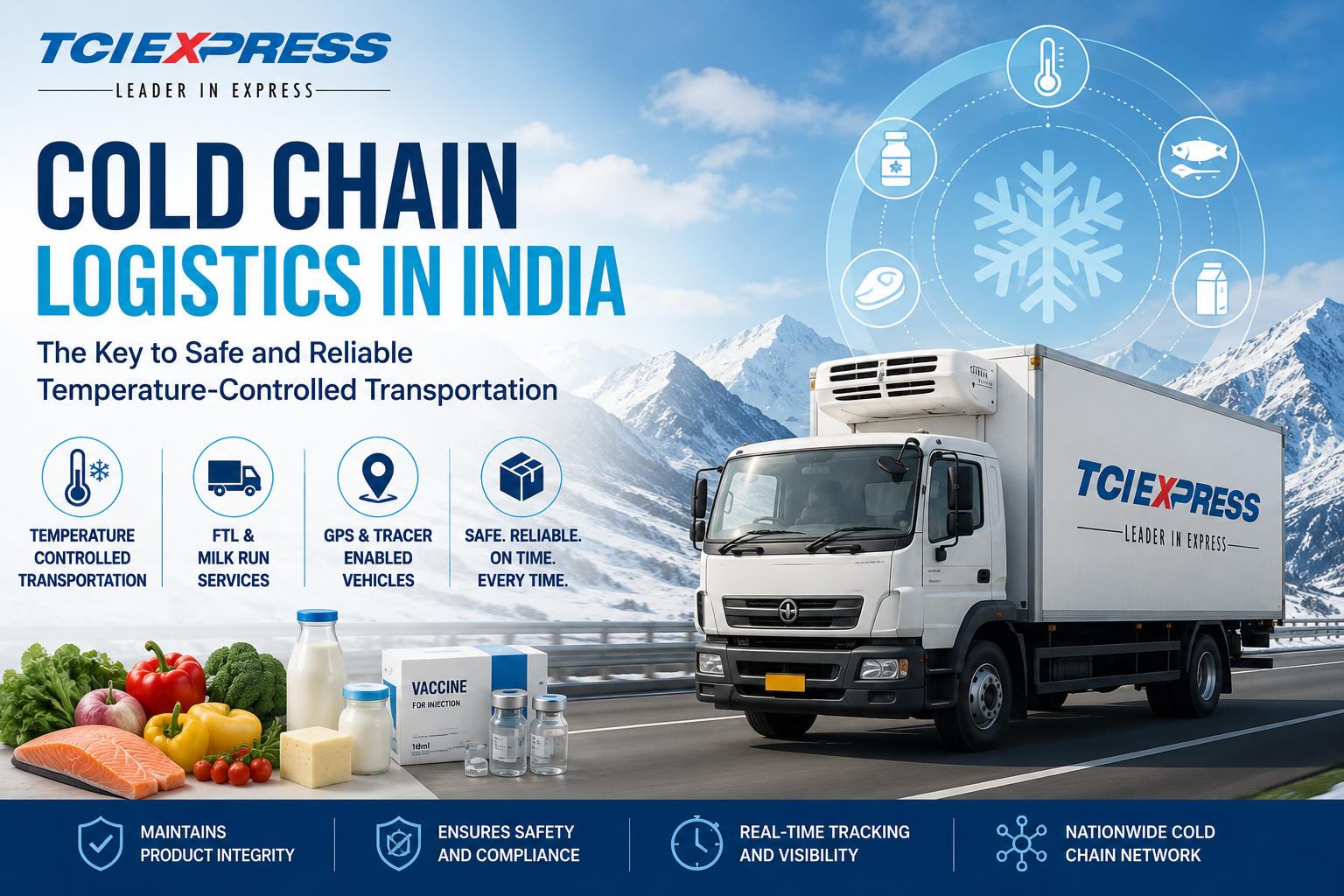
TCI Express's Cold Chain Express service includes GPS and tracer-enabled vehicles that support access to temperature and vehicle-location information.
For additional industry context, read Pharma Cold Chain Logistics in India: Planning Temperature-Controlled Shipments on TCI Express Insights. It explains the importance of product-specific temperature requirements, monitoring plans, packaging, handovers and excursion response.
How TCI Express Supports Temperature-Controlled Transportation
Pharmaceutical businesses require transportation arrangements that consider the nature of their products and the agreed shipment conditions.
TCI Express provides temperature-controlled transportation through its Cold Chain Express service.
Key service capabilities include:
Full Truck Load Transportation
Full Truck Load (FTL) transportation can support businesses requiring dedicated vehicle capacity for planned shipment movements.
Milk Run Transportation
Milk Run transportation follows a planned route involving multiple pickup or delivery points. It can support distribution operations that require coordinated movement between different locations.
Secondary Transportation
Temperature-controlled secondary transportation supports movement beyond the primary distribution stage, helping businesses coordinate deliveries between distribution points and receiving locations.
Different Vehicle Capacities
TCI Express offers cold chain vehicles ranging from 1 ton to 18 tons, subject to operational requirements.
GPS and Tracer-Enabled Vehicles
These capabilities support access to vehicle-location and temperature information, helping businesses improve shipment visibility.
Businesses can review the TCI Express Cold Chain Express service to understand its transportation offering.
Planning a Pharmaceutical Cold Chain Shipment
Effective pharmaceutical transportation begins before the shipment leaves the manufacturing or storage facility.
A structured planning process can help businesses identify operational requirements in advance.
Step 1: Identify Product Requirements
Confirm the approved temperature range, packaging instructions, handling requirements and any other product-specific transportation conditions.
Step 2: Evaluate Packaging
Packaging should be appropriate for the product and expected transportation conditions. Depending on the shipment, businesses may require qualified thermal packaging or other suitable protective solutions.
Step 3: Select the Transportation Arrangement
Choose the vehicle and transportation model according to shipment volume, route, transit time and temperature requirements.
Step 4: Prepare the Vehicle
Complete the required vehicle and equipment checks before loading. Any pre-conditioning procedure should follow the agreed operating instructions.
Step 5: Establish a Monitoring Plan
Determine how temperature information and vehicle movement will be monitored, recorded and reviewed during transportation.
Step 6: Coordinate Delivery
Ensure the receiving facility is ready for the shipment. Timely unloading and proper handover procedures are important.
Step 7: Review Shipment Records
Check available temperature and transportation records after delivery. If an excursion is identified, the authorised quality team should assess it according to the product's stability information and established procedures.
The Role of Secondary Transportation in Healthcare Distribution
Pharmaceutical distribution often involves multiple locations. Medicines may move from manufacturing facilities to central warehouses, regional distribution centres, hospitals, pharmacies and other healthcare destinations.
Secondary transportation is important because the final distribution stage also requires suitable handling and transportation arrangements.
Businesses should pay attention to:
-
Coordination between distribution centres.
-
Vehicle suitability for the shipment.
-
Planned delivery schedules.
-
Monitoring during transportation.
-
Clear handover procedures.
-
Communication between dispatch and receiving teams.
TCI Express includes temperature-controlled secondary transportation within its Cold Chain Express offering.
How Businesses Can Improve Pharmaceutical Logistics Efficiency
A well-organised pharmaceutical supply chain requires cooperation between manufacturers, quality teams, warehouse operators and logistics providers.
Businesses can improve transportation planning by following these practices:
-
Standardise shipment instructions: Provide clear product-specific transportation requirements before dispatch.
-
Plan routes carefully: Consider expected transit time, road conditions and possible delays.
-
Use suitable monitoring systems: Select monitoring arrangements according to the shipment's risk and quality requirements.
-
Reduce unnecessary handling: Coordinate loading, transfers and unloading to minimise avoidable exposure.
-
Maintain accurate records: Keep relevant shipment and temperature information available for review.
-
Define escalation procedures: Establish who should be contacted when an unusual reading or operational issue occurs.
-
Review transportation performance: Use shipment records and operational feedback to identify areas for improvement.
Businesses can also explore the wider TCI Express service portfolio for different transportation requirements.
Other services include Domestic Air Express, International Air Express, Surface Express and Rail Express.
Technology and the Future of Pharmaceutical Cold Chain Logistics
The pharmaceutical supply chain is becoming more dependent on shipment visibility, digital records and coordinated logistics operations.
Technology can help businesses access information about transportation conditions and vehicle movement. This information can support better operational decisions, particularly when shipments involve multiple distribution points.
Future development in pharmaceutical cold chain logistics is likely to place greater emphasis on:
-
Improved temperature monitoring.
-
Better integration of shipment and vehicle information.
-
More organised exception reporting.
-
Stronger coordination between supply chain participants.
-
Better use of transportation data for operational planning.
Businesses can explore more industry developments through TCI Express Insights, which publishes information about logistics, transportation and supply chain management.
Leadership and the Growth of Specialised Logistics
The development of specialised logistics services requires continued attention to infrastructure, technology and operational capabilities.
Chander Agarwal, Managing Director of TCI Express, is associated with the company's development in India's express logistics sector.
As businesses increasingly require specialised transportation services, the ability to coordinate different shipment types and distribution requirements remains important for logistics providers.
Read more about his professional journey in the TCI Express leadership profile of Chander Agarwal.
Conclusion
Pharmaceutical cold chain logistics is an essential part of modern healthcare distribution. Medicines and other temperature-sensitive products require suitable transportation conditions, careful handling and appropriate monitoring throughout their journey.
Businesses can strengthen their supply chain processes by defining product-specific requirements, preparing vehicles, monitoring temperature conditions and coordinating every delivery stage.
TCI Express provides temperature-controlled transportation through FTL, Milk Run and secondary transportation, supported by GPS and tracer-enabled vehicle capabilities.
Explore TCI Express Cold Chain Express and request a shipment estimate to discuss your pharmaceutical transportation requirements.
Frequently Asked Questions
1. What is pharmaceutical cold chain logistics?
Pharmaceutical cold chain logistics is the transportation and handling of medicines and healthcare products under specified environmental conditions to help maintain their required quality.
2. Why is temperature monitoring important for pharmaceutical shipments?
Temperature monitoring provides records of transportation conditions and can help identify potential excursions that may require quality assessment.
3. Do all pharmaceutical products require refrigerated transportation?
No. Different products have different storage and transportation requirements. Some require refrigeration, others may require frozen conditions, and some can be transported under controlled room-temperature conditions.
4. What is a temperature excursion?
A temperature excursion occurs when recorded conditions move outside the approved range for a product. Its impact must be assessed using relevant product stability information and quality procedures.
5. What is the role of GPS in pharmaceutical transportation?
GPS helps logistics teams monitor vehicle location and route progress. It can support shipment visibility and coordination.
6. What is secondary transportation in pharmaceutical logistics?
Secondary transportation refers to the movement of products from central distribution points towards regional warehouses, hospitals, pharmacies and other receiving locations.
7. What cold chain transportation services does TCI Express offer?
TCI Express offers temperature-controlled FTL, Milk Run and secondary transportation, along with GPS and tracer-enabled vehicle capabilities.
8. How can businesses enquire about TCI Express pharmaceutical transportation?
Businesses can visit the TCI Express website, review the Cold Chain Express service and submit their shipment requirements.

 English
 Arabic
 French
 Spanish
 Portuguese
 Deutsch
 Turkish
 Dutch
 Italiano
 Russian
 Romaian
 Portuguese (Brazil)