


Profitability and Margin Analysis Services: How to Evaluate Whether Business Growth Is Actually Improving Returns
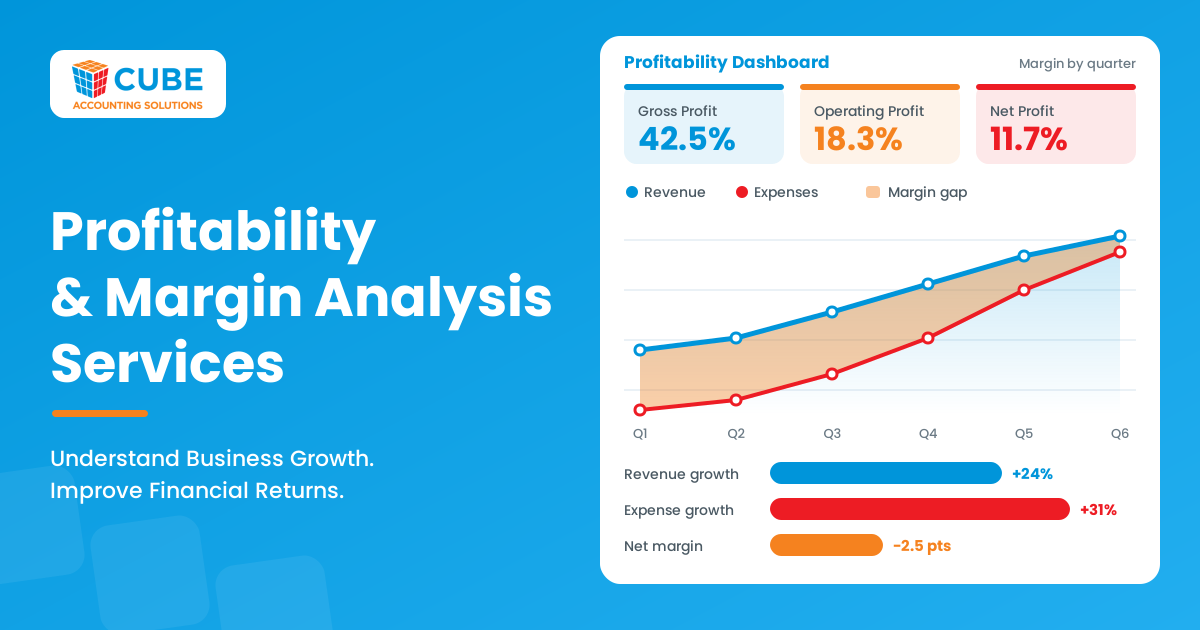
Growing revenue is often seen as a sign of business success. However, higher sales do not always mean a company is making more money. A business may attract new customers, sell more products, or open new locations while its expenses increase even faster. As a result, profits may stay the same or even decrease.
This is why business owners need to look beyond revenue and understand how much money the company actually keeps after covering its costs. Profitability and margin analysis services help businesses examine their income, expenses, and profit margins to understand whether growth is creating real financial value.
By reviewing financial performance regularly, business owners can identify profitable activities, control unnecessary spending, and make better decisions about the future.
What Is Profitability and Margin Analysis?
Profitability and margin analysis is the process of reviewing how much profit a business earns compared to its revenue, operating costs, and other expenses.
It helps answer important questions such as:
-
Is the business earning enough profit from its sales?
-
Are expenses increasing faster than revenue?
-
Which products or services generate the highest returns?
-
Are certain customers or projects costing more than they contribute?
-
Is business growth improving overall financial performance?
For example, imagine a company increases its monthly revenue from $100,000 to $150,000. At first, this looks like strong growth. However, if its monthly expenses increase from $80,000 to $140,000, its profit falls from $20,000 to $10,000.
The company is selling more but earning less. Without reviewing its profit margins, the owner might believe the business is performing better than it actually is.
Why Higher Revenue Does Not Always Mean Higher Profit
Revenue shows how much money a business earns from selling its products or services. Profit shows what remains after expenses are paid. These two numbers are connected, but they do not always move in the same direction.
Several factors can cause revenue to increase while profitability declines.
1. Rising Operating Costs
As a business grows, it may need more employees, equipment, office space, software, and other resources. These expenses can increase quickly, especially when a company expands without a clear spending plan.
If operating costs rise faster than sales, the business may earn less profit even when revenue is growing.
2. Pricing That Does Not Cover Costs
Some businesses keep prices low to attract more customers. While this may increase sales, it can reduce profit margins if prices do not cover labor, materials, delivery, and overhead expenses.
Businesses should regularly review their pricing to make sure each product or service generates a reasonable return.
3. Unprofitable Customers and Projects
Not every customer or project contributes equally to business profits. Some customers may require extra support, frequent changes, discounts, or additional resources. Similarly, certain projects may take more time and money than originally planned.
Looking at revenue alone can hide these problems. A company needs to understand the actual cost of serving each customer and completing each project.
4. Poor Expense Management
Small expenses can become a major problem when they happen regularly. Unused subscriptions, unnecessary purchases, inefficient processes, and rising administrative costs can slowly reduce profitability.
Regular financial reviews help businesses identify these expenses before they become difficult to manage.
Important Profit Margins Every Business Should Track
Profit margins show how much of each dollar earned remains as profit at different stages of the business. Tracking several types of margins gives owners a clearer picture of financial performance.
Gross Profit Margin
Gross profit margin measures how much money remains after subtracting the direct costs of producing goods or delivering services.
Formula:
Gross Profit Margin = (Revenue - Cost of Goods Sold) / Revenue × 100
For example, if a company earns $100,000 in revenue and spends $40,000 on direct costs, its gross profit is $60,000. Its gross profit margin is 60%.
This helps business owners understand whether their products or services are generating enough income before operating expenses are considered.
Operating Profit Margin
Operating profit margin measures how much profit remains after covering both direct costs and regular operating expenses.
Formula:
Operating Profit Margin = Operating Profit / Revenue × 100
For example, if a business generates $100,000 in revenue and earns $15,000 in operating profit, its operating margin is 15%.
This margin helps owners evaluate how efficiently the business manages its everyday activities.
Net Profit Margin
Net profit margin shows how much money remains after all expenses, including interest and taxes, have been deducted.
Formula:
Net Profit Margin = Net Profit / Revenue × 100
If a business earns $100,000 in revenue and keeps $8,000 after all expenses, its net profit margin is 8%.
This is an important measure because it shows how much of the company's revenue ultimately becomes profit.
How to Evaluate Whether Business Growth Is Improving Returns
Understanding profitability requires more than checking a single financial statement. Businesses should compare their financial results over time and examine what is driving changes in performance.
1. Compare Revenue Growth With Profit Growth
Start by comparing revenue and profit over the same periods. Review monthly, quarterly, and annual results to see whether profits are growing at a similar rate to sales.
For example, if revenue increases by 25% but operating profit increases by only 5%, the business may be experiencing rising costs or declining margins.
This comparison helps owners identify whether expansion is creating financial value or simply increasing business activity.
2. Review Costs by Category
Break expenses into meaningful categories, such as employee costs, rent, materials, marketing, transportation, and technology.
Compare these costs with previous periods to identify unusual increases. It is also useful to calculate how much each expense category represents as a percentage of revenue.
This makes it easier to identify expenses that are growing faster than the business itself.
3. Measure Profitability by Product or Service
A business may offer several products or services, but some may generate much better returns than others.
For example, a company might earn strong revenue from one service but spend a large amount on labor and materials to deliver it. Another service may generate less revenue but require fewer resources and produce a higher margin.
Comparing these results helps owners decide where to focus their time, money, and resources.
4. Understand Customer-Level Profitability
Businesses should also examine how much profit they earn from individual customers or customer groups.
Customer profitability analysis for small business can help identify which relationships generate healthy returns and which require more resources than expected.
Consider a business with two customers. Customer A generates $20,000 in monthly revenue and costs $12,000 to serve. Customer B generates $15,000 in revenue but costs only $5,000 to serve.
Although Customer A brings in more revenue, Customer B generates a higher contribution after direct service costs. This information can help the business improve pricing, service arrangements, and resource allocation.
5. Compare Actual Results With Financial Plans
Budgets and financial forecasts give businesses a target to work toward. Comparing actual results with planned figures helps owners understand where performance is improving or falling behind.
For example, if labor expenses are consistently higher than expected, management can investigate whether staffing levels, overtime, or project estimates need adjustment.
Regular comparisons make financial problems easier to identify and address.
Key Financial Reports That Support Profitability Analysis
Accurate financial information is essential for understanding business performance. The following reports can help owners evaluate profitability and identify areas that need attention.
-
Profit and Loss Statement: Shows revenue, expenses, and profit over a selected period.
-
Balance Sheet: Provides a picture of the company's assets, liabilities, and equity.
-
Cash Flow Statement: Shows how money moves into and out of the business.
-
Departmental Reports: Help compare the financial performance of different business units.
-
Job Costing Reports: Show the costs and returns associated with individual projects.
-
Budget vs. Actual Reports: Compare planned financial results with actual performance.
Businesses can combine these reports with monthly management reporting services to monitor important financial changes and make decisions using reliable information.
Common Mistakes Businesses Make When Reviewing Profitability
Even businesses that regularly review their financial statements can make mistakes when evaluating performance.
Focusing Only on Total Revenue
Higher revenue may look impressive, but it does not show how much money the business keeps. Owners should review profit and margins alongside sales figures.
Ignoring Small Expenses
Small expenses may not seem important individually. However, repeated costs can add up over time and reduce overall returns.
Using Outdated Financial Information
Financial decisions based on old or incomplete reports can lead to poor planning. Businesses should keep their accounting records updated and review performance regularly.
Comparing Results Without Considering Business Changes
A business that hires more employees, opens a new location, or launches a product may experience temporary changes in profitability. Financial comparisons should consider these changes rather than treating every increase or decrease as a problem.
Not Taking Action on Financial Findings
Identifying a declining margin is only the first step. Business owners must investigate the cause and decide what changes are needed. This could include adjusting prices, improving processes, reducing waste, or changing how resources are used.
How Profitability Analysis Supports Better Business Decisions
Regular profitability reviews help business owners make decisions based on financial facts rather than assumptions.
Some important decisions supported by this analysis include:
-
Pricing decisions: Determine whether current prices cover costs and provide suitable returns.
-
Business expansion: Evaluate whether opening another location or entering a new market is financially practical.
-
Hiring decisions: Understand whether additional employees can be supported by expected revenue.
-
Product and service planning: Identify which offerings deserve more investment.
-
Cost management: Find areas where expenses can be reduced without harming quality.
-
Investment planning: Decide where available funds can create the greatest financial benefit.
These insights are especially useful when a business is growing quickly. Expansion decisions should be based on sustainable returns, not revenue increases alone.
How Financial Professionals Can Help Businesses Understand Profitability
Profitability analysis can become complicated as a company grows. Multiple departments, customer groups, locations, and projects may have different costs and revenue patterns. Reviewing all this information requires accurate accounting records and a clear understanding of financial performance.
Financial professionals can help businesses organize financial information, review profit margins, identify cost trends, and prepare reports that support better decisions.
Fractional CFO services for small business can provide additional financial guidance without requiring a company to hire a full-time chief financial officer. This support may include budgeting, forecasting, financial reporting, cash flow planning, and profitability reviews.
At Cube Accounting Solutions, businesses can access Accounting Services, Tax Services, Fractional CFO Services, and Staff Augmentation & Managed Staffing Services. These services support different financial and operational needs, from maintaining accurate records and managing tax responsibilities to reviewing business performance and strengthening staffing capacity.
Through its financial and accounting services, Cube Accounting Solutions helps businesses organize their financial information and better understand the numbers behind their operations. Its Fractional CFO services can also support financial planning, performance reporting, and informed business decisions.
When Should a Business Consider Profitability and Margin Analysis Services?
Businesses do not need to wait until they experience financial problems to review their profitability. Regular analysis can help identify potential issues before they affect long-term performance.
Consider seeking professional support when:
-
Revenue is increasing, but profits are not improving.
-
Operating expenses are becoming difficult to control.
-
The business is expanding into new markets or locations.
-
Management cannot identify which products or services are most profitable.
-
Customer and project costs are difficult to track.
-
Financial reports do not provide enough information for important decisions.
-
The company needs a clearer financial plan for future growth.
Professional Profitability and Margin Analysis Services can help business owners gain a clearer understanding of their financial performance and identify opportunities to improve returns.
Conclusion
Business growth should be measured by more than increased sales. A company may generate more revenue every year, but if expenses grow faster, its financial position may not improve.
Understanding gross, operating, and net profit margins helps business owners see how efficiently their company operates. Reviewing costs, customer profitability, product performance, and financial reports can reveal where money is being earned and where it is being lost.
With regular financial reviews and accurate reporting, businesses can make better decisions, manage expenses, and build a stronger foundation for sustainable growth. The goal is not simply to grow bigger, but to become more profitable while growing.

 English
 Arabic
 French
 Spanish
 Portuguese
 Deutsch
 Dutch
 Italiano
 Russian
 Romaian
 Portuguese (Brazil)
 Greek