

NGO Annual Compliance in Assam: Important Filings, Legal Requirements and Deadlines for FY 2026–27
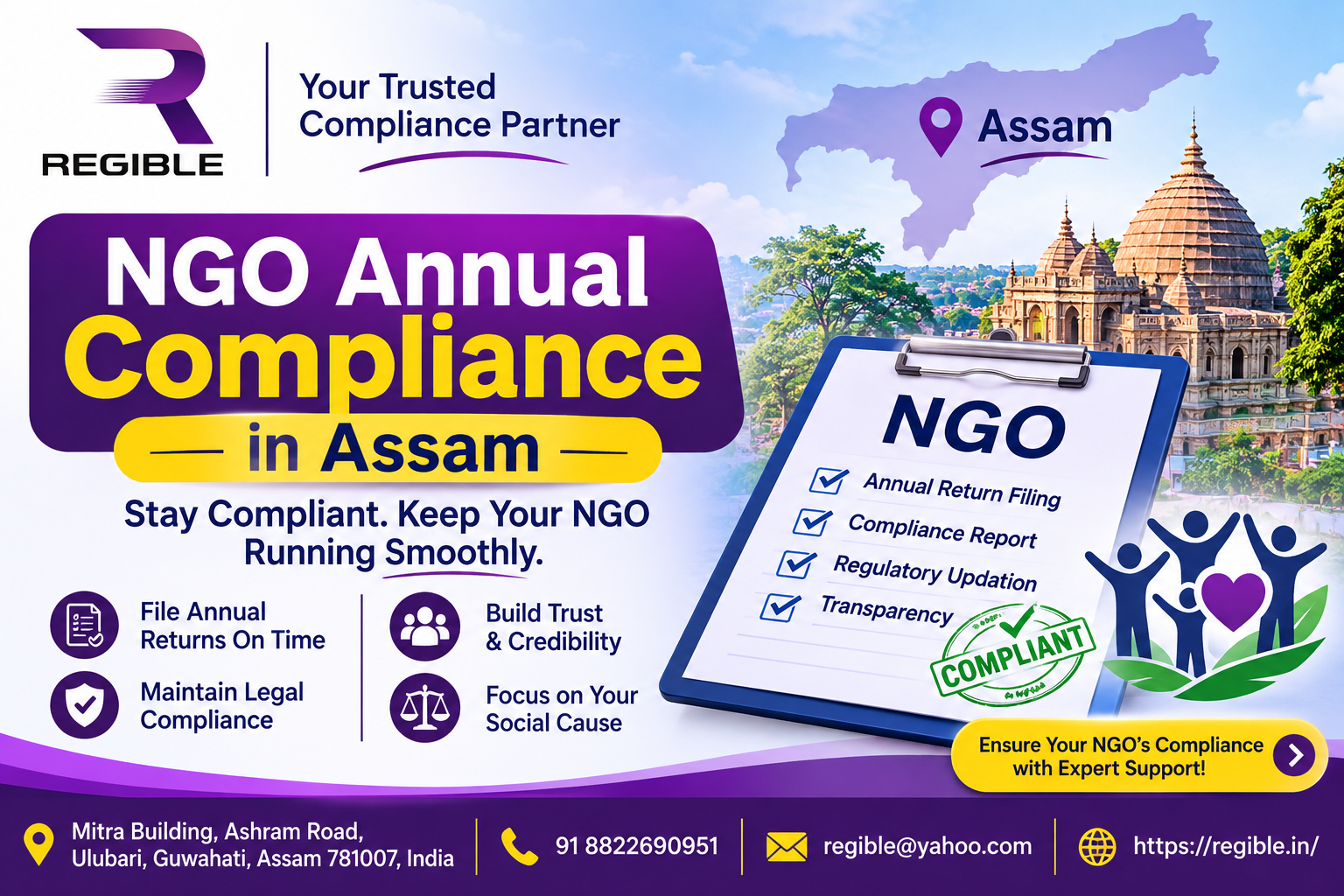
Running a Non-Governmental Organisation (NGO) involves more than delivering social welfare activities, supporting communities or implementing development projects. Every NGO must also fulfil important legal, financial and statutory responsibilities to maintain transparency, protect its tax-exempt status and continue operating without unnecessary legal complications.
Whether an organisation is registered as a public charitable trust, society or Section 8 company, maintaining proper records and completing annual statutory filings is essential. In Assam, NGOs must pay particular attention to the requirements of the Registrar of Firms and Societies, Income Tax Department, Ministry of Home Affairs and Ministry of Corporate Affairs, depending on their registration structure and activities.
Understanding NGO Annual Compliance in Assam becomes especially important for organisations receiving government grants, CSR contributions, domestic donations or foreign contributions.
With FY 2026–27 bringing a new income tax framework under the Income-tax Act, 2025, NGOs should also review their existing compliance procedures and prepare for the applicable reporting requirements.
This guide explains the important annual filings, statutory responsibilities, documentation requirements and compliance timelines that NGOs in Assam should understand.
1. Understanding NGO Annual Compliance in Assam
NGO annual compliance refers to the statutory filings, financial reporting, audits and administrative responsibilities that an organisation must complete during or after each financial year.
The applicable requirements depend on the organisation's legal structure.
Generally, NGOs in Assam operate under one of these structures:
-
Public Charitable Trust: Governed by the applicable trust deed and relevant legal provisions.
-
Registered Society: Generally registered under the Societies Registration Act, 1860, and applicable Assam requirements.
-
Section 8 Company: Registered under the Companies Act, 2013, for charitable and other permitted not-for-profit objectives.
Each structure has different filing requirements.
For example, a registered society must comply with applicable Registrar requirements, whereas a Section 8 company must complete MCA annual filings. Organisations holding income tax registration or FCRA registration have additional responsibilities.
Therefore, NGO compliance should be planned according to the organisation's registration type rather than following a single checklist for every NGO.
2. Important Annual Compliance Filings for NGOs in Assam
Completing the required annual filings on time helps NGOs maintain their legal standing and financial credibility.
Here are the major compliance areas that organisations should monitor.
A. Annual Accounts Preparation and Financial Audit
Maintaining accurate financial records is one of the most important responsibilities of an NGO.
Every organisation should maintain proper documentation of its income, expenditure, donations, grants and programme-related expenses.
Important financial documents include:
-
Income and expenditure statement.
-
Balance sheet.
-
Receipt and payment account.
-
Cash book and general ledger.
-
Bank statements.
-
Donation receipts and supporting records.
-
Grant utilisation statements.
-
Details of assets and liabilities.
-
Supporting bills, vouchers and invoices.
An independent audit should be conducted wherever required under the applicable law, registration conditions or funding agreements.
A properly maintained financial audit trail also helps organisations demonstrate accountability to donors, government departments and regulatory authorities.
B. Income Tax Return Filing
NGOs enjoying charitable tax exemptions must pay attention to their income tax obligations.
Under the previous income tax framework, eligible charitable or religious trusts and institutions generally filed ITR-7 under the applicable provisions.
However, the Income-tax Act, 2025 came into effect on 1 April 2026. Consequently, income earned during FY 2026–27 falls under the new Tax Year 2026–27 framework.
NGOs should therefore verify the applicable return provisions and prescribed forms for the new tax year instead of automatically relying on previous-year filing procedures.
Depending on the organisation's structure and circumstances, income tax compliance may include:
-
Filing the applicable income tax return.
-
Reporting donations and other income.
-
Maintaining details of charitable activities.
-
Reporting eligible expenditure and application of income.
-
Reconciling TDS and other tax credits.
-
Complying with applicable audit requirements.
Timely filing is important for protecting eligible tax benefits and avoiding unnecessary notices or penalties.
C. Charitable Tax Registration and Approval
NGOs seeking income tax exemptions must ensure that their registration or approval remains valid under the applicable provisions.
The transition to the Income-tax Act, 2025 has introduced revised provisions and forms for non-profit organisations.
For example, the Income Tax Department has introduced Form 105 for certain applications relating to regular registration or approval under the new framework.
NGOs should review:
-
Validity of existing charitable registration.
-
Provisional or regular registration status.
-
Applicable renewal requirements.
-
Changes in organisational objectives.
-
Compliance with prescribed conditions.
-
Documentation supporting charitable activities.
An organisation should not assume that its registration requirements remain unchanged simply because its original certificate was issued under the earlier income tax law.
D. Form 10BD and Form 10BE: Donation Reporting
Under the earlier income tax framework, eligible institutions approved under Section 80G were required to report donations through Form 10BD and issue donation certificates in Form 10BE.
The prescribed deadline under that framework was 31 May following the relevant financial year.
For FY 2026–27, NGOs should check the corresponding reporting provisions and prescribed forms under the Income-tax Act, 2025 and Income-tax Rules, 2026.
Accurate donor information should be maintained throughout the year, including:
-
Donor name and identification details.
-
Donation amount.
-
Date of receipt.
-
Payment mode.
-
Donation category.
-
Relevant approval details.
Proper donation reporting improves transparency and helps donors claim eligible deductions.
3. Assam-Specific Compliance Requirements for Registered Societies
NGOs registered as societies in Assam must pay special attention to the requirements of the Registrar of Firms and Societies.
Under the applicable provisions of the Societies Registration Act, 1860, registered societies have annual reporting responsibilities.
Important requirements include:
Annual governing body information: A list of the names, addresses and occupations of the governing body members must be filed as prescribed under Section 4. Generally, this is required within 14 days following the annual general meeting, or in January where the society's rules do not provide for an AGM.
Annual financial statements: Assam government guidance specifies that a copy of the balance sheet and auditor's report must be filed with the Registrar within 30 days after the AGM, as applicable under the relevant statutory provisions.
Changes in governing body: Changes in executive committee members or governing body details should be reported according to applicable requirements.
Changes in rules and regulations: Amendments to the society's constitution, rules or registered particulars should be properly documented and filed.
Organisations should also review their registered constitution and internal rules to ensure that annual meetings and governance procedures are followed correctly.
4. FCRA Annual Return for NGOs Receiving Foreign Contributions
NGOs receiving foreign contributions must comply with the Foreign Contribution (Regulation) Act, 2010 (FCRA).
FCRA compliance is particularly important because violations can affect an organisation's ability to receive or utilise foreign contributions.
The major annual requirement is filing Form FC-4.
Important responsibilities include:
-
Maintaining separate records of foreign contributions.
-
Recording foreign funds received and utilised.
-
Maintaining the prescribed FCRA bank account arrangements.
-
Preparing annual financial statements.
-
Obtaining the required Chartered Accountant certification.
-
Filing the annual FCRA return online.
-
Maintaining supporting bank statements and utilisation records.
Important deadline: Form FC-4 must generally be filed within nine months after the financial year ends, which means 31 December 2027 for FY 2026–27.
Even if an organisation does not receive foreign contributions during a financial year, a NIL return is generally mandatory while its FCRA registration or prior permission remains applicable.
Changes in registration details, bank accounts and other prescribed particulars must also be reported within the applicable timelines.
5. Section 8 Company Annual Compliance
NGOs registered as Section 8 companies must comply with the Companies Act, 2013 and applicable MCA regulations.
Unlike societies and trusts, Section 8 companies have specific corporate governance and annual filing responsibilities.
Their compliance checklist generally includes:
A. Annual General Meeting (AGM)
A Section 8 company must conduct its AGM according to applicable Companies Act requirements and any relevant exemptions.
B. Financial Statement Filing – Form AOC-4
The financial statements and applicable attachments must generally be filed with the Registrar of Companies within 30 days of the AGM.
C. Annual Return – Form MGT-7 or MGT-7A
The applicable annual return must generally be filed within 60 days of the AGM.
D. Board and Governance Records
The organisation should maintain:
-
Board meeting records.
-
Minutes of meetings.
-
Statutory registers.
-
Director and member information.
-
Financial statements.
-
Related-party transaction records, where applicable.
Additional requirements may apply depending on the company's size, activities and regulatory status.
6. NGO Compliance Calendar for FY 2026–27
Maintaining an organised compliance calendar helps trustees, accountants and administrative teams avoid missing important deadlines.
The following is a practical planning calendar for NGOs in Assam.
| Period / Deadline | Important Compliance Activity |
|---|---|
| April–June 2026 | Begin annual bookkeeping and reconcile previous-year accounts |
| Throughout FY 2026–27 | Maintain donation, grant, expenditure and bank records |
| 31 May 2027 | Legacy donation-reporting deadline reference under the earlier Form 10BD framework; verify the corresponding new-law requirement |
| After the AGM | File applicable society governing body information within the prescribed period |
| Within 30 days after AGM | File applicable society balance sheet and auditor's report |
| Within 30 days after AGM | Section 8 company AOC-4 filing |
| Within 60 days after AGM | Section 8 company MGT-7/MGT-7A filing |
| 30 September 2027 | General tax audit planning reference; verify the applicable audit requirement and any extension |
| 31 December 2027 | General FCRA Form FC-4 annual return deadline |
Important: These dates are planning references, not universal deadlines for every NGO. The actual due date depends on the legal structure, applicable legislation, AGM date, audit status and prescribed forms. FY 2026–27 income tax filings must follow the new tax framework. Always check the latest government notifications before filing.
7. Common NGO Annual Compliance Mistakes to Avoid
Many NGOs face compliance difficulties because administrative and financial responsibilities are not monitored throughout the year.
Some common mistakes include:
-
Failing to conduct the AGM within the required period.
-
Not submitting annual returns to the Registrar.
-
Maintaining incomplete financial records.
-
Using donation funds without proper supporting documentation.
-
Missing income tax filing deadlines.
-
Failing to maintain separate FCRA records.
-
Not reporting changes in governing body details.
-
Allowing charitable registration or approvals to lapse.
-
Ignoring statutory notices and filing discrepancies.
To avoid these issues, NGOs should assign compliance responsibilities to designated individuals and conduct periodic internal reviews.
8. How Professional Compliance Support Helps NGOs in Assam
Managing multiple statutory obligations can become challenging, particularly for small NGOs with limited administrative resources.
Professional compliance assistance can help organisations maintain accurate records, identify applicable filing requirements and complete statutory procedures within prescribed timelines.
A professional corporate compliance consultant can assist with:
-
NGO registration and documentation.
-
Annual compliance planning.
-
Financial statement coordination.
-
Income tax return filing support.
-
Charitable registration and approval assistance.
-
FCRA compliance documentation.
-
Society annual filings.
-
Section 8 company MCA compliance.
-
Statutory deadline monitoring.
For organisations looking for reliable assistance with NGO Annual Compliance in Assam, working with an experienced compliance consultant can help reduce administrative difficulties and improve regulatory preparedness.
Organisations can explore Regible Corporate Advisor LLP for professional guidance on NGO registration, statutory documentation and corporate compliance services.
Conclusion
Annual statutory compliance is an essential responsibility for every NGO operating in Assam. Whether an organisation is registered as a trust, society or Section 8 company, maintaining accurate financial records, completing annual filings and following applicable regulatory requirements helps protect its legal and financial credibility.
For FY 2026–27, NGOs should pay particular attention to the transition to the Income-tax Act, 2025, Assam society filing requirements, FCRA annual returns and applicable MCA obligations.
Rather than waiting until the end of the financial year, organisations should maintain a compliance calendar, review their documentation regularly and seek professional assistance whenever necessary.
Looking for assistance with NGO Annual Compliance in Assam?
Connect with Regible Corporate Advisor LLP for professional guidance on NGO statutory filings, annual compliance, financial documentation and regulatory requirements.
Visit: https://regible.in/

 English
 Arabic
 French
 Spanish
 Portuguese
 Deutsch
 Turkish
 Dutch
 Italiano
 Romaian
 Portuguese (Brazil)
 Greek