


MBBS Abroad 2026: How to Evaluate Medical University Dermatology Training
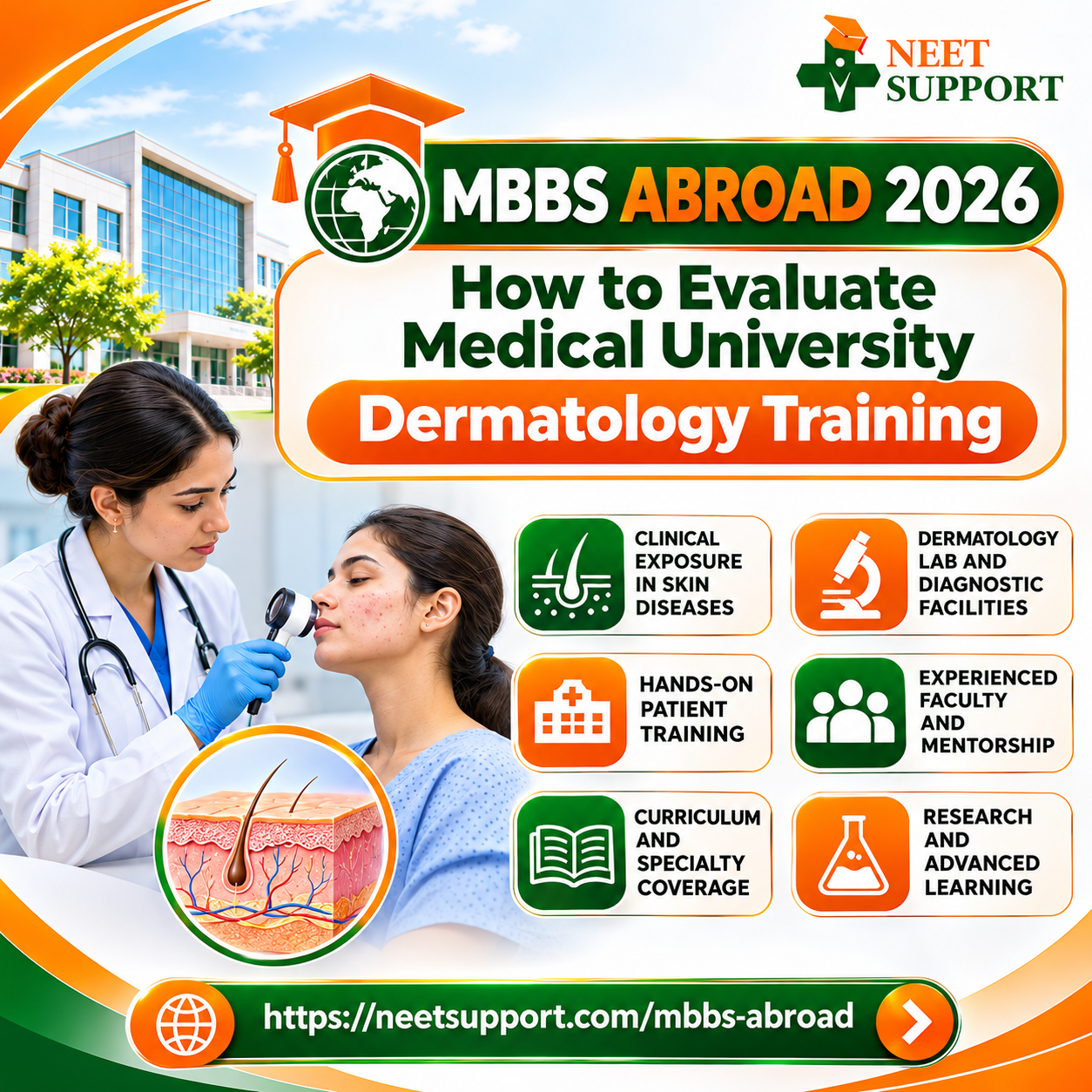
MBBS Abroad 2026 aspirants should evaluate the quality of dermatology education when comparing international medical universities. Dermatology is an important medical specialty that focuses on the diagnosis, prevention and management of conditions affecting the skin, hair, nails and related structures. Medical students need a combination of theoretical knowledge, clinical observation and supervised practical learning to understand common skin disorders and recognise conditions that require specialist attention. NEET Support encourages students and parents to examine the dermatology curriculum, clinical exposure, teaching facilities and faculty expertise before selecting an international medical programme.
Why Dermatology Education Matters in MBBS
Skin conditions are among the common health concerns encountered in medical practice. They may occur independently or as manifestations of infections, allergies, autoimmune disorders, nutritional deficiencies and systemic diseases.
A doctor should be able to recognise common skin problems, understand their possible causes and identify situations requiring further investigation or specialist referral.
Dermatology education helps medical students develop the ability to:
-
Recognise common skin, hair and nail disorders.
-
Understand the relationship between skin findings and systemic diseases.
-
Identify possible infectious and inflammatory conditions.
-
Understand basic principles of skin examination.
-
Recognise warning signs that require urgent assessment.
-
Communicate clearly with patients about skin-related concerns.
-
Understand when specialist dermatological care is necessary.
A university should teach dermatology as a clinical subject rather than limiting the learning experience to memorising disease names and textbook descriptions.
Evaluate the Dermatology Curriculum
The first step is to review the official MBBS syllabus and identify the dermatology topics included in the programme.
A comprehensive curriculum should introduce students to different categories of skin conditions and their clinical presentation.
Inflammatory skin disorders: Students should learn about conditions such as eczema, dermatitis and psoriasis, including their typical clinical features and general management principles.
Infectious skin diseases: The curriculum should cover bacterial, viral, fungal and parasitic skin infections, with attention to diagnosis and prevention.
Allergic skin conditions: Students should understand common allergic reactions, contact dermatitis and other hypersensitivity-related skin problems.
Pigmentation disorders: Medical students should study changes in skin pigmentation, their possible causes and relevant clinical features.
Hair and nail disorders: The subject should introduce common conditions affecting hair growth, scalp health and nail structure.
Autoimmune and systemic skin conditions: Students should learn how certain skin findings may be associated with underlying systemic or immune-related diseases.
The curriculum should also introduce basic dermatological terminology, lesion classification and the principles of differential diagnosis.
Check Clinical Exposure and Patient Interaction
Clinical exposure is essential for developing dermatological observation skills. Skin conditions often have visible features, but accurate assessment requires attention to the patient's history, symptoms, examination findings and relevant investigations.
When evaluating a university, students should investigate whether dermatology teaching includes:
-
Supervised outpatient department observations.
-
Demonstrations of common skin conditions.
-
Patient history-taking exercises.
-
Guided skin examination sessions.
-
Clinical case discussions.
-
Opportunities to observe specialist consultations.
-
Appropriate patient communication training.
Students should confirm whether these activities are part of the regular MBBS curriculum or optional experiences.
Direct patient interaction must always follow university policies, patient consent requirements and clinical supervision arrangements.
Examine Training in Skin Examination Techniques
A structured skin examination helps doctors identify important clinical findings. Students should receive appropriate teaching on how to examine the skin, scalp, hair and nails.
Important learning areas include:
Primary skin lesions: Understanding common lesion types such as macules, papules, plaques, vesicles, pustules and nodules.
Secondary skin changes: Recognising findings such as crusting, scaling, ulceration, scarring and excoriation.
Distribution patterns: Understanding how the location and distribution of lesions may contribute to clinical assessment.
Colour and texture: Learning to observe changes in pigmentation, surface appearance and skin texture.
Hair and nail assessment: Identifying visible abnormalities that may indicate dermatological or systemic conditions.
A good teaching programme should use clinical photographs, demonstrations and supervised examinations to help students develop accurate observation skills.
Assess Training in Dermatological Diagnosis
Dermatological diagnosis requires students to connect clinical findings with possible underlying causes.
A university should teach students how to develop a differential diagnosis rather than assuming that every similar-looking skin condition has the same cause.
Important areas of diagnostic education include:
-
Taking a detailed dermatological history.
-
Identifying the onset and progression of symptoms.
-
Understanding itching, pain and other associated complaints.
-
Examining the distribution and appearance of lesions.
-
Recognising possible infectious and inflammatory causes.
-
Understanding when laboratory investigations are appropriate.
-
Identifying conditions requiring specialist assessment.
Students should also learn that some dermatological conditions may look similar but require different diagnostic approaches.
Review Practical Dermatology Learning Facilities
Medical universities may use different facilities and teaching resources to support dermatology education.
Students should check whether the institution provides access to:
-
Dermatology outpatient teaching areas.
-
Clinical photographs and case libraries.
-
Microscopy demonstrations.
-
Relevant specimen-based teaching.
-
Dermatoscopy demonstrations, where included in the curriculum.
-
Histopathology teaching materials.
-
Digital clinical learning resources.
The availability of advanced equipment does not automatically mean that every undergraduate student receives hands-on training. Ask which facilities are available to students, how frequently they are used and whether faculty members supervise practical sessions.
Understand Dermatopathology and Diagnostic Investigations
Dermatology is connected with pathology, microbiology and other diagnostic disciplines. Some skin conditions require laboratory investigation or tissue examination to support diagnosis.
Students should understand the basic purpose and clinical relevance of investigations such as:
-
Skin scraping examinations for selected fungal infections.
-
Microbiological testing when clinically indicated.
-
Skin biopsy and histopathological examination.
-
Selected immunological investigations.
-
Other tests based on the suspected underlying condition.
The university should explain the role and limitations of these investigations. Students should understand that diagnostic tests are selected according to clinical findings rather than performed routinely for every skin complaint.
Evaluate Faculty Expertise and Teaching Methods
Faculty expertise can influence the quality of dermatology education. Students should examine the qualifications, clinical experience and teaching responsibilities of the academic staff.
Useful factors to consider include:
-
Relevant postgraduate dermatology qualifications.
-
Experience in undergraduate medical education.
-
Availability of clinical teaching sessions.
-
Use of real clinical cases and visual learning resources.
-
Opportunities for academic discussion.
-
Regular feedback on student performance.
Teaching methods should combine classroom instruction with supervised clinical demonstrations and case-based learning.
Students should also ask about faculty availability during practical sessions and whether clinical groups are small enough to support meaningful participation.
Check Exposure to Common and Serious Skin Conditions
Medical students should understand both frequently encountered skin conditions and potentially serious disorders that require timely medical attention.
The curriculum should introduce common problems such as acne, eczema, fungal infections, urticaria and psoriasis.
It should also help students recognise warning signs associated with severe drug reactions, rapidly progressing infections, suspicious skin lesions and certain skin manifestations of systemic disease.
The objective is not to train undergraduate students as independent dermatology specialists. Instead, the aim is to help future doctors recognise clinical concerns, provide appropriate initial assessment and arrange timely referral when necessary.
Understand Dermatology Training in Different Geographical Settings
Students pursuing MBBS abroad may study in regions where climate, environmental conditions and disease patterns differ from those in India.
For example, temperature, humidity, sunlight exposure, occupational activities and local healthcare patterns can influence the dermatological conditions encountered in a population.
A useful medical programme should provide a broad understanding of dermatological diseases rather than concentrating only on conditions common in its immediate region.
Students planning to return to India should also understand that clinical education must prepare them to assess patients from diverse backgrounds and recognise locally relevant health concerns.
Evaluate Assessment and Examination Methods
Dermatology assessments should test both theoretical knowledge and clinical understanding.
Universities may use written examinations, oral examinations, image-based questions, clinical case discussions and practical assessments.
Before admission, students should ask:
-
Are dermatology clinical cases included in examinations?
-
Are students assessed on lesion identification?
-
Is supervised clinical observation part of the evaluation?
-
Are practical records or case presentations required?
-
How frequently are internal assessments conducted?
-
What academic support is available for students who need improvement?
A transparent assessment system helps students understand the expected learning outcomes and prepare systematically.
Compare Medical Universities Before Admission
Students should compare dermatology education using official academic documents and verifiable university information.
| Evaluation factor | What students should check |
|---|---|
| Curriculum | Coverage of common and important skin conditions |
| Clinical exposure | Supervised outpatient teaching |
| Examination skills | Structured skin and lesion assessment |
| Diagnostic education | Understanding of relevant investigations |
| Practical facilities | Availability of dermatology learning resources |
| Faculty | Qualifications and clinical teaching experience |
| Assessment | Written, practical and case-based evaluation |
| Patient interaction | Supervision and consent arrangements |
Do not rely exclusively on university advertisements, rankings or verbal assurances. Request the current syllabus, teaching schedule and information about clinical learning opportunities.
Check Recognition and Future Medical Practice Requirements
Academic quality is only one part of selecting an international medical university. Students must also verify the recognition and regulatory status of the institution and programme.
Indian students planning to return after completing their degree should independently review the applicable eligibility, course-duration, internship, examination and registration requirements through the relevant official authorities.
Regulatory conditions can change, and requirements may depend on the student's admission and graduation circumstances. Therefore, students should verify current rules before making financial commitments.
How NEET Support Helps Students Evaluate MBBS Abroad Options
Selecting an international medical university requires careful assessment of academic quality, clinical training, financial planning and future professional requirements.
NEET Support encourages students and parents to compare official curricula, clinical exposure, faculty qualifications, practical facilities and admission conditions before finalising a university.
Students should ask specific questions, request documentary evidence and avoid depending entirely on promotional claims. They should also consider their academic interests, personal learning needs and long-term career objectives.
A structured university evaluation can help families make more informed decisions and understand the educational opportunities available through different MBBS programmes.
Frequently Asked Questions (FAQs)
1. Why is dermatology included in MBBS education?
Dermatology helps medical students understand common skin, hair and nail disorders, recognise important clinical findings and identify conditions that may require specialist care.
2. What practical skills should MBBS students learn in dermatology?
Students should develop basic skills in skin examination, lesion recognition, patient history-taking and clinical observation under appropriate supervision.
3. Do international medical universities provide dermatology clinical exposure?
Clinical exposure varies between universities and programmes. Students should verify outpatient teaching schedules, supervised clinical sessions and the opportunities available to undergraduate students.
4. What is dermatopathology?
Dermatopathology is the study of skin diseases through the examination of tissue samples and microscopic pathological changes. It helps support the diagnosis of selected dermatological conditions.
5. Is dermatoscopy important in dermatology training?
Dermatoscopy is a non-invasive technique used to examine skin lesions in greater detail. Students may receive introductory demonstrations depending on the university curriculum and available facilities.
6. How can students evaluate dermatology faculty at a university?
Students should review relevant qualifications, clinical experience, undergraduate teaching responsibilities and the availability of faculty supervision during clinical sessions.
7. Can dermatology education abroad help students returning to India?
Yes. A strong foundation in dermatology can be relevant to future medical practice in India. However, students must fulfil all applicable medical eligibility and registration requirements before practising.
Conclusion
Dermatology training is an important part of undergraduate medical education because it develops clinical observation, disease recognition and diagnostic understanding. Students comparing international medical universities should examine curriculum coverage, supervised clinical exposure, examination methods, faculty expertise and practical learning resources. They should also verify official programme information and applicable medical regulations before making an admission decision. With careful planning and reliable information, MBBS Abroad 2026 aspirants can make more informed choices about their medical education. NEET Support encourages students and parents to prioritise academic quality, genuine clinical learning opportunities and long-term professional development when selecting an international medical university.

 English
 Arabic
 French
 Spanish
 Portuguese
 Deutsch
 Turkish
 Dutch
 Italiano
 Russian
 Romaian
 Greek