


How SD-WAN Works: Traffic Management, Routing, and Connectivity
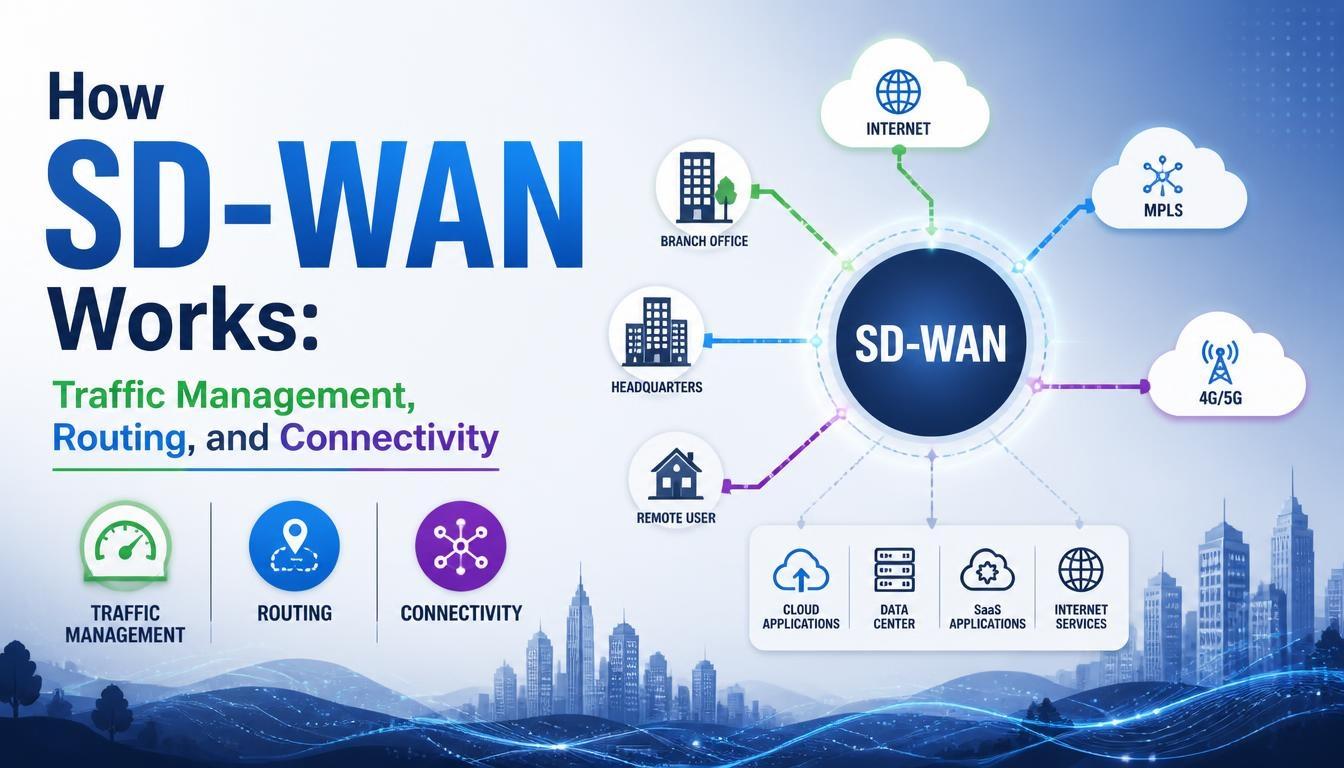
Software-Defined Wide Area Networking (SD-WAN) is a technology that connects branch offices, data centers, and cloud environments through centrally managed network infrastructure. It helps organizations manage network traffic, improve connectivity, and use multiple WAN links efficiently.
Understanding how SD-WAN works is important for networking professionals who manage enterprise networks. SDWAN Training provides knowledge of traffic management, intelligent routing, and network connectivity, helping professionals understand how SD-WAN handles communication across different locations.
What Is SD-WAN?
Software-Defined Wide Area Networking (SD-WAN) is a networking technology that connects different business locations using software-based network management. It allows organizations to manage WAN connections through a centralized platform instead of configuring every network device individually.
Traditional WAN networks often depend on dedicated MPLS connections and manually configured routing policies. SD-WAN supports multiple connection types, including broadband internet, MPLS, LTE, and 5G, providing greater flexibility in managing enterprise connectivity.
How Does SD-WAN Work?
SD-WAN works by creating a virtual network overlay across available WAN connections. It monitors network conditions and selects suitable paths for application traffic based on predefined policies and performance requirements.
The technology uses centralized management to configure network devices, monitor connectivity, and manage traffic distribution.
1. Centralized Network Management
SD-WAN uses a centralized management platform to configure and monitor network devices from a single interface.
Network administrators can define routing policies, manage security settings, monitor WAN links, and apply configuration changes across multiple branch locations.
This approach reduces the need to configure every network device individually and simplifies network administration.
2. Network Overlay and Underlay
SD-WAN uses two important networking concepts: underlay and overlay.
Underlay Network
The underlay is the physical network infrastructure that provides connectivity between locations. It can include MPLS, broadband internet, fiber, and cellular connections.
Overlay Network
The overlay is a virtual network built on top of the underlay infrastructure. It uses secure tunnels to connect different locations and manage communication between network devices.
The overlay allows organizations to manage traffic independently of the physical connection technology.
3. Intelligent Traffic Management
SD-WAN identifies application traffic and applies policies to determine how packets should travel across available WAN connections.
For example, voice and video applications may require low latency and minimal packet loss. File transfers and software updates may use other available connections based on bandwidth and network conditions.
This application-aware approach helps organizations distribute traffic according to business and application requirements.
How SD-WAN Manages Network Traffic
Traffic management is one of the important functions of SD-WAN. It helps organizations use available network connections efficiently while maintaining application performance.
Application-Aware Routing
Application-aware routing identifies different types of network traffic and selects suitable paths based on application requirements.
For example, video conferencing traffic can be directed through a connection with lower latency, while general web browsing can use another available WAN link.
This helps prioritize business-critical applications and maintain consistent application performance.
Dynamic Path Selection
SD-WAN continuously evaluates the performance of available network paths using metrics such as:
-
Latency: Measures the time required for data to travel between two network points.
-
Jitter: Measures variations in packet arrival times.
-
Packet Loss: Identifies packets that fail to reach their destination.
-
Bandwidth: Indicates the available capacity of a network connection.
Based on configured policies and performance thresholds, SD-WAN can select a more suitable path when network conditions change.
Quality of Service (QoS)
Quality of Service helps prioritize important network traffic over less critical applications.
Administrators can configure traffic classes and assign priority levels based on application requirements. For example, real-time voice traffic can receive higher priority than background file downloads.
QoS helps manage network resources when bandwidth is limited.
How SD-WAN Routing Works
Routing determines how data packets travel between different network locations. SD-WAN combines traditional routing protocols with software-defined policies to control traffic movement.
Static and Dynamic Routing
SD-WAN environments can use static routes and dynamic routing protocols to exchange network information.
Dynamic routing protocols such as BGP and OSPF help network devices learn available routes and adapt to network changes.
Static routes can also be used when administrators need predictable paths for specific destinations.
Policy-Based Routing
Policy-based routing allows administrators to define traffic forwarding decisions based on specific conditions.
These conditions may include source IP addresses, destination networks, applications, and service requirements.
For example, an organization can configure policies to direct traffic from a particular business application through a preferred WAN connection.
Load Balancing Across WAN Links
SD-WAN can distribute network traffic across multiple WAN connections to improve link utilization.
Depending on the configured policies, traffic can be distributed based on bandwidth availability, application requirements, or connection performance.
Load balancing helps organizations make better use of their available network resources.
How SD-WAN Provides Network Connectivity
SD-WAN connects branch offices, headquarters, cloud environments, and remote locations using different types of WAN connections.
Multiple WAN Connection Types
Organizations can combine several connectivity options within an SD-WAN environment.
Common connection types include:
-
MPLS: Provides private WAN connectivity with defined service characteristics.
-
Broadband Internet: Offers cost-effective connectivity through public internet services.
-
LTE and 5G: Provide cellular connectivity for backup or primary WAN access.
-
Dedicated Internet Access: Provides business-grade internet connectivity.
Using multiple connection types gives organizations more flexibility when designing their WAN infrastructure.
Secure VPN Tunnels
SD-WAN commonly uses IPsec VPN tunnels to establish encrypted communication between network locations.
These tunnels help protect data transmitted across public internet connections. Authentication and encryption mechanisms help maintain secure communication between SD-WAN devices.
Automatic Failover
Automatic failover helps maintain network connectivity when a WAN connection becomes unavailable or experiences performance degradation.
For example, if the primary MPLS connection fails, SD-WAN can redirect traffic through an available broadband or LTE connection according to configured policies.
This reduces dependence on a single network connection and supports business continuity.
Traditional WAN vs SD-WAN
Traditional WAN and SD-WAN differ in how they manage network traffic, connectivity, and configuration.
Traditional WAN
-
Often relies on MPLS connections for branch connectivity.
-
Network devices may require individual configuration.
-
Traffic routing generally depends on traditional routing policies.
-
Network changes can require manual intervention.
-
Traffic visibility depends on the monitoring tools available.
SD-WAN
-
Supports MPLS, broadband, LTE, and other WAN connections.
-
Provides centralized network management.
-
Uses application-aware and policy-based routing.
-
Supports automated configuration and network management.
-
Offers centralized monitoring and dynamic path selection.
SD-WAN provides greater flexibility in managing distributed networks, while traditional WAN may remain suitable for organizations with existing infrastructure and specific connectivity requirements.
Common SD-WAN Use Cases
SD-WAN supports different networking requirements across industries and enterprise environments.
Enterprise Branch Connectivity
Organizations with multiple branch offices can use SD-WAN to connect locations through centrally managed network infrastructure. It helps maintain communication between headquarters, remote branches, and data centers.
Cloud Application Access
SD-WAN can improve connectivity to cloud platforms and SaaS applications by selecting suitable network paths based on configured policies.
Remote Workforce Connectivity
Organizations can integrate remote access solutions with their SD-WAN infrastructure to support employees working from different locations.
Business Continuity
Multiple WAN connections and automatic failover capabilities help organizations maintain connectivity during network disruptions.
Best Practices for SD-WAN Deployment
A well-planned SD-WAN deployment requires proper network assessment and configuration.
Consider the following practices:
-
Assess existing WAN infrastructure before deployment.
-
Identify business-critical applications and their performance requirements.
-
Configure appropriate routing and traffic management policies.
-
Establish suitable latency, jitter, and packet loss thresholds.
-
Implement secure VPN tunnels and access control policies.
-
Monitor WAN link performance regularly.
-
Test failover scenarios before moving into production.
These practices help organizations maintain network stability and manage distributed connectivity effectively.
Conclusion
SD-WAN provides a software-defined approach to managing enterprise WAN connectivity through centralized management, intelligent traffic routing, application-aware policies, and multiple network connections. Its traffic management capabilities help prioritize applications, while dynamic path selection and automatic failover support network availability and performance.
Understanding these concepts is important for network engineers who work with enterprise infrastructure, routing, and WAN technologies. A structured SDWAN course can help networking professionals develop practical knowledge of SD-WAN architecture, traffic management, routing protocols, VPN connectivity, and deployment methods.

 English
 French
 Spanish
 Portuguese
 Deutsch
 Turkish
 Dutch
 Italiano
 Russian
 Romaian
 Portuguese (Brazil)
 Greek