


Cisco ACI Policy Model: How Application-Centric Networking Works
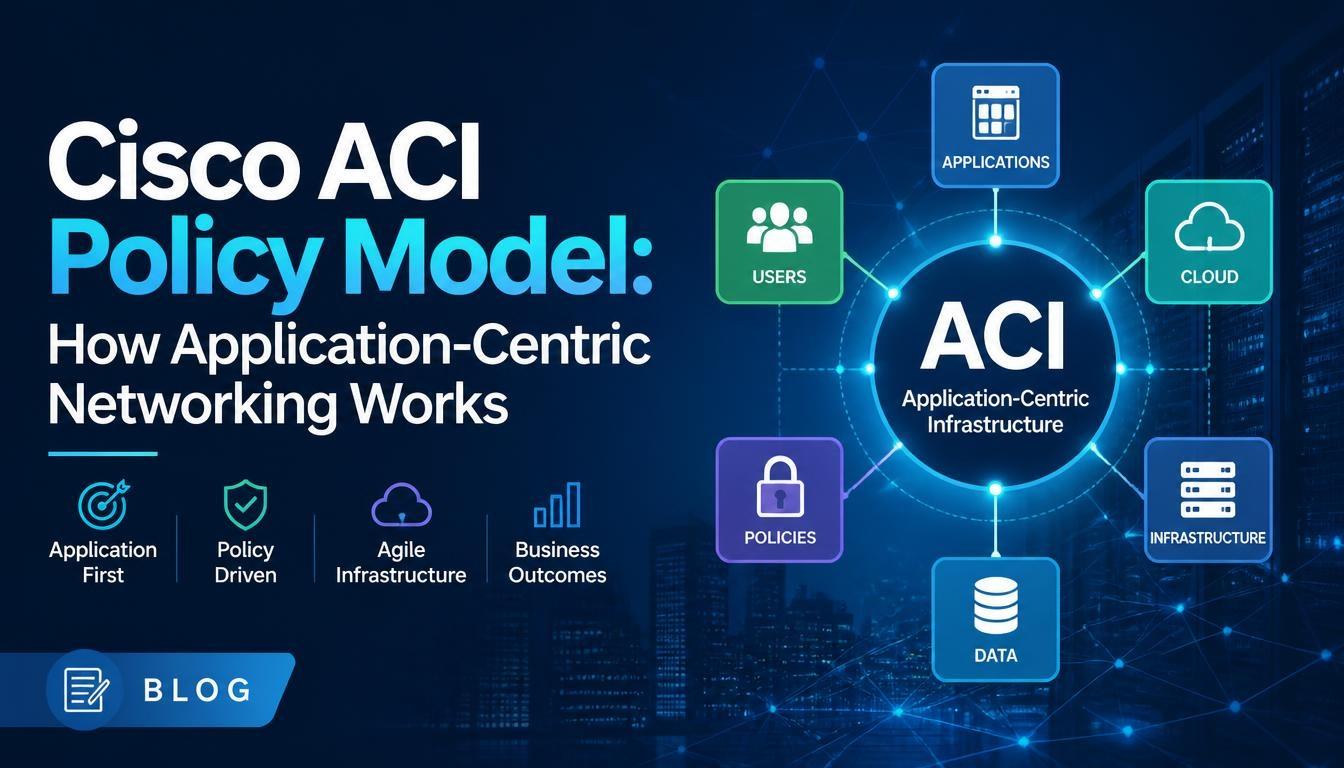
Cisco Application Centric Infrastructure (ACI) is a software-defined networking solution designed to simplify data center network management through centralized policies and automation. It allows network administrators to manage connectivity based on application requirements rather than configuring individual network devices manually. Cisco ACI Training helps networking professionals understand how application-centric networking works and how policies control communication across a data center.
What Is the Cisco ACI Policy Model?
The Cisco ACI policy model is a framework that defines how applications communicate within a data center. Instead of managing network connectivity through traditional VLAN-based configurations alone, Cisco ACI uses application requirements to create and enforce network policies.
The policy model connects applications, network resources, and security requirements through a centralized management platform called the Application Policy Infrastructure Controller (APIC).
Administrators can define policies for communication between application components, control access, and manage network resources from a single interface.
How Does Application-Centric Networking Work?
Application-centric networking focuses on the communication requirements of applications rather than the physical network infrastructure.
For example, consider a three-tier application consisting of:
-
Web tier: Handles user requests.
-
Application tier: Processes business logic.
-
Database tier: Stores application data.
In a traditional network, administrators configure VLANs, access control lists, and routing policies to establish connectivity between these components.
With Cisco ACI, administrators define application requirements using policies. These policies determine which application components can communicate and what type of traffic is permitted.
Cisco ACI translates these requirements into network configurations and applies them across the fabric.
Core Components of the Cisco ACI Policy Model
Understanding the main components helps explain how Cisco ACI organizes application connectivity.
1. Tenant
A tenant is a logical container used to organize network resources and policies. It provides administrative separation between different applications, departments, or business environments.
Tenants can contain multiple VRFs, bridge domains, application profiles, and endpoint groups.
2. VRF (Virtual Routing and Forwarding)
A VRF provides Layer 3 network isolation within the Cisco ACI fabric. It maintains separate routing information for different network environments.
For example, an organization can create separate VRFs for production, development, and testing environments.
3. Bridge Domain
A bridge domain provides Layer 2 forwarding within a Cisco ACI fabric. It defines the broadcast domain and includes settings such as subnet configuration, IP learning, and forwarding behavior.
Bridge domains connect endpoint groups to the underlying network infrastructure.
4. Application Profile
An application profile organizes the different components of an application. It contains endpoint groups that represent application tiers or functional groups.
For example, a business application may have separate endpoint groups for web servers, application servers, and database servers.
5. Endpoint Group (EPG)
An Endpoint Group is a logical collection of endpoints that share similar network and policy requirements.
Endpoints can include physical servers, virtual machines, and other connected devices.
EPGs allow administrators to apply consistent policies to groups of endpoints instead of configuring each device individually.
6. Contracts
Contracts define communication permissions between endpoint groups.
A contract specifies which traffic is allowed between consumer and provider EPGs. Filters define the permitted protocols, ports, and traffic characteristics.
For example, a contract can allow HTTP and HTTPS traffic from a web EPG to an application EPG while restricting other communication.
How Cisco ACI Policies Control Application Communication
Cisco ACI uses a policy-driven approach to manage communication between endpoint groups.
The process generally involves the following steps:
Step 1: Define Application Requirements
Administrators identify application components and determine which components need to communicate.
For example, web servers may need access to application servers, while database servers may only accept connections from authorized application servers.
Step 2: Create Endpoint Groups
Administrators create EPGs to group endpoints based on their application roles and communication requirements.
Each EPG represents a logical security and policy boundary.
Step 3: Configure Contracts
Contracts establish communication rules between EPGs. Administrators define filters and subjects to specify the traffic that can pass between application components.
Step 4: Apply Policies Through APIC
The APIC manages the policies and distributes the required configurations to the appropriate switches in the ACI fabric.
Step 5: Enforce Network Communication
Leaf switches enforce the configured policies when traffic moves between endpoints. This allows the network to apply consistent communication rules across the infrastructure.
Cisco ACI Policy Model vs Traditional Networking
Traditional networking generally relies on device-level configurations, VLANs, access control lists, and routing settings.
Cisco ACI introduces a centralized, application-focused policy model.
Some important differences include:
-
Configuration: Traditional networking often requires manual configuration across multiple devices, while Cisco ACI uses centralized policy management.
-
Application management: Traditional networks organize connectivity mainly around network segments, whereas ACI organizes policies around application requirements.
-
Security: Traditional environments commonly use device-level access control lists, while ACI uses contracts and endpoint groups to define communication permissions.
-
Automation: Traditional network changes may require individual device updates, while ACI distributes policies through APIC.
-
Scalability: Cisco ACI provides policy-based management that can simplify operations across large data center environments.
Both approaches have their own use cases, and the appropriate choice depends on network requirements and existing infrastructure.
Benefits of the Cisco ACI Policy Model
The Cisco ACI policy model offers several benefits for enterprise data center environments.
Centralized Network Management
Administrators can define and manage network policies through APIC instead of configuring every switch individually.
Improved Application Visibility
The application-centric approach provides a logical view of application components and their communication requirements.
Consistent Security Policies
Contracts and EPGs help apply communication rules consistently across application environments.
Network Automation
Cisco ACI supports automation through REST APIs and integration with tools such as Python and Ansible.
Simplified Network Operations
Policy-based management reduces repetitive configuration tasks and helps administrators manage changes more efficiently.
Common Challenges When Working with Cisco ACI Policies
Although the policy model simplifies network management, administrators may encounter some challenges.
-
Incorrect EPG assignments can affect application connectivity.
-
Missing or improperly configured contracts can prevent required communication.
-
Incorrect bridge domain settings may cause forwarding problems.
-
VRF configuration issues can affect network isolation and routing.
-
Misconfigured access policies can prevent endpoints from connecting to the fabric.
Understanding the relationship between EPGs, contracts, bridge domains, and VRFs is important when configuring and troubleshooting Cisco ACI environments.
Conclusion
The Cisco ACI policy model provides an application-focused approach to data center networking. By using tenants, VRFs, bridge domains, application profiles, endpoint groups, and contracts, organizations can manage application connectivity and enforce network security policies through centralized management.
Understanding these components helps network engineers design, configure, and troubleshoot policy-driven data center environments. Cisco ACI Online Training can also help professionals develop practical knowledge of application-centric networking, policy configuration, and enterprise data center operations.

 English
 French
 Spanish
 Portuguese
 Deutsch
 Turkish
 Dutch
 Italiano
 Russian
 Romaian
 Portuguese (Brazil)
 Greek