


Why Names Matter: The Case for Custom Name Patches in Community Life
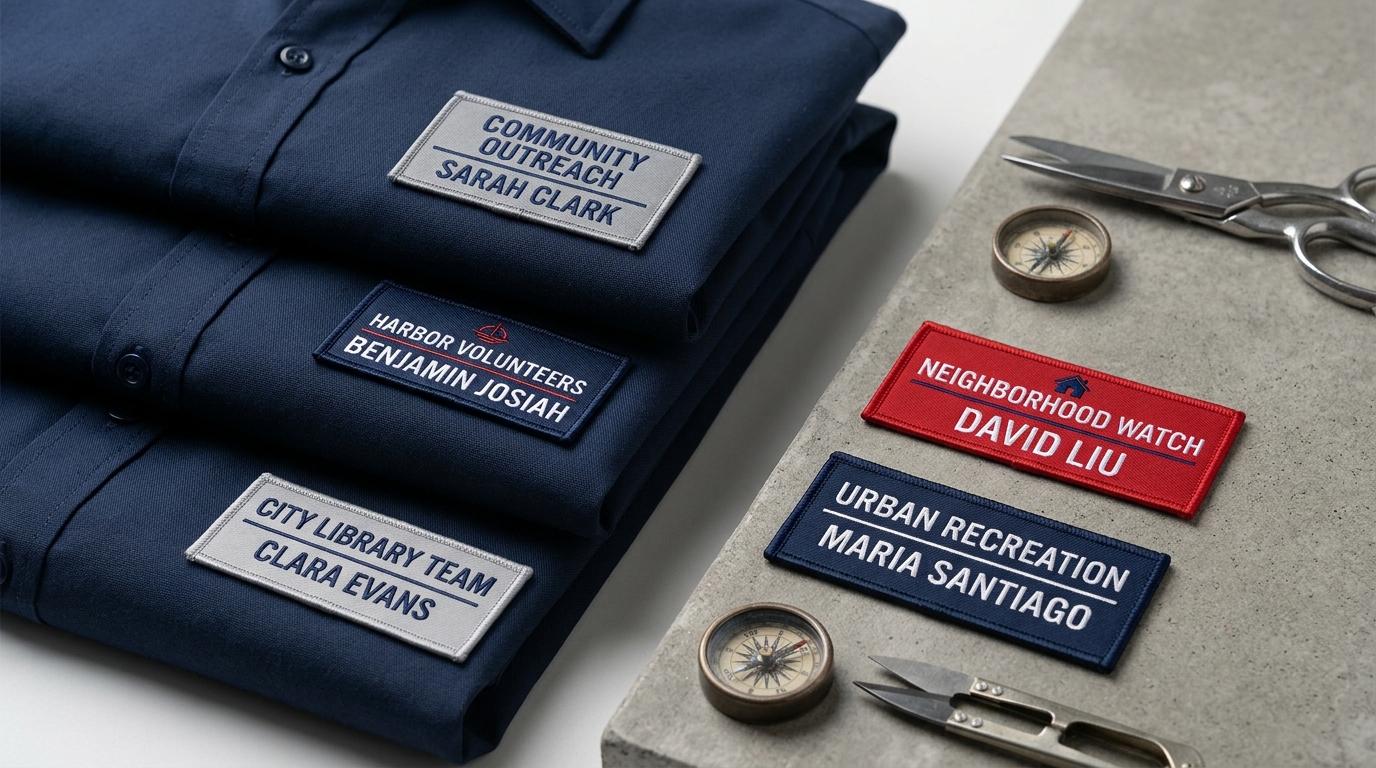
Every community is built on names. The name you are given, the name you choose, the name stitched onto a uniform or a jacket these are the markers that tell the world who you are and where you belong. In a social network, a name is a profile. On a garment, it is a patch. The difference is that one can be deleted and the other cannot. For professional organisations that want their people to be recognised and remembered, woven name patches offer a durable, legible way to make identity visible. This article explores why names matter in community and professional life, and how to specify custom name patches that survive daily wear.
Why a Name Is More Than a Label
A name is the first thing a customer looks for when they need help. It is the first thing a team member looks for when they meet a new colleague. It is the first thing a volunteer looks for when they arrive at an event and need to know who is in charge.
In service settings, a visible name does two things at once. It makes the interaction personal, and it makes the person accountable. A customer who can address a staff member by name is more likely to trust them. A staff member whose name is visible is more likely to behave as a representative of the organisation. That is not a small effect. It is the foundation of professional trust.
In community settings clubs, teams, associations, volunteer groups the same logic applies. A name patch on a jacket or a bag tells members and outsiders who belongs. It turns an anonymous group into a collection of identifiable people. For new members, that visibility is welcoming. For long-standing members, it is a record of belonging.
Where Name Patches Work Hardest
Not every setting needs a name patch, but several benefit disproportionately.
Service and Retail Staff
A name patch on a polo shirt, apron or work jacket is the most direct way to make service personal. Customers can address staff by name, and staff can be recognised for good service. In high-turnover environments, a removable or swappable system keeps identification current without reordering uniforms.
Healthcare and Community Care
In clinics, home-care services and community health programmes, staff identification is a trust issue. A legible name patch tells patients who they are speaking to and what role that person holds. Woven construction holds small lettering cleanly, which matters when the name must be read at a glance.
Teams and Clubs
Sports teams, hobby clubs and community groups often share garments and rotate members. A name patch especially a removable one allows the same jacket or bag to serve different people without permanent alteration. It also gives members a sense of belonging that a generic logo cannot.
Trades and Field Services
For tradespeople visiting homes and businesses, a name patch on a work shirt or jacket signals professionalism and accountability. It tells the customer that the person at the door is authorised, identifiable and responsible for the work.
Choosing the Right Construction for Name Patches
The specification decisions are straightforward, but they determine whether the name stays legible and the patch stays attached.
Woven Construction for Legibility
A woven patch interlocks fine threads into the design itself, rather than printing on a surface or stitching thicker thread on top of a base fabric. The image becomes part of the textile. The lettering stays crisp, the lines hold, and the surface remains flat and flexible.
For name patches, that flatness matters. A name is often small, and a raised embroidered badge can blur lettering at that scale. Woven construction reproduces small text more cleanly, which is the difference between a readable name and an unreadable smudge.
Backing to Match the Use
Sew-on backing is the most durable option for uniforms and garments that are washed frequently. It does not depend on an adhesive layer, and the stitching holds the patch securely through repeated laundering.
Iron-on backing is faster and suits low-wear items, samples or short-term event gear. It is not the best choice for a daily-wear uniform, where the adhesive can weaken under heat and washing.
Velcro backing allows the name patch to be removed and swapped. It suits shared uniforms, rotating teams and environments where names change frequently. The trade-off is a slightly more utilitarian look and the need for a loop panel on the garment.
The practical rule is to match the backing to how the garment will be washed and how often the name will change.
Border and Shape
A merrowed border is durable and classic, and it suits rectangular name patches well. A laser-cut edge gives a cleaner outline for custom shapes. For a name patch that will be handled often, a simple shape with a sturdy border is the more practical choice.
Designing a Name Patch That Stays Readable
A name patch is a small canvas. Most design mistakes are avoidable.
Use a clean, open typeface. Decorative scripts and condensed fonts lose legibility at badge scale. A simple sans-serif with generous spacing reads more reliably.
Test the longest name. A layout that works for short names may fail for longer ones. Proof with the longest name in the team, not the shortest.
Prioritise contrast. The name must stand out clearly against the patch background. Low-contrast combinations look subtle on screen and become illegible on fabric.
Decide whether to include a role or department. Adding a role can be useful in service and healthcare settings. If both name and role are needed, keep the name visually dominant.
Proof before production. A physical or high-fidelity proof catches colour shifts, legibility problems and border issues before a full run is produced. Never approve from a screen mockup alone.
Common Mistakes Organisations Make
-
Ordering without a proof. Colour mismatches and blurred names are caught at proofing, not after production.
-
Choosing the wrong backing. An iron-on name patch on a daily-wear uniform will lift. Sew-on is the specification that lasts.
-
Using the brand font for names. A font chosen for a website header may not work at badge scale. Legibility should take priority.
-
Ignoring turnover. If staff change frequently, the name patch system should be designed for replacement from the start.
-
Overcrowding the design. A small patch cannot carry a full name, a long role title and a logo. Simplify for the medium.
A Buyer’s Checklist
Before ordering custom name patches, confirm the following:
-
The proof has been approved.
-
The longest name in the team has been tested at final size.
-
The backing matches the wash regime (sew-on for frequent laundering, iron-on for low-wear items, Velcro for interchangeable names).
-
The garment weight suits the patch.
-
Minimum order quantities are confirmed.
-
One person owns the approval.
FAQs
What is the most durable backing for a name patch on a daily-wear uniform?
Sew-on backing is the most durable option for garments that are laundered frequently. It does not rely on an adhesive layer, and the stitching holds the patch securely through repeated washing.
Can name patches be removed and reused when staff change?
Sew-on and iron-on patches are intended to be permanent. Velcro-backed patches are removable and can be swapped between garments, which makes them the better choice for shared uniforms or high-turnover teams.
What is the smallest readable text on a woven name patch?
It depends on the typeface and the weave, but names are generally legible at a few millimetres. Always test the longest name in the team at the final patch size before ordering.
Can small organisations order custom name patches in modest quantities?
Many suppliers accommodate small runs, though minimums vary. Confirm the minimum before finalising the artwork so the design is not built around a quantity the organisation cannot meet.
Conclusion
A name is the smallest unit of identity. It is how we recognise each other, how we build trust, and how we know who belongs. In a social network, that recognition happens on a screen. On a garment, it happens in thread.
Custom name patches make that recognition durable. They hold the name legibly, survive the wash, and stay attached when it matters. For organisations that care about how their people are seen and remembered, the name patch is not a detail. It is the detail. Specify it well, proof it properly, and it will carry the name for years.

 English
 Arabic
 French
 Portuguese
 Deutsch
 Turkish
 Dutch
 Italiano
 Russian
 Romaian
 Portuguese (Brazil)
 Greek