


Why Comme des Garcons Continues to Influence American Fashion
Comme des Garcons has remained an important name in American fashion because it treats clothing as more than something designed to follow popular trends. Rei Kawakubo, the creative force behind the Japanese fashion house, has spent decades challenging familiar ideas about beauty, proportion, tailoring, and the relationship between clothing and the body. The Metropolitan Museum of Art describes Kawakubo's work as a continual challenge to conventional ideas of beauty, good taste, and fashionability.
A Different Way to Think About Clothing
One of the biggest reasons Comme des Garcons continues to influence American fashion is its willingness to question ordinary clothing rules. Instead of asking how a jacket should fit or how a dress should follow the body, Kawakubo often begins with a different question: what else can clothing become?
Her collections have explored oversized proportions, unusual shapes, asymmetry, exposed construction, unconventional layering, and unexpected materials. The result can look very different from traditional fashion. The Met's collection records how Kawakubo's early work challenged accepted ideas about the fashionable body through unusual silhouettes and proportions.
American designers and consumers have responded to this approach because it encourages experimentation. Clothing does not always have to follow a fixed formula. A jacket can be oversized, a shirt can have an unusual cut, and a familiar garment can become something completely different through proportion or construction.
Comme des Garcons Made Avant-Garde Fashion More Visible
Avant-garde fashion can sometimes seem distant from everyday clothing, but Comme des Garcons helped make experimental design part of wider fashion conversations. The brand's influence can be seen in the way designers approach oversized garments, deconstruction, unconventional tailoring, and unusual silhouettes.
The Metropolitan Museum of Art dedicated its 2017 Costume Institute exhibition to Rei Kawakubo and Comme des Garcons US. The exhibition presented roughly 140 examples of her work and examined the idea of "in-betweenness," focusing on the spaces between established fashion categories.
The importance of that exhibition went beyond a single fashion season. It placed Kawakubo's work inside one of America's most important cultural institutions and introduced her design philosophy to an audience far beyond the traditional fashion industry.
The Influence on American Streetwear
Comme des Garcons also became important to American streetwear because its ideas could be interpreted outside the runway. The brand's pieces could be combined with denim, sneakers, hoodies, graphic T-shirts, workwear, and other casual clothing.
This helped create an interesting contrast. A highly conceptual jacket could appear alongside ordinary jeans. A Comme des Garcons shirt could be worn with sneakers rather than formal footwear. A simple Play T-shirt could become part of an everyday outfit while still carrying a connection to the larger fashion house.
That flexibility helped bridge the gap between experimental fashion and casual American dressing.
Comme des Garcons PLAY Reached a Wider Audience
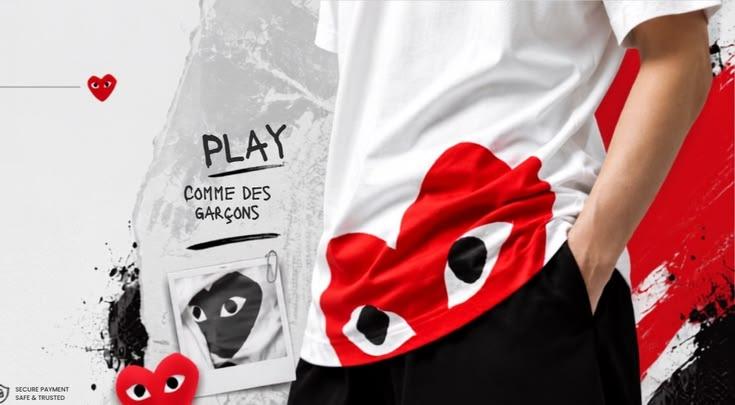
The PLAY line played an important role in making the Comme des Garcons name more accessible to shoppers who may not normally buy avant-garde fashion. The recognizable heart-with-eyes graphic became one of the most familiar symbols associated with the wider brand.
Unlike some of the more challenging runway collections, PLAY pieces can fit easily into everyday wardrobes. T-shirts, hoodies, sweaters, and sneakers can work with jeans, chinos, shorts, and casual jackets.
This created a path for American consumers to discover Comme des Garcons without immediately entering the world of experimental tailoring. Someone might begin with a simple PLAY T-shirt and later become interested in the broader design history of the label.
American Fashion Values Individuality
American fashion has always included strong traditions of individual expression. Denim, sportswear, workwear, skate culture, hip-hop, and streetwear have all contributed to a clothing culture where personal style can matter more than strict dress codes.
Comme des Garcons fits this environment because the brand encourages people to interpret clothing in their own way. Its designs do not always provide an obvious answer about how a garment should be worn.
That open-ended quality can appeal to people who want their clothes to feel personal. A single piece can look different depending on the proportions, colors, footwear, and layers surrounding it.
The Brand Challenged Traditional Ideas of Beauty
Kawakubo's influence goes deeper than unusual clothing. She challenged the idea that fashion must always make the body appear slimmer, taller, more traditionally attractive, or conventionally proportioned.
Her 1997 "Body Meets Dress, Dress Meets Body" collection famously used padded forms to create exaggerated shapes around the body. The Met notes that the collection confronted established ideas about the feminine ideal and explored the boundaries between clothing and physical form.
This kind of work influenced the broader fashion conversation. Designers could think about clothing as a structure rather than simply a layer designed to flatter the body.
American fashion has continued to explore these ideas through oversized silhouettes, sculptural garments, unconventional tailoring, and gender-fluid approaches to dressing.
Deconstruction Became a Design Tool
Comme des Garcons helped demonstrate that unfinished-looking details could become intentional design elements. Raw edges, unusual seams, displaced pockets, irregular shapes, and altered proportions can all create visual interest.
This approach influenced designers who wanted to move away from perfectly polished clothing. SFMOMA describes Kawakubo's work as austere and deconstructed, noting her use of unconventional construction and silhouettes.
American designers and streetwear labels have adopted similar ideas in different ways. Some use exposed seams or distressed fabrics, while others experiment with oversized cuts and garments that appear reconstructed.
The influence does not require direct imitation. The larger lesson is that construction itself can become part of the design.
Black Became More Than a Basic Color
Comme des Garcons is often associated with black, especially because of Kawakubo's influential early Paris collections. Her 1980s work used black, dark materials, oversized forms, and body-obscuring layers in ways that challenged the fashion standards of the period. The Met describes the reception as controversial and connected to an anti-fashion approach.
American fashion has long used black as a practical and versatile color, but Comme des Garcons showed how an all-black wardrobe could also become conceptual. Texture, shape, layering, and proportion could create variation even when the color palette remained restrained.
This idea remains visible in contemporary American streetwear and minimalist fashion, where black clothing often forms the foundation of an outfit.
The Brand Encourages Designers to Take Risks
Kawakubo's influence can also be seen through the designers who have learned from her approach. SFMOMA notes that her work has inspired designers including Ann Demeulemeester and Helmut Lang, while Junya Watanabe began his own line after working with her.
Her importance therefore extends beyond the garments carrying the Comme des Garcons name. Designers can take the principles behind her work and apply them to completely different aesthetics.
That is one reason her influence remains difficult to measure. It does not always appear as an obvious copy. Sometimes it appears as a designer questioning traditional tailoring, changing the proportions of a garment, or treating construction as the main visual feature.
New York Has Been Important to the Brand's American Presence
New York has provided an important setting for Comme des Garcons in the United States. The brand's relationship with the city has included distinctive retail spaces and a strong connection to fashion communities interested in independent and experimental design.
The brand's retail approach has also helped reinforce the idea that shopping can be part of the creative experience. Comme des Garcons has often treated stores as environments rather than simple places to display clothing.
This fits New York's broader fashion culture, where designers, artists, musicians, and streetwear communities often overlap.
Why Comme des Garcons Still Feels Relevant
Fashion changes quickly, but Comme des Garcons does not depend entirely on short-term trends. Its foundation comes from experimentation and a willingness to challenge familiar ideas.
That gives the brand room to remain relevant even as American fashion changes. When oversized clothing becomes popular, Comme des Garcons already has a long history of exploring proportion. When deconstructed garments gain attention, the brand has decades of experience with unconventional construction. When consumers move toward quieter branding, the label can offer pieces where design matters more than large logos.
Its influence survives because the questions behind the clothing remain useful.
How Americans Can Wear Comme des Garcons Today
You do not need an avant-garde wardrobe to wear Comme des Garcons. A simple PLAY T-shirt can work with straight-leg jeans and sneakers. A Comme des Garcons hoodie can pair with relaxed trousers and a jacket. More experimental pieces can become the focus of an outfit while the rest of the clothing remains simple.
For a New York-inspired look, try a graphic T-shirt with dark denim, a structured jacket, and simple sneakers. For a more minimalist outfit, combine a black Comme des Garcons piece with wide trousers and understated footwear.
The important part is not copying a runway look. The brand's influence works best when you use its ideas to develop your own combination.
Final Thoughts
Comme des Garcons continues to influence American fashion because it has consistently challenged the assumptions that shape clothing. Rei Kawakubo's work has questioned traditional silhouettes, conventional beauty, tailoring, construction, and the relationship between clothing and the body. Her work has received major recognition in the United States, including a dedicated exhibition at The Metropolitan Museum of Art.

 Arabic
 French
 Spanish
 Portuguese
 Deutsch
 Turkish
 Dutch
Dutch
 Italiano
 Russian
 Romaian
 Portuguese (Brazil)
 Greek
Greek