


Railway Telematics Market Trends Across Fleet Management and Tracking Solutions
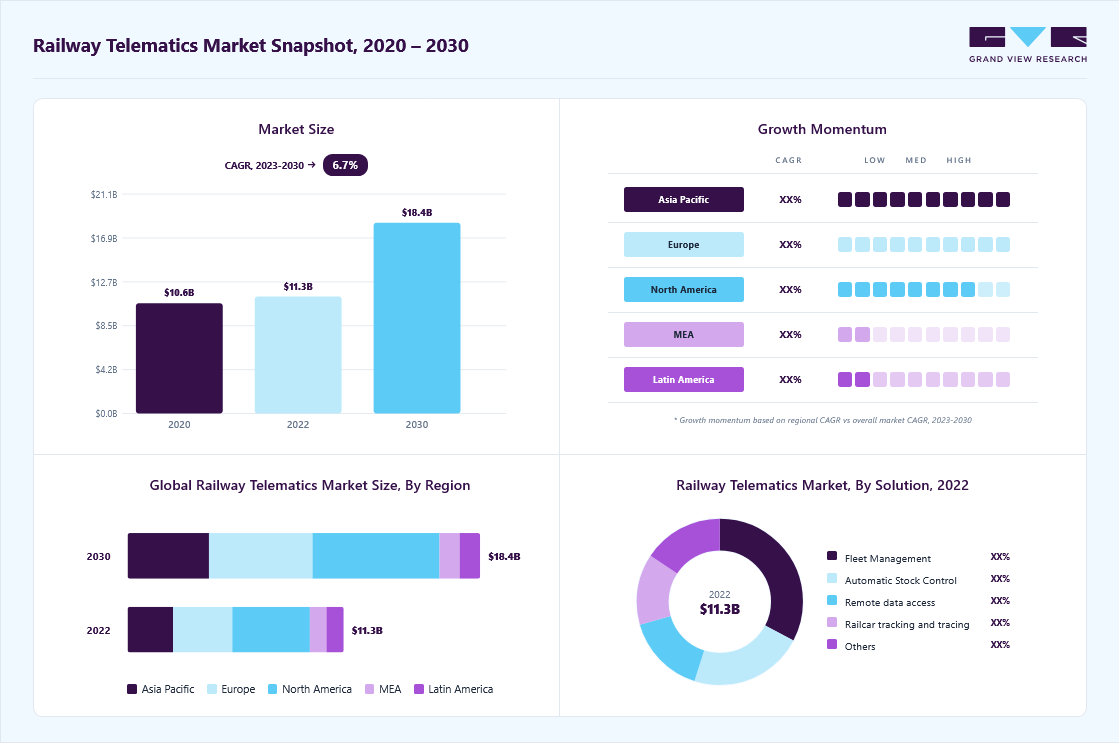
The railway telematics market was valued at USD 11.26 billion in 2022 and is expected to reach USD 18.37 billion by 2030, expanding at a CAGR of 6.7% from 2023 to 2030. Growing freight transportation requirements, railway infrastructure modernization, and increasing attention to operational safety are supporting the adoption of connected rail technologies.
Go Deeper! Ask Prism AI about the Railway Telematics Market.
From Railcar Visibility to Intelligent Fleet Management
Managing large railway fleets requires continuous information about vehicle location, condition, movement, and utilization. Traditional monitoring methods can limit the speed and accuracy of operational decisions, particularly across extensive freight networks. Telematics platforms address this challenge by collecting and transmitting information from railcars through connected devices and communication systems.
Fleet management was the leading solution category, accounting for more than 30.0% of market revenue in 2022. These solutions help operators monitor fleet utilization, coordinate maintenance activities, improve asset availability, and optimize transportation schedules. Better visibility into railcar movements can also reduce idle time and support more efficient freight planning.
However, railcar tracking and tracing is expected to record the fastest growth, with a projected CAGR of 7.5% during the forecast period. The increasing need to monitor freight wagons, improve shipment visibility, and coordinate maintenance is creating demand for more advanced tracking capabilities.
The Technology Behind Connected Railways
Telematics control units represented more than 55.0% of the market's component revenue in 2022. These units enable communication between railcars and monitoring platforms, supporting two-way control, location tracking, and the transmission of operational information. Their ability to provide integrated fleet monitoring makes them an important part of railway connectivity infrastructure.
Sensors represent another important component category. They collect information related to movement, equipment condition, and operating parameters. As railway operators adopt smart infrastructure and more sophisticated monitoring systems, sensor-based data collection is becoming increasingly valuable for maintenance planning and operational safety.
The combination of control units, sensors, wireless communication, and data analytics is creating opportunities for more proactive railway management. Instead of relying exclusively on scheduled inspections, operators can increasingly use equipment data to identify potential issues and plan maintenance activities before disruptions occur.
Request a Sample Report to Explore Detailed Market Insights and Industry Analysis.
Different Railcars, Different Monitoring Requirements
Railway telematics supports multiple freight vehicle categories, including hoppers, tank cars, well cars, boxcars, and refrigerated boxcars. Hoppers accounted for more than 20.0% of market revenue in 2022. Their use in transporting bulk commodities such as grain, coal, and ore creates a requirement for efficient tracking and fleet coordination.
Refrigerated boxcars also present opportunities for connected monitoring technologies. These vehicles transport temperature-sensitive products across food and beverage, healthcare, and chemical supply chains. Telematics can support better visibility into vehicle movement and operating conditions, helping logistics companies manage specialized freight transportation.
The growing diversity of rail freight requirements is encouraging manufacturers to develop solutions that address different vehicle configurations, cargo characteristics, and operational needs.
Infrastructure Modernization Is Accelerating Adoption
Investment in railway infrastructure and digital communication systems is an important growth factor. Governments and railway operators are prioritizing safer transportation networks, improved signaling, and more efficient freight operations. Modern communication technologies, including railway-specific wireless networks, can support the exchange of information between trains, infrastructure, and control centers.
North America accounted for more than 35.0% of market revenue in 2022, while Europe represented over 25.0%. Asia Pacific is anticipated to register the highest growth rate during the forecast period, supported by railway modernization, increasing freight activity, and the adoption of advanced transportation technologies.
India is also an important growth market. Its railway telematics market is projected to grow at a CAGR of 9.8% from 2024 to 2030, reflecting rising investment in railway digitalization and operational improvements.
What Comes Next for Railway Telematics?
The industry's development will increasingly depend on the integration of Internet of Things connectivity, real-time analytics, automated monitoring, and predictive maintenance. These capabilities can help operators improve asset utilization, reduce unplanned downtime, and strengthen supply chain visibility.
Nevertheless, implementation costs, integration with legacy railway infrastructure, cybersecurity requirements, and communication reliability remain important considerations. Railway operators must ensure that new systems work effectively with existing operational technologies while maintaining stringent safety requirements.
As freight networks become more connected and railway infrastructure continues to modernize, telematics is moving beyond basic location tracking toward comprehensive digital asset management. Companies offering reliable, scalable, and interoperable solutions are positioned to benefit from this transition.
Key Railway Telematics Companies:
· A1 Digital
· Alstom SA
· Amsted Industries
· Hitachi Ltd.
· Knorr-Bremse AG
· Orbcomm
· Rail nova SA
· Robert Bosch GmbH
· SAVVY Telematics Systems AG
· Siemens AG
· Wabtec Corporation
About us:
Grand View Research, a market research and consulting company, provides syndicated research reports, customized research reports, and consulting services. Grand View Research database is used by the world's renowned academic institutions and Fortune 500 companies to understand the global and regional business environment. Our database features thousands of statistics and in-depth analysis on 46 industries in 25 major countries worldwide.

 English
 Arabic
 French
 Spanish
 Portuguese
 Deutsch
 Dutch
 Italiano
 Russian
 Romaian
 Portuguese (Brazil)
 Greek