


Next-Generation Sequencing Strengthening Precision Diagnostic Capabilities
A medical diagnosis often begins long before a treatment decision is made. A blood sample, tissue specimen, or other biological material can reveal information that helps clinicians identify infections, assess organ function, detect cancer-related biomarkers, and monitor chronic conditions. In vitro diagnostics (IVD) provides the technologies and testing systems behind these insights, making it an essential part of modern healthcare.
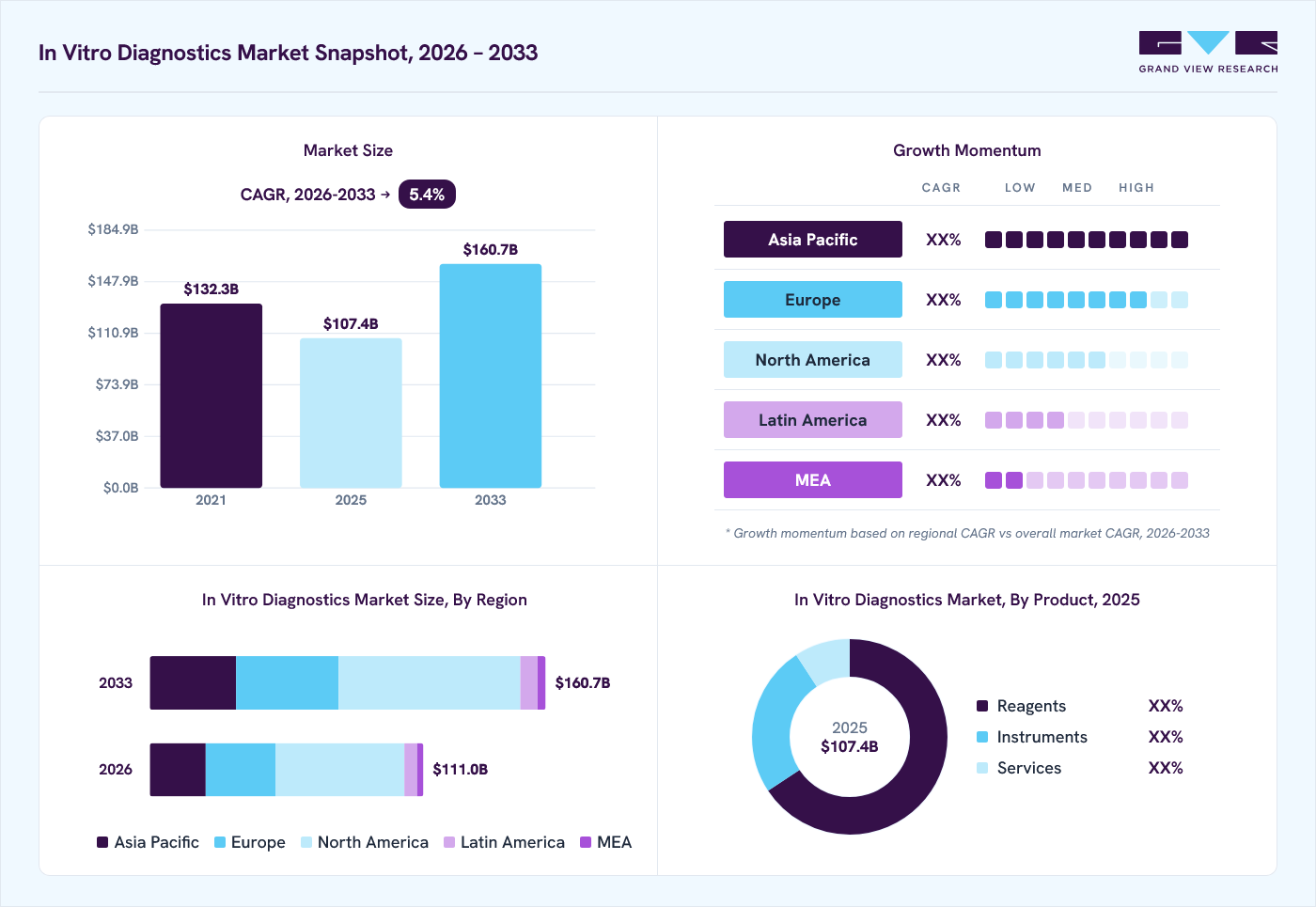
The global in vitro diagnostics market was valued at USD 107.4 billion in 2025. It is estimated to increase to USD 111.0 billion in 2026 and reach USD 160.7 billion by 2033, registering a CAGR of 5.4% from 2026 to 2033. Greater emphasis on early detection, disease surveillance, personalized treatment, and accessible testing is supporting this expansion.
From Routine Blood Tests to Precision Diagnostics
IVD has developed beyond conventional laboratory procedures. Diagnostic systems now support a wide range of clinical needs, from routine blood chemistry and infectious disease screening to genetic profiling and cancer monitoring. This wider clinical role is increasing demand for tests that deliver accurate results with shorter turnaround times.
The growing burden of chronic diseases and cancer is an important demand driver. Patients often require repeated testing to assess disease progression, evaluate treatment effectiveness, or identify complications. Infectious disease surveillance also continues to support testing volumes across hospitals, diagnostic laboratories, and point-of-care settings.
At the same time, molecular diagnostics, next-generation sequencing, biomarker analysis, and liquid biopsy are extending the value of IVD in precision medicine. These technologies can help clinicians identify disease-associated genetic changes and select or monitor targeted therapies.
Go Deeper! Ask Prism AI about the In Vitro Diagnostics Market.
The Commercial Engine: Reagents and Diagnostic Platforms
Reagents represented the largest product segment, accounting for 65.7% of market revenue in 2025. Their recurring use across clinical chemistry, immunoassays, molecular testing, and other diagnostic procedures creates consistent demand. As testing volumes increase and laboratories expand their assay portfolios, the need for specialized reagents and consumables is expected to remain significant.
Instruments are projected to record the fastest growth among product categories. Laboratories are investing in automated analyzers, integrated testing platforms, and high-throughput systems to manage rising workloads and improve operational efficiency. Modern platforms increasingly combine sample processing, analysis, quality control, and digital connectivity within streamlined workflows.
Molecular diagnostics held a 25.8% share of the market by technology in 2025. Its importance reflects the growing use of genetic and pathogen detection methods in infectious disease testing, oncology, and inherited disorder assessment. Coagulation diagnostics are also expected to register the fastest technology-segment growth, supported by the need to evaluate bleeding and thrombotic disorders and monitor anticoagulant therapy.
Request a Sample Report to Explore Detailed Market Insights and Industry Analysis.
Where Testing Demand Is Concentrated
Infectious diseases accounted for 39.7% of market revenue in 2025, making them the leading application segment. Multiplex assays that detect multiple pathogens from a single sample are improving testing efficiency, particularly for respiratory infections. Oncology is expected to grow at the fastest rate as biomarker testing, genomic profiling, companion diagnostics, and residual disease monitoring become more widely adopted.
Hospitals remained the largest end-use segment, accounting for 44.5% of revenue in 2025. Their demand reflects the need for diagnostic support across emergency care, surgery, oncology, cardiology, and routine patient management. Home care, meanwhile, is expected to experience the fastest growth as self-testing and remote monitoring gain acceptance.
Point-of-care testing held the largest share by test location in 2025. These solutions bring selected diagnostic procedures closer to patients and can support faster clinical decisions without relying exclusively on centralized laboratories.
Regional Strength and the Next Growth Opportunity
North America led the market with a 47.3% revenue share in 2025, supported by advanced laboratory infrastructure, high diagnostic utilization, established healthcare networks, and strong adoption of molecular and automated testing technologies.
Asia Pacific is expected to register the fastest CAGR during the forecast period. Healthcare infrastructure development, rising diagnostic awareness, population aging, and increasing investment in local diagnostic capabilities are supporting regional demand. Expanding access to testing in countries such as India and China also creates opportunities for manufacturers offering affordable, reliable, and scalable platforms.
What Could Reshape the Competitive Landscape?
The next phase of IVD development will depend on how effectively manufacturers combine analytical performance with accessibility and workflow efficiency. AI-assisted interpretation, digital pathology, connected diagnostic systems, and automated laboratories are becoming increasingly relevant. Decentralized testing and home-based solutions may also broaden access, particularly where conventional laboratory infrastructure is limited.
FAQs
1. What is the projected value of the in vitro diagnostics market by 2033?
The market is projected to reach USD 160.7 billion by 2033, growing at a CAGR of 5.4% from 2026 to 2033.
2. Which product segment holds the largest share of the IVD market?
The reagents segment leads the market, accounting for 65.7% of revenue in 2025, supported by recurring consumption across diagnostic procedures.
Key In Vitro Diagnostics Companies:
· Abbott
· Thermo Fisher Scientific, Inc.
· Bio-Rad Laboratories, Inc.
· Siemens Healthineers AG
· BIOMÉRIEUX
About us:
Grand View Research, a market research and consulting company, provides syndicated research reports, customized research reports, and consulting services. Grand View Research database is used by the world's renowned academic institutions and Fortune 500 companies to understand the global and regional business environment. Our database features thousands of statistics and in-depth analysis on 46 industries in 25 major countries worldwide.

 English
 Arabic
 French
 Spanish
 Portuguese
 Deutsch
 Turkish
 Dutch
 Italiano
 Romaian
 Portuguese (Brazil)
 Greek