


Flight TerminationSystem Antennas: Picking Omni or Directional for a Range
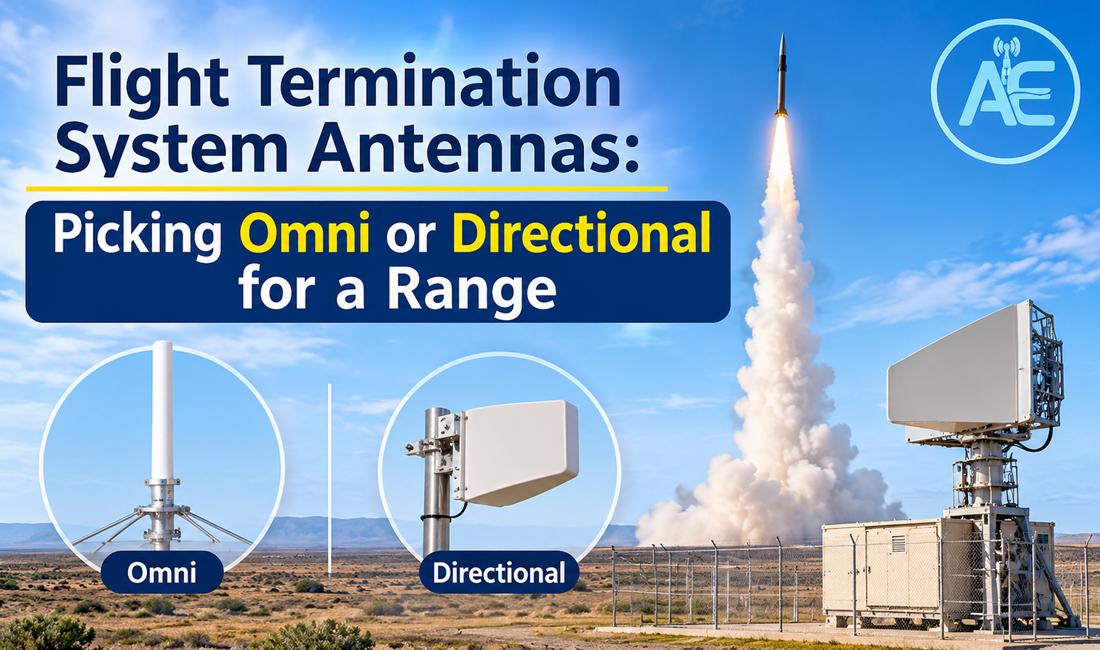
A flight termination system (FTS) is used to terminate a wrong test flight. Its ground antenna is the first link of this chain. Even the best receiver on the vehicle will be of no assistance if the coverage or polarization is wrong. Omni or directional is a function of range geometry and site conditions. And that’s also how you size up a FTS antenna manufacturer in India, by the questions that they help you answer, not the claims they make.
What an FTS Ground Antenna Is Responsible For
The antenna provides the command link from the ground transmitter to the vehicle's FTS receiver. This determines the margin of the coverage and reliability of the system design. It provides no safety alone. Safety is the whole chain: transmitter, antenna, receiver, procedures and approved design.
Destruct links for commands are typically based on Range Commanders Council guidance. FTS Commonality Standard: RCC 319. The receiver data sheets reference IRIG 313-01 and RCC 319. Use the antenna specified in your range’s approved specification.
Omni Quadrifilar vs Directional Helix: Coverage Trade-offs
The quadrifilar helix antenna (QHA) has a wide, omnidirectional pattern. It is suitable for a ground station which has to cover many bearings, like several launch directions. See our Quadrifilar Helix Antennas category.
A directional helix funnels energy into a sector. It provides more gain in the direction of the vehicle's path, but requires proper aiming and a trajectory that stays within the beam. We have this style in our High Gain Helical Antenna category.
First, plot the trajectory on the site. Record the bearings, the lowest elevation and the furthest point the antenna has to reach. Check for obstructions and nearby metal. Neither kind is always better.
LHCP, RHCP and Matching the Airborne Receiver
Circular polarization means the signal rotates either left-handed (LHCP) or right-handed (RHCP). The ground antenna has to match the airborne receiving antenna, because a mismatch loses a lot of signals. Circular polarization is popular as the vehicle attitude changes in flight. Don't assume one sense; compare it with the approved system specification.
The circular polarisation is employed when an aircraft or a rocket is moving in the course of the flight. If the system is designed for it , the signal can still be received without relying on one fixed antenna angle . But the ground antenna and airborne antenna require compatible polarisations. LHCP and RHCP are opposite types. Using the wrong type can reduce the received signal strength. This can impact the communication link between the vehicle and the ground station. Check the approved system documents for required polarisation before selecting a FTS antenna. Check with the engineering team for operating frequency and antenna orientation. Don’t just select an antenna based on its polarisation. Consider the full system requirements.
Band Coverage and Power Handling
Match frequency, bandwidth, RF power handling, connector and impedance to transmitter and cable. Common bands listed in published FTS datasheets are 406 to 450 MHz, but your approved allocation will determine. Compare the peak to the average power. Other links in the range, like relay, have different antenna requirements. These fall under the Tactical Radio Relay Antenna category.
Redundancy at the Ground Site
Antenna and link redundancy shall comply with the range safety architecture and approved design. Decide on the plan. Then choose antennas that support it.
Mounting and Weather Protection
A stable mount keeps the pattern where you pointed it. Cable routing, connector moisture protection, wind exposure and vibration.
MIL-STD-810G Parameters
Environmental test methods are described in MIL-STD-810G, and the procurement specification states which methods to apply. What methods were run, what configuration, what reports, ask. A listed standard is not compliant.
Choosing an FTS Antenna Manufacturer in India: What to Confirm
Our FTS Antennas category includes FTS antennas such as circular polarized helical and omni types. There are no numeric specifications on the category page, ask us for datasheets. Before requesting a quote, check the band, polarization sense, gain, pattern, power rating, connector, mounting and test docs.
DRDO on July 8, 2026, flight-tested the Pinaka Long Range Guided Rocket from the Integrated Test Range, Chandipur in Odisha, All India Radio reported. Range safety supports tests such as this. This item is not affiliated with Antenna Experts.
Why Choose Antenna Experts?
Antenna Experts offers a variety of antenna types for flight termination system (FTS) applications, such as helical, omni and high gain antennas. We help buyers to explore these options based on their system requirements and installation needs. Prior to selecting an antenna, it is essential to check the operating frequency, polarisation, gain, radiation pattern, power rating, connector and mounting arrangement. You can get a good start in comparing suitable antenna types in our FTS antenna category. Technical specifications are not listed on the category page. Please reach out to us for datasheets and discuss the details with your engineering team before making a final decision.
Frequently Asked Questions
1. What is an FTS antenna?
A ground FTS antenna sends the command signal to the vehicle’s flight termination receiver during an authorized test. It is a link in the chain and does not determine safety by itself.
2. Which frequencies do flight termination antennas use?
Datasheets published for FTS receivers and transmitters show a common band of 406 to 450 MHz. The real answer is your authorized allocation, so confirm that before selecting an antenna.
3. Why are FTS antennas circularly polarised?
Circular polarization is more tolerant to variations in vehicle attitude than linear. The ground antenna still has to be in the same sense as the airborne antenna, LHCP or RHCP. So check the approved spec.
4. Should a range use an omni or a directional FTS antenna?
Nor is it always right. Omni QHAs are wide angle. Directional helices are pointed at a sector. It is contingent upon range geometry and site conditions.
About the Author
Kajal Singh is the marketing manager of Antenna Experts. Her work includes antenna solutions, RF communications and applications in defence and aviation, written for technical buyers.
Visit the FTS category page or consult with Antenna Experts to discuss your requirements.

 English
 Arabic
 Spanish
 Portuguese
 Deutsch
 Turkish
 Dutch
 Italiano
 Russian
 Romaian
 Portuguese (Brazil)
 Greek