


Why Agar Is the Perfect Medium for Mushroom Cloning
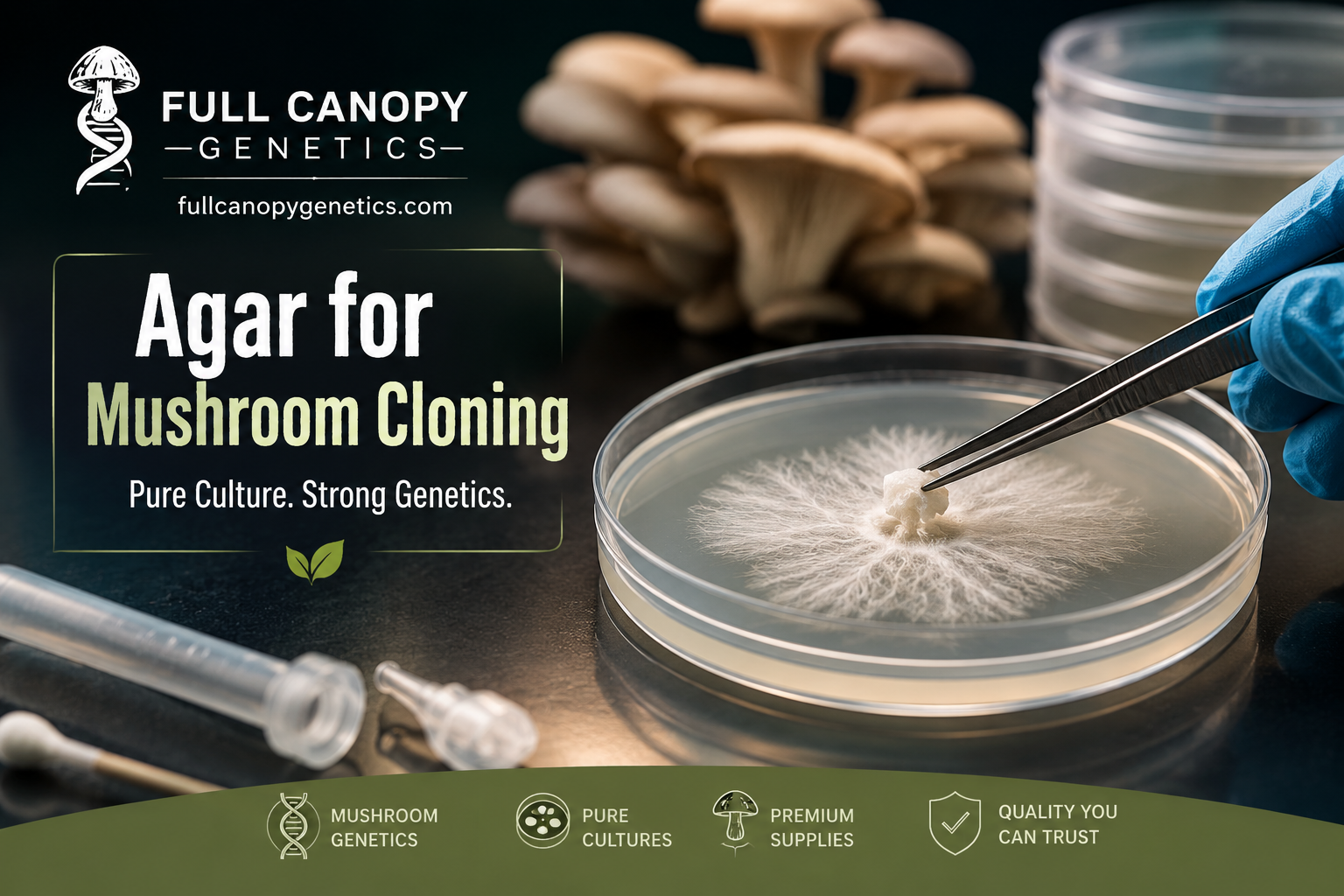
Mushroom cloning is one of the most useful techniques for growers who want to preserve the characteristics of an excellent mushroom. Instead of starting with spores, cloning allows a grower to take living tissue from a selected mushroom and encourage its mycelium to grow into a new culture. Agar has become one of the most popular media for this process because it provides a simple, visible, and controllable environment for mycelial growth.
For growers interested in maintaining reliable cultures, agar offers more than just a place for mycelium to grow. It makes it possible to observe growth patterns, identify contamination, select healthy tissue, and preserve desirable genetics before moving a culture into a larger growing system. Research and extension resources also describe tissue culture on agar as a practical way to obtain a mushroom clone from a desirable fruiting body.
Understanding Mushroom Cloning
Mushroom cloning is essentially a form of vegetative propagation. A small piece of living tissue is taken from a mushroom and placed onto a suitable nutrient medium. Under appropriate conditions, the tissue produces mycelium that expands across the medium.
Cloning Versus Growing From Spores
The major difference between cloning and spore-based cultivation is genetic consistency. A tissue clone comes from an existing fruiting body, so it preserves the genetic makeup of that mushroom. In contrast, spores can combine genetically when they germinate, producing offspring with different characteristics.
This distinction is particularly important when a grower has found a mushroom with desirable traits such as attractive appearance, vigorous growth, good texture, or strong fruiting performance. Penn State Extension notes that tissue culture is essentially a clone of the mushroom, while spore cultures can produce different genetic combinations.
Why Agar Works So Well
Agar is a gelatinous substance commonly used as a solid growth medium. When combined with nutrients, it creates a stable surface where fungal mycelium can develop. Unlike a liquid medium, a solid agar plate allows the grower to see exactly where the culture is growing.
A Clear Window Into Mycelial Growth
One of agar's greatest advantages is visibility. As mycelium expands, its growth pattern can be observed directly. Healthy-looking growth can be distinguished from areas that appear unusual, discolored, or otherwise suspicious.
This visibility makes agar useful for culture management. If contamination appears on one section of a plate, a healthy portion of mycelium may sometimes be transferred to a fresh medium under appropriate sterile conditions. Extension guidance for oyster mushroom culture specifically describes transferring healthy growth to new agar after observing the developing culture.
The Role of Mushroom Growing Supplies
Successful cloning depends on more than the agar itself. A clean working environment, suitable containers, sterile tools, and proper handling practices all contribute to culture quality. The exact equipment required can vary according to the scale and sophistication of the grower's setup.
For beginners, basic Mushroom Growing Supplies may include prepared agar plates, suitable culture containers, sterile tools, gloves, and cleaning materials. More advanced culture work may involve specialized equipment designed to reduce exposure to airborne contaminants. The goal is always the same: give the desired fungal culture an environment where it has a better opportunity to grow without competition.
Clean Technique Matters
Mushrooms and their surrounding environments can carry microorganisms that compete with the desired culture. Because agar provides nutrients that can support many organisms, contamination can become visible quickly if sterile handling is poor.
Working carefully, minimizing unnecessary exposure, and using appropriately sterilized materials are therefore essential parts of successful cloning. Agar does not eliminate contamination; rather, its transparency makes contamination easier to detect and manage.
Choosing a Mushroom for Cloning
The quality of the starting mushroom can strongly influence the value of the resulting culture. Ideally, growers select a healthy fruiting body that demonstrates characteristics they want to preserve.
Selecting Desirable Traits
A mushroom may be selected because of its size, shape, color, texture, vigor, or overall performance. For cultivation projects, choosing a specimen with desirable characteristics provides an opportunity to preserve those traits in a living culture.
Penn State Extension recommends selecting fruiting bodies based on characteristics such as quality, size, color, shape, or other desirable features when establishing tissue cultures.
It is important to remember that cloning preserves existing genetics; it does not automatically improve them. A clone should therefore be viewed as a way to preserve and reproduce a selected specimen rather than as a method for creating a new genetic combination.
From Agar to a Larger Culture
Once a clean culture has been established, agar can serve as an important intermediate stage before expansion into another growing medium. This provides growers with an opportunity to inspect the culture before committing larger quantities of materials.
Building a Reliable Culture Pipeline
A typical culture workflow may progress from selected tissue to agar, followed by additional culture expansion and eventually inoculation of an appropriate growing substrate. The advantage of this staged approach is that each step provides an opportunity to evaluate the culture.
A clean agar culture can also become a useful reference point for maintaining a culture collection. Agricultural guidance describes pure mushroom cultures being established on agar and subsequently used to prepare mother cultures and spawn.
The Importance of Mushroom Supply Quality
The quality of materials used throughout cultivation can influence consistency and workflow efficiency. Growers should consider whether their Mushroom Supply provides materials appropriate for their particular level of culture work.
Matching Materials to Your Goals
A beginner working with a few cultures may require only a simple selection of prepared materials, while a dedicated culture laboratory may need specialized containers, sterile instruments, storage solutions, and environmental controls.
The most important principle is not simply purchasing more equipment. It is selecting materials that support clean handling, observation, and repeatable procedures. A well-organized setup can make it easier to identify problems and maintain cultures over time.
Common Problems With Agar Cloning
Although agar is highly useful, it is not completely foolproof. Slow growth, contamination, drying, poor tissue selection, and unsuitable environmental conditions can all affect results.
Recognizing Contamination
Contamination may appear as unexpected colors, unusual textures, rapidly spreading colonies, or growth that differs significantly from the intended mycelium. Some contaminants can develop quickly, which is why regular observation is valuable.
When contamination occurs, the safest response depends on the situation and the specific organism involved. Rather than assuming every unusual growth pattern is healthy mycelium, growers should learn to distinguish normal culture development from suspicious growth.
Avoiding Unnecessary Transfers
Repeated handling can increase opportunities for contamination and can make culture management more complicated. Transfers should therefore have a clear purpose, such as isolating healthy growth or maintaining a clean culture.
Careful labeling is also valuable. Recording the source mushroom, date, culture generation, and observations can help growers understand how a culture performs over time.
Maintaining Mushroom Supplies for Culture Work
Keeping essential Mushroom Supplies organized can make cloning much easier. Culture work often involves multiple stages, and running out of a basic material at the wrong time can interrupt an otherwise successful workflow.
A practical setup may include culture containers, prepared media, sterile tools, labeling materials, cleaning supplies, and appropriate storage options. The exact list depends on the grower's goals, but organization is useful at every scale.
Why Organization Improves Consistency
Good organization reduces unnecessary handling and helps growers keep different cultures clearly separated. Proper labels can prevent confusion between strains, transfers, and dates.
For anyone maintaining multiple cultures, documentation can be just as important as physical equipment. A simple culture record can help identify which specimens performed well and which ones developed problems.
Why Agar Remains a Favorite
Agar has remained popular because it combines several valuable characteristics in one medium. It supports mycelial growth while allowing growers to observe that growth directly. It can also provide a practical platform for isolating healthy tissue and evaluating cultures before expansion.
Research on agar-based mushroom culture continues to examine how different media influence mycelial development, demonstrating the importance of culture conditions in maintaining and propagating fungal strains.
Most importantly, agar gives growers control and visibility. Instead of immediately transferring a tissue sample into a large amount of substrate, they can first observe the culture on a small, manageable surface.
Final Thoughts
For mushroom cloning, agar is valuable because it turns an invisible biological process into something growers can observe and manage. A carefully selected mushroom can provide living tissue; that tissue can develop into mycelium on a suitable agar medium, and a clean culture can then become the foundation for further propagation.
The real strength of agar is not simply that it helps mushrooms grow. Its greatest advantage is that it gives growers a practical way to observe, evaluate, preserve, and manage mushroom genetics. When combined with careful selection, clean technique, proper documentation, and suitable cultivation materials, agar can become one of the most useful tools in a mushroom grower's culture workflow.

 English
 Arabic
 French
 Spanish
 Portuguese
 Deutsch
 Dutch
Dutch
 Italiano
 Russian
 Romaian
 Portuguese (Brazil)
 Greek
Greek