


Which Factors Matter When Choosing Uterine Fibroid Treatment Without Surgery?
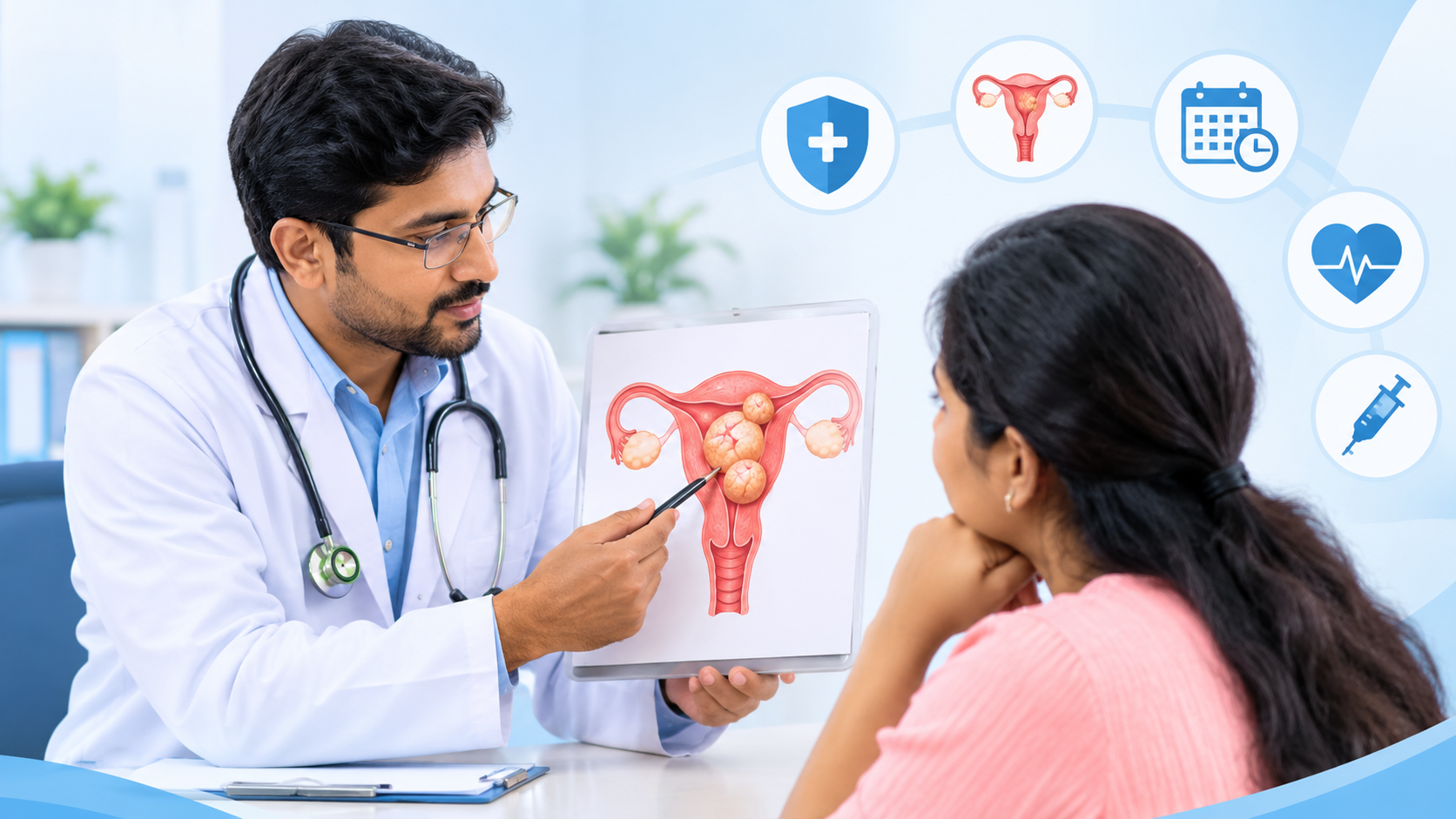
A woman in her late thirties arrives with a scan report that reads “multiple fibroids.” She has bled heavily for a year, her hemoglobin is low, and a relative has already told her the uterus will have to come out. Consultations like this are common, and they often start from the wrong place. Fibroids are benign, several kinds of care can manage them, and the right one depends on details that rarely appear in the first report.
Not Every Fibroid Needs Treatment
A fibroid that causes no trouble can be left alone. Many are found during an ultrasound done for another reason, and a yearly review is often enough. After menopause, when estrogen levels fall, they usually shrink by themselves.
Treatment becomes reasonable when symptoms start to interfere with ordinary life: periods that flood, anemia, a dragging heaviness in the pelvis, passing urine every hour or two, constipation, or difficulty conceiving. Size alone is a poor guide. A two-centimetre fibroid inside the uterine cavity can cause more bleeding than a much larger one on the outer wall.
Where the Fibroids Are and How Many There Are
Ultrasound gives the first picture. MRI gives the detailed one, and it is worth having when there is more than one fibroid or when a procedure is being considered.
A fibroid pushing into the cavity can often be shaved away through the cervix with a hysteroscope, so there is no cut on the abdomen. Fibroids buried in the muscle wall, especially a cluster of them, are the ones most often considered for embolization. A fibroid hanging from the outer surface on a thin stalk is a weaker candidate, because it may detach afterwards.
What the Symptoms Call For
Heavy bleeding and pressure symptoms need different answers. For bleeding, tranexamic acid taken during periods or a hormone-releasing IUD can help a good deal, and iron replacement is part of the plan. These control the bleeding without removing the fibroid, and the problem often returns once the medicine stops.
Pressure on the bladder or bowel behaves differently. Tablets rarely help, and this is usually when a procedure that reduces the fibroid’s volume comes up.
Plans for Pregnancy
This belongs in the very first conversation. For women who want to conceive, myomectomy has the longest record and remains the usual recommendation. Pregnancies have been reported after embolization, but the evidence is less extensive, and a patient is entitled to hear that plainly before she agrees to anything. A woman whose family is complete, and who only wants to keep her uterus, is in a different position.
Age and the Years Ahead
A woman of 48 with bearable symptoms may need medication only to reach menopause. A woman of 34 needs something that will hold for decades. Age also touches risk. Embolization can occasionally reduce ovarian function, and the concern grows closer to menopause, so it should be discussed openly.
Making Sure It Is Really a Fibroid
Adenomyosis is the usual impostor. It causes similar bleeding and an enlarged uterus, and it responds differently to treatment. A fibroid that grows quickly, or any bleeding after menopause, deserves further investigation, because uterine sarcoma, though rare, can look like a fibroid on imaging. That has to be excluded before any non-surgical procedure goes ahead.
Uterine Fibroid Treatment Without Surgery: Where Each Option Fits
Medication suits women whose main problem is bleeding, or who are close to menopause. Hysteroscopic removal suits fibroids inside the cavity. Uterine fibroid embolization, which blocks the arteries supplying the fibroids, is considered for symptomatic women who have completed their families and want to keep the uterus. Focused ultrasound and radiofrequency ablation are offered at a limited number of centres, for selected fibroids.
During embolization, a thin catheter is passed through a puncture at the wrist or groin and guided under X-ray imaging into the uterine arteries. Tiny particles are released to block the vessels feeding the fibroids, which then shrink over weeks to months. Most patients stay overnight, expect period-like cramping for a few days, and return to routine activity within one to two weeks.
Pain, low fever and nausea, together called post-embolization syndrome, are common and settle with treatment. Less often there is infection, a fibroid passing through the vagina, a change in ovarian function, or a need for repeat treatment. Outcomes vary, and none can be guaranteed.
Uterine Fibroid Treatment Without Surgery works best when the patient has been chosen carefully. For the wrong patient it can delay the treatment that would have helped.
Embolization is interventional radiology work. Dr. Arjunlokesh Netaji, who trained at JIPMER and AIIMS, offers it at Kauvery Hospital in Vadapalani. The catheter skills overlap with those used in vein disease, which is why interventional radiologists are also consulted as a Varicose Veins Specialist In Chennai.
Frequently Asked Questions
Can fibroids shrink on their own?
Mostly after menopause. During the reproductive years they rarely disappear without treatment.
Will medicines get rid of them?
They control symptoms, chiefly bleeding. Some shrink fibroids for a while, but growth often resumes after stopping.
Is embolization safe for everyone?
No. Pregnancy, active pelvic infection, suspected cancer and some medical conditions rule it out. Examination and imaging decide eligibility.
Can fibroids come back?
Treated fibroids usually do not regrow much, but new ones can form, so follow-up scans are advised.
How long before I notice a difference?
Many women see lighter periods within one to three cycles. Pressure symptoms ease more slowly as the fibroids shrink. Response varies.
Does an interventional radiologist treat anything besides fibroids?
Yes, including thyroid nodules, liver tumors and knee pain. Many also treat varicose veins, so a patient looking for a Varicose Veins Specialist In Chennai may end up in the same department.
Conclusion
Choosing Uterine Fibroid Treatment Without Surgery depends on where the fibroids sit, what they are doing to you, whether you want children, and how near you are to menopause. Good imaging and an honest history settle most of it.
If you have a scan report you are unsure about, bring it along. Dr. Arjunlokesh Netaji sees patients at Kauvery Hospital, Vadapalani, Chennai, and appointments can be booked on +91 99942 25090 or through the website.
This article is for general information and does not replace a personal medical consultation.

 English
 Arabic
 French
 Spanish
 Portuguese
 Deutsch
 Turkish
 Dutch
 Italiano
 Romaian
 Portuguese (Brazil)
 Greek