


Recycled Precious Metals Gain Importance in the Circular Economy
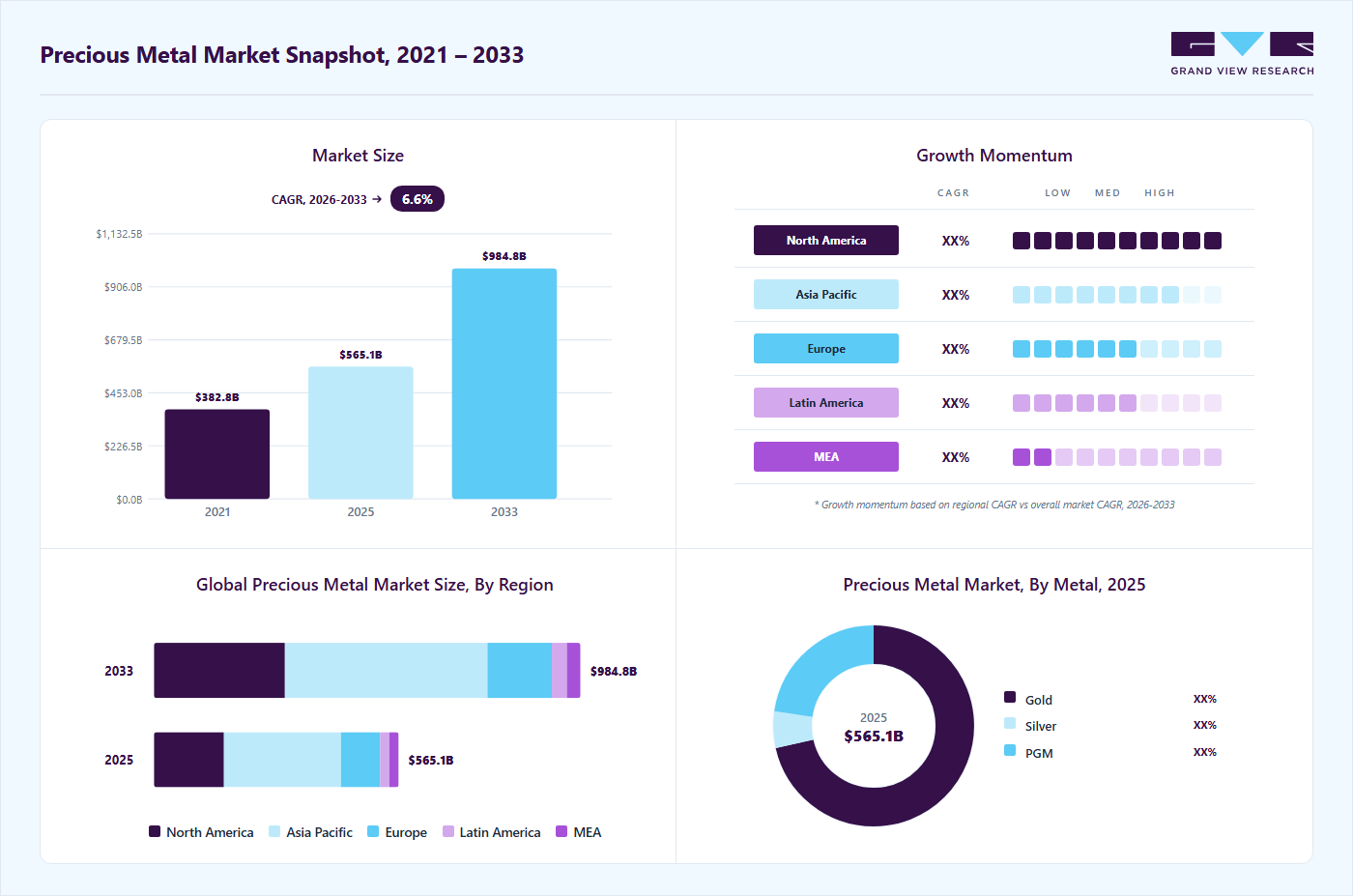
The global precious metals market is gaining momentum as gold, silver, and platinum group metals (PGMs) serve an expanding range of investment, jewelry, and industrial purposes. These metals hold strategic importance across financial markets and manufacturing industries, supported by their value-preservation characteristics, conductivity, catalytic properties, and role in advanced technologies. Rising interest in safe-haven assets, alongside demand from electronics, automotive, and renewable energy industries, is shaping the market's growth trajectory.
According to Grand View Research, the global precious metals market was valued at USD 565.1 billion in 2025. It is projected to increase from USD 630.0 billion in 2026 to USD 984.8 billion by 2033, expanding at a CAGR of 6.6% from 2026 to 2033.
Investment and Industrial Demand Strengthen Market Fundamentals
Precious metals attract investors seeking to manage financial uncertainty, inflation exposure, and geopolitical risks. Gold remains particularly important as a store of value, with demand supported by central bank purchases, institutional investment, and consumer buying. Jewelry consumption in countries such as India and China also contributes to sustained demand, reflecting the cultural and financial significance of gold.
Beyond investment, industrial consumption is broadening the market's demand base. Silver is widely used in electrical components, electronics, and solar photovoltaic systems because of its conductivity. PGMs, including platinum and palladium, are essential to automotive catalytic converters and several chemical processing applications. Their use in renewable energy technologies and advanced manufacturing further connects precious metals demand with industrial innovation.
Gold Dominates While Silver Gains Industrial Momentum
Gold accounted for over 71.0% of the global precious metals market revenue share in 2025, maintaining its leading position among the metal categories. Its dominance reflects demand across jewelry and investment applications, as well as its role in central bank reserves. Economic uncertainty and geopolitical developments continue to reinforce interest in gold-backed assets.
Silver is expected to register the fastest growth among the metal segments during the forecast period. Its applications in solar energy systems, electric vehicles, electronics, and advanced electrical components are expanding alongside investment demand. Compared with gold, silver's lower price point also makes it accessible to a broader range of retail investors.
The market is segmented into gold, silver, and platinum group metals. Each category serves distinct end-use requirements, from wealth preservation and jewelry manufacturing to industrial processing and emission-control technologies.
Go Deeper! Ask Prism AI about the Precious Metals Market.
Asia Pacific Leads Regional Revenue as North America Accelerates
Asia Pacific accounted for over 47.0% of the global precious metals market revenue share in 2025, making it the largest regional market. Strong gold jewelry consumption in China and India, rapid industrialization, and expanding electronics manufacturing contribute to regional demand. Investments in solar energy, electric vehicles, and digital technologies are also supporting consumption of silver and PGMs.
North America is expected to register the fastest regional growth, with a projected CAGR of 7.4% during the forecast period. Investment demand, established industrial capabilities, and the adoption of renewable energy and electric vehicle technologies are supporting the regional outlook. The U.S. represents the largest single-country market in North America.
Europe remains an important market, particularly for PGMs used in automotive emission-control systems and for precious metals consumed in electronics and chemical processing. The regional industry is also influenced by advanced refining capabilities and sustainability-focused operations.
Supply Risks and Sustainability Shape Industry Strategies
The precious metals market faces supply-side challenges related to mining concentration, geopolitical tensions, regulatory changes, and operational disruptions. Platinum group metal availability is particularly exposed to production conditions in regions such as Russia and South Africa. Changes in automotive manufacturing and the transition toward battery electric vehicles may also influence long-term demand for palladium and platinum in catalytic converters.
At the same time, companies are increasingly emphasizing responsible sourcing, energy-efficient refining, and lower-emission mining operations. Recycling precious metals from electronic waste and industrial scrap is gaining importance as a way to recover valuable materials and reduce dependence on primary mining. Automation, digital mine management, and advanced extraction technologies are further helping producers improve operational efficiency.
FAQS
1. What is the projected size of the precious metals market by 2033?
The global precious metals market is projected to reach USD 984.8 billion by 2033, growing at a CAGR of 6.6% from 2026 to 2033.
2. Which segment is expected to grow fastest in the precious metals market?
Silver is expected to register the fastest growth among metal segments, while the industrial application segment is projected to grow at a CAGR of 7.1% during the forecast period.
Request a Sample Report to Explore Detailed Market Insights and Industry Analysis.
Key Precious Metals Companies:
· Anglo American Platinum Limited
· Barrick Mining Corporation
· First Quantum Minerals Ltd.
· Fresnillo plc
· Glencore plc
· Impala Platinum Holdings Limited
· Newmont Corporation
· MMC Norilsk Nickel
· Pan American Silver Corp.
· Sibanye-Stillwater Limited
About us:
Grand View Research, a market research and consulting company, provides syndicated research reports, customized research reports, and consulting services. Grand View Research database is used by the world's renowned academic institutions and Fortune 500 companies to understand the global and regional business environment. Our database features thousands of statistics and in-depth analysis on 46 industries in 25 major countries worldwide.

 English
 Arabic
 French
 Spanish
 Portuguese
 Deutsch
 Turkish
 Dutch
 Italiano
 Russian
 Romaian
 Greek