


Power Plant Retrofitting Supports Carbon Capture & Storage Market Opportunities
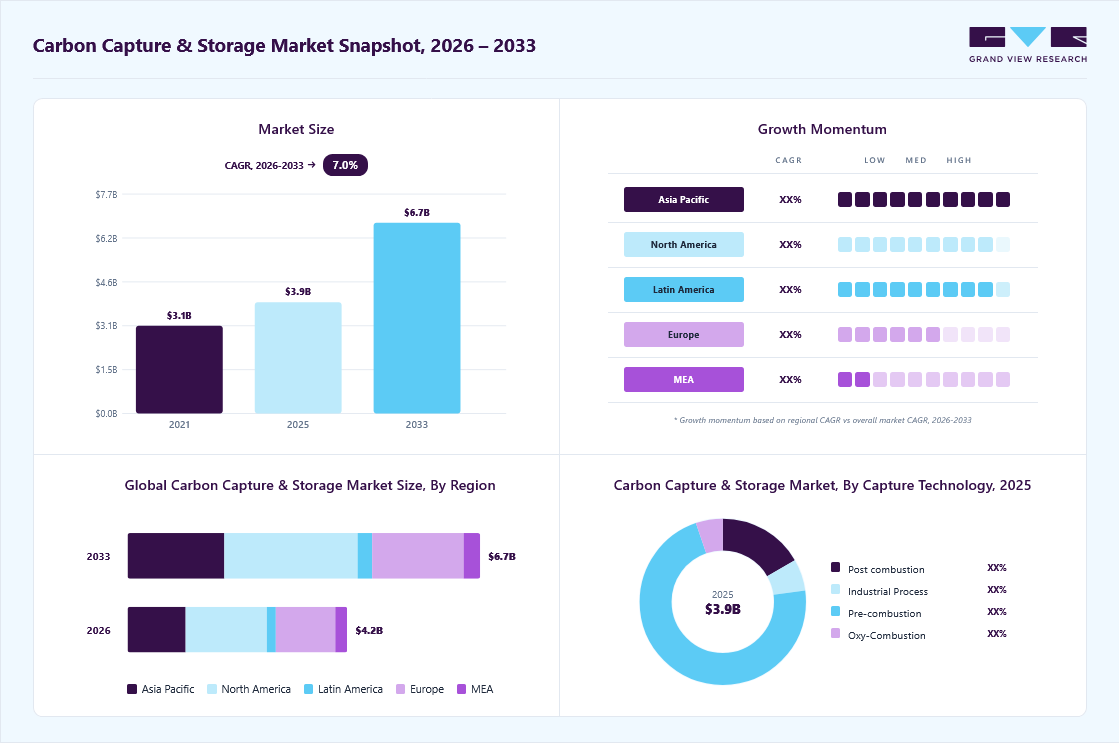
Carbon capture and storage (CCS) is becoming an important component of industrial emission reduction strategies. The technology captures carbon dioxide from sources such as power plants, cement factories, steel facilities, and oil and gas operations. The captured CO₂ is then transported for utilization or stored in suitable geological formations, helping reduce emissions from sectors where eliminating carbon output can be technically challenging.
Carbon Capture & Storage Market: Key Figures and Highlights
· 2025 market size: USD 3.9 billion
· 2026 market estimate: USD 4.2 billion
· 2033 market projection: USD 6.7 billion
· CAGR from 2026 to 2033: 7.0%
· Leading capture technology: Pre-combustion, with a 71.8% revenue share in 2025
· Leading application: Power generation, accounting for 70.1% of revenue in 2025
· Leading region: North America, with a 36.9% revenue share in 2025
· Fastest-growing region: Asia Pacific
Pre-Combustion Technology Maintains a Strong Position
Pre-combustion capture accounted for 71.8% of market revenue in 2025, making it the leading technology segment. This approach separates carbon dioxide before fuel combustion, commonly through processes that convert fuel into a mixture of hydrogen and carbon dioxide. Its suitability for large-scale industrial operations and integrated gasification combined cycle facilities supports its adoption.
The technology is also relevant to low-carbon hydrogen production, where captured CO₂ can be separated during hydrogen generation. Growing interest in blue hydrogen and industrial decarbonization is creating additional opportunities for pre-combustion systems.
Other technologies, including post-combustion, industrial process capture, and oxy-combustion, serve different operating requirements. Post-combustion systems can be particularly relevant for retrofitting existing facilities, while industrial process capture addresses emissions generated directly through manufacturing activities.
Go Deeper! Ask Prism AI about the Carbon Capture & Storage Market.
Power Generation Leads Application Demand
Power generation represented 70.1% of market revenue in 2025. Coal- and natural gas-fired power plants remain significant sources of carbon emissions, creating demand for technologies that can capture CO₂ while allowing existing electricity infrastructure to continue operating.
Utilities are exploring capture systems to support emission reduction targets and meet environmental requirements. Retrofitting existing facilities, developing lower-emission thermal plants, and integrating CCS with advanced power generation technologies are contributing to investment opportunities.
Industrial applications also offer considerable potential. Cement and steel production generate process emissions that are difficult to eliminate through energy efficiency or renewable electricity alone. Oil and gas companies are exploring carbon capture and enhanced oil recovery applications, while chemicals, hydrogen, and bioenergy production provide additional avenues for deployment.
North America Leads as Asia Pacific Expands
North America accounted for 36.9% of global market revenue in 2025, supported by established industrial infrastructure, early project development, and government incentives. The United States benefits from tax credits, public funding, geological storage potential, and investments in large-scale carbon management projects. Canada also contributes through industrial decarbonization initiatives and carbon storage development.
Asia Pacific is expected to register the fastest regional growth from 2026 to 2033. China, Japan, South Korea, and Australia are investing in carbon management technologies and demonstration projects. The region's large industrial base, particularly in steel, cement, and power generation, creates significant demand for emission reduction solutions. Growing government support and research collaborations are expected to encourage further deployment.
Carbon Utilization and Infrastructure Create New Opportunities
Captured carbon dioxide is increasingly being considered a potential feedstock for value-added products, including synthetic fuels, chemicals, and construction materials. Carbon utilization can create commercial opportunities while supporting broader carbon management strategies.
The development of shared transportation networks and regional storage hubs is another important market opportunity. Public-private partnerships and cross-border CO₂ transport initiatives can help connect industrial emission sources with suitable storage locations. Integration with direct air capture and carbon capture, utilization, and storage projects may further diversify the market.
High Costs and Storage Requirements Remain Challenges
Despite its potential, CCS deployment faces challenges related to capital investment, operating expenses, and infrastructure availability. Projects require specialized capture equipment, transportation systems, geological assessments, and long-term storage monitoring. These requirements can make implementation difficult, particularly in regions without established carbon management networks.
Uncertainty around carbon pricing, regulatory frameworks, storage integrity, and public acceptance can also influence investment decisions. Continued research, supportive policies, and cost-efficient project models will be important for wider adoption.
Request a Sample Report to Explore Detailed Market Insights and Industry Analysis.
FAQs
1. What is the projected size of the carbon capture and storage market by 2033?
The global carbon capture and storage market is projected to reach USD 6.7 billion by 2033, growing at a CAGR of 7.0% from 2026 to 2033.
2. Which technology and application segments lead the carbon capture and storage market?
Pre-combustion was the leading capture technology, accounting for 71.8% of revenue in 2025. Power generation was the leading application, representing 70.1% of market revenue in the same year.
Key Carbon Capture & Storage Companies:
· Aker Solutions
· Dakota Gasification Company
· Equinor ASA
· Fluor Corporation
· Japan CCS Co. Ltd
· Linde plc
· Mitsubishi Heavy Industries Ltd. (MHI)
· Shell PLC
· Siemens Energy
· Sulzer Ltd.
About us:
Grand View Research, a market research and consulting company, provides syndicated research reports, customized research reports, and consulting services. Grand View Research database is used by the world's renowned academic institutions and Fortune 500 companies to understand the global and regional business environment. Our database features thousands of statistics and in-depth analysis on 46 industries in 25 major countries worldwide.

 Arabic
 French
 Spanish
 Portuguese
 Deutsch
 Turkish
 Dutch
 Italiano
 Russian
 Romaian
 Portuguese (Brazil)
 Greek