


How Can an ACE Rotary Damper Improve Product Feel?
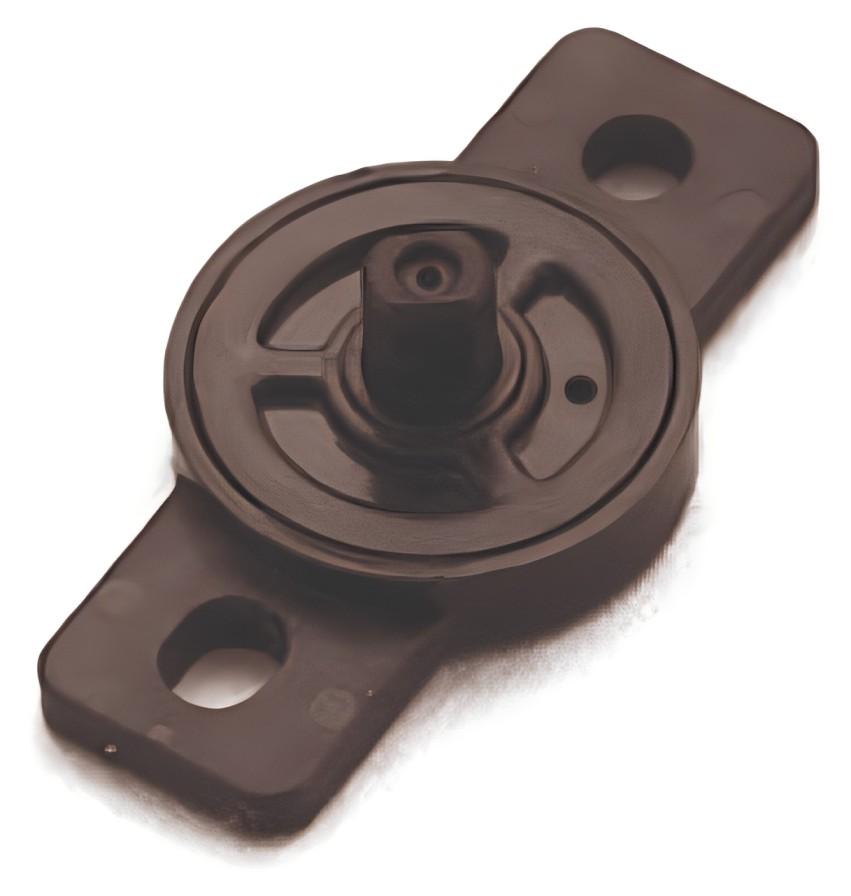
A product can work perfectly and still feel poorly made. A compartment that snaps open or a panel that drops too quickly may give users an impression of low quality, even when nothing is broken. An ACE Rotary Damper helps product designers shape these everyday interactions by introducing resistance to rotating parts.
The ACE Rotary Damper, part FRT-E2-400, is a miniature ACE component for subtle motion control. Its nominal damping torque is 0.4 ± 0.1 Ncm, specified at 20 rpm and 23°C, and it resists rotation in both directions. With a housing approximately 10 mm in diameter, it can fit into mechanisms where available space is limited.
Why Does the Feel of Movement Matter?
Users rarely inspect the mechanism behind a small cover. Instead, they notice whether it opens smoothly, stops predictably and feels comfortable to operate. An abrupt motion may sound inexpensive or make a control feel harder to manage.
Controlled resistance can improve that experience without adding a motor or electrical controller. Crucially, damping is not the same as locking a panel in place. The device slows motion, but other components must support the weight and determine where movement ends.
What Does a Rotary Damper Change?
Inside the FRT-E2 family, silicone oil creates resistance as the mechanism turns. The damper dissipates movement energy rather than storing it like a spring. This lets designers shape the motion itself instead of simply adding a stronger return force.
However, the effect is not constant at every speed or temperature. A prototype should be tested under realistic conditions rather than judged solely by the nominal catalogue torque.
Which Compact Products Benefit Most?
Miniature dampers can be useful wherever a lightweight rotating part needs a more deliberate response. Think of a small instrument lid, a manually operated flap or an interior compartment with a short travel path.
In furniture or equipment cabinetry, Drawer Runners guide sliding movement while hinges or pivots guide rotation. A rotary damper belongs in the latter type of mechanism unless an appropriate transmission converts the motion.
The goal is not always to make movement slower. Sometimes the design needs less noise at closure, a controlled opening action or a more consistent feel between units coming off a production line.
How Is Damping Different From Other Motion Hardware?
A spring supplies force, while a damper resists movement. Door Stays can keep an access panel at a selected angle, but the damper does not hold that angle by itself. Similarly, Clamping Knobs secure an adjustment after positioning rather than regulate its travel. Gas Struts may support heavier lids, but support and damping remain different functions.
Separating these functions makes designs easier to troubleshoot. If the lid drops under its own weight, first examine the balance and support arrangement; do not automatically increase damping to compensate for an unsuitable pivot.
How Should the Damper Work With the Pivot?
The most reliable starting point is the hinge axis. Well-matched Hinges carry the panel load and guide its rotation, while a separate damper can provide resistance. This division prevents the miniature damper from being forced to act as a structural bearing.
ACE specifically warns against applying radial or axial loading through the damper shaft. Keep mounting tabs aligned, account for tolerances and ensure the moving part never pushes sideways on the component.
What About Direct Drive and Geared Designs?
The standard FRT-E2-400 is the version without a supplied gear. Where a design requires transmission through a pinion or rack, ACE lists distinct geared variants. These must be selected deliberately, not treated as identical replacements.
A compact package is useful, but do not squeeze the damper into an assembly with no clearance for movement, fasteners or inspection. Leave room to check alignment before final enclosure assembly.
What Does the Torque Rating Tell a Designer?
The specified 0.4 Ncm is equivalent to 0.004 Nm, a small damping moment appropriate to delicate mechanisms. It does not describe the weight of a lid that the device can safely carry.
ACE also specifies a maximum rotational speed of 50 rpm and an operating range of 0°C to 50°C. A part that behaves pleasantly in a warm workshop may feel different in a cold storeroom, making temperature testing essential.
What Should a Useful Prototype Test Include?
Measure more than whether the panel opens and closes. Try the mechanism with different users, at different speeds and with the expected load. Listen for clicking, look for bouncing and check whether the closing point is easy to predict.
Where a housing needs a firm endpoint, suitably placed Door Stops can limit travel, while damping manages the approach. These components perform different jobs, so neither should be expected to replace the other.
Practical prototype checks include:
- Consistency of opening and closing feel across repeated cycles.
- Clearance between the damper, housing and adjacent fittings.
- Behaviour at the expected minimum and maximum temperatures.
- Signs of binding, shaft side-load or unexpected mechanical noise.
- Ease of assembly and access if replacement becomes necessary.
How Can Production Teams Preserve the Intended Feel?
A prototype may work because an experienced engineer adjusts it by hand. Production requires repeatable locating features, clear assembly instructions and a test that operators can perform consistently.
Avoid relying on subjective descriptions such as “fairly smooth”. Define measurable acceptance criteria where possible, then compare samples after repeated use. ACE publishes a nominal life of 50,000 cycles under its defined test procedure, but actual service life depends on the application.
What Makes the Right Choice Easier?
Begin with the desired user interaction, then calculate the available space, rotational speed and likely environmental conditions. Match the damper to a correctly supported mechanism, and confirm the result through physical trials rather than assumptions.
For projects where several damping strengths or mounting styles may be suitable, compare Rotary Dampers alongside the actual hinge and enclosure design. The right choice makes motion feel intentional while keeping the mechanism simple to build, inspect and maintain.

 English
 Arabic
 Spanish
 Portuguese
 Deutsch
 Turkish
 Dutch
 Italiano
 Russian
 Romaian
 Portuguese (Brazil)
 Greek