


BCom Distance Education After 12th: Complete Admission Guide
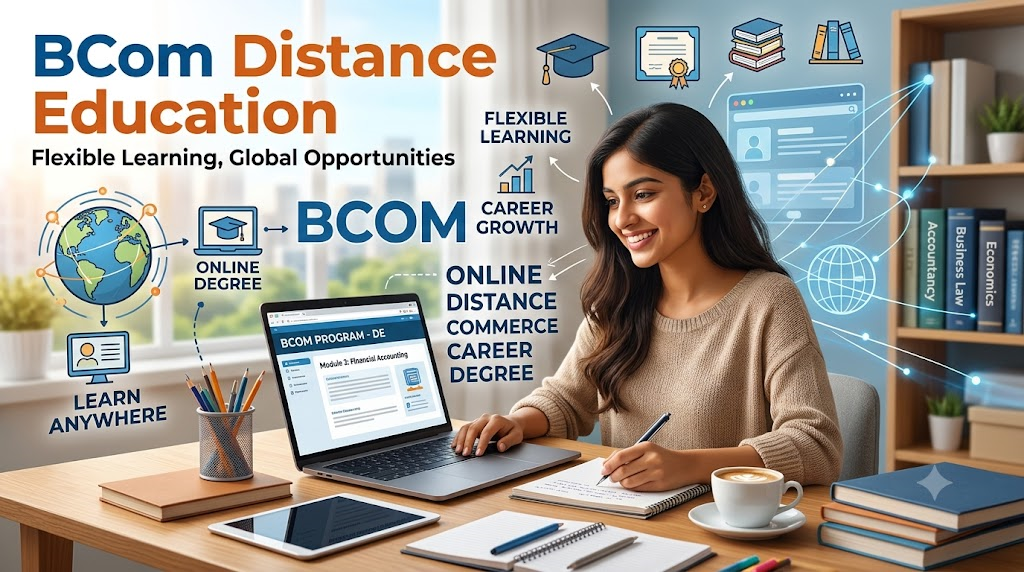
Have you completed Class 12 and want to pursue a Bachelor of Commerce without attending a regular college every day? BCom Distance Education can be a suitable option for students who want flexible learning while preparing for competitive examinations, working part-time, or managing other responsibilities.
A Bachelor of Commerce (BCom) programme helps students understand accounting, business, economics, taxation, and financial management. Through distance education, students can work towards a recognised undergraduate qualification while studying at their own pace within the university's academic requirements.
In this guide, we explain how to pursue BCom Distance Education after 12th, including eligibility, fees, admission procedures, course subjects, career opportunities, and important points to consider before applying.
What Is BCom Distance Education?
BCom Distance Education is an undergraduate commerce programme offered through an Open and Distance Learning (ODL) system. Instead of attending conventional classroom lectures regularly, students learn through study materials, digital resources, assignments, and examinations arranged by their university.
The course is suitable for students interested in commerce, business operations, accounting, banking, and finance.
Depending on the university, the programme may be available as a general BCom or with specialised subjects and electives. Students should check the curriculum carefully before selecting an institution.
Eligibility for BCom Distance Education After 12th
Students who have completed Class 12 can generally apply for BCom distance learning, subject to the admission requirements of their chosen university.
The common eligibility conditions include:
1. Educational qualification
Applicants usually need to pass Class 12 or an equivalent examination from a recognised board.
2. Commerce or other streams
Many universities accept students from Commerce, Science, and Arts backgrounds. However, some programmes may specify subject requirements, so applicants should check the relevant prospectus.
3. Minimum marks
The minimum qualifying percentage varies by institution. Some universities require only a pass in Class 12, while others may prescribe additional academic conditions.
4. Age limit
Many general BCom programmes do not impose a strict upper age limit. Students should confirm the rules applicable to their chosen university.
5. Required documents
Applicants may need their Class 10 and Class 12 marksheets, certificates, photograph, signature, identity documents, and other information requested by the university.
Meeting the general criteria does not guarantee admission. The university's official rules determine final eligibility.
BCom Distance Education Admission Process After 12th
Most universities allow students to complete the application process online. The exact procedure depends on the institution, but the following steps provide a useful starting point.
Step 1: Research universities
Compare course subjects, fees, examination arrangements, student support, and the availability of study materials.
Step 2: Check programme recognition
Verify that the university and the specific BCom programme are recognised or entitled for the relevant admission session under the applicable UGC-DEB framework.
Step 3: Read the admission prospectus
Review the eligibility criteria, application dates, fee details, and document requirements before filling in the form.
Step 4: Create your DEB ID
For covered ODL and online admissions, complete the prescribed DEB ID process through the official UGC-DEB portal.
Step 5: Fill out the application form
Enter your personal details, educational qualifications, contact information, and other requested information accurately.
Step 6: Upload the documents
Submit the required marksheets, certificates, photograph, signature, and identity documents in the prescribed format.
Step 7: Pay the application fee
Make the payment through the university's official payment facility and keep the receipt for future reference.
Step 8: Track your application
Monitor the admission portal for application verification, confirmation, and further instructions.
Always apply through the official university website rather than an unverified third-party admission agent.
BCom Distance Education Fees After 12th
Course fees are an important factor when choosing a distance learning programme. The total cost varies depending on the university, curriculum, study materials, examination fees, and other applicable charges.
The following figures are illustrative estimates for budgeting, not confirmed fees for any specific institution.
|
Fee component |
Indicative amount |
|
Annual tuition fee |
₹3,000–₹15,000 |
|
Application or registration fee |
₹200–₹1,000 |
|
Examination fees |
Additional, where applicable |
|
Study materials |
Included or charged separately |
|
Approximate three-year tuition |
₹9,000–₹45,000 |
Actual fees may fall outside these ranges. Check the latest official prospectus for the exact amount payable.
When comparing universities, look beyond the tuition fee. Consider the quality of learning resources, examination centres, academic support, and access to practical or digital learning facilities.
Duration and Subjects in BCom Distance Education
A BCom programme commonly takes three years, although the applicable programme structure and maximum completion period depend on the university's regulations.
Students may study subjects such as:
-
Financial Accounting
-
Business Law
-
Business Economics
-
Business Organisation and Management
-
Corporate Accounting
-
Cost Accounting
-
Income Tax
-
Business Statistics
-
Financial Management
-
Auditing and Business Communication
The exact subjects differ between universities. Some programmes offer electives that allow students to explore taxation, finance, banking, or business management in greater depth.
Students should also check the examination pattern, assignment requirements, and practical components, where applicable.
Career Opportunities After BCom Distance Education
A BCom degree can provide a foundation for entry-level employment and further professional education. Career opportunities depend on a student's skills, experience, additional qualifications, and employer requirements.
Possible career paths include:
Accounting and finance: Accounts assistant, junior accountant, billing executive, and finance support associate.
Banking and financial services: Banking operations associate, customer service executive, and financial services support staff.
Taxation: Tax assistant, GST support executive, and accounting services associate, depending on the role's requirements.
Business operations: Administrative executive, office coordinator, and business support associate.
Higher education: Students can explore postgraduate programmes such as an MCom or MBA, subject to the relevant institution's eligibility requirements.
To improve employment prospects, students can develop practical skills in Excel, accounting software, financial reporting, communication, and data analysis. Internships and hands-on projects can also help them prepare for workplace responsibilities.
Is BCom Distance Education Valid After 12th?
Yes, a BCom earned through an appropriately recognised ODL programme can be valid for higher education and employment, subject to applicable regulations and the eligibility requirements of the receiving institution or employer.
Before enrolling, verify the recognition status of the specific university and programme for the relevant academic session. Do not assume that every university offering a regular BCom automatically offers a recognised distance version.
For official information, visit the UGC Distance Education Bureau.
Frequently Asked Questions
1. Can I do BCom distance education after Class 12 Arts or Science?
Many universities accept students from different streams, but applicants must check the specific programme's eligibility criteria.
2. Is Mathematics compulsory for BCom distance education?
Not necessarily. Requirements vary by university and programme.
3. Can I pursue BCom while preparing for government examinations?
Yes. The flexible learning format can help students manage both activities, provided they meet assignment and examination requirements.
4. Can I study BCom distance education while working?
Yes, where you meet the admission criteria. The format can suit working learners who need flexibility.
5. Can I pursue an MBA after distance BCom?
You may be eligible if your undergraduate qualification meets the MBA institution's admission requirements.
Conclusion
BCom Distance Education after 12th can be a practical choice for students seeking flexibility, affordable study options, and a foundation in commerce. Before applying, compare universities, check eligibility, review the fee structure, and understand the course curriculum.
Most importantly, verify the programme's recognition for your admission session and complete the application through the official university portal. With a recognised qualification and additional practical skills, you can prepare for opportunities in accounting, finance, banking, business operations, and higher education.
https://posteezy.com/best-courses-pursue-after-bba-distance-education-top-career-options
https://janjaonline.mn.co/posts/what-is-an-online-ma-degree-beginners-guide-2026
https://unatalk.site/read-blog/9213_how-to-build-a-strong-it-career-with-a-online-bca-degree.html
https://www.mcmacademy.in//blog/bosse-april-2026-admission-class-10-and-12/
https://www.mcmacademy.in//blog/petroleum-engineering-colleges-in-india/
https://www.mcmacademy.in//llb-in-one-year/
https://www.mcmacademy.in//llb-non-attending/
https://www.onesittingdegrees.com/
https://www.mcmacademy.in/one-sitting-degree/
https://taggedface.com/blogs/87670/How-to-Build-a-Successful-Career-With-an-Online-BA
https://articlescad.com/online-mba-for-fresh-graduates-is-it-the-right-choice-in-2026-403390.html
https://mcmacademy.stck.me/post/2260445/Best-Online-MCA-Specializations-for-IT-Careers-in-2026
https://onlinedegreeprograms2026.blogspot.com/2026/10/best-online-msc-courses-in-india-2026.html

 English
 Arabic
 French
 Portuguese
 Deutsch
 Turkish
 Dutch
 Italiano
 Russian
 Romaian
 Portuguese (Brazil)
 Greek