


Wholesale Paper Bags for Retail Stores: How to Compare Quality and Pricing
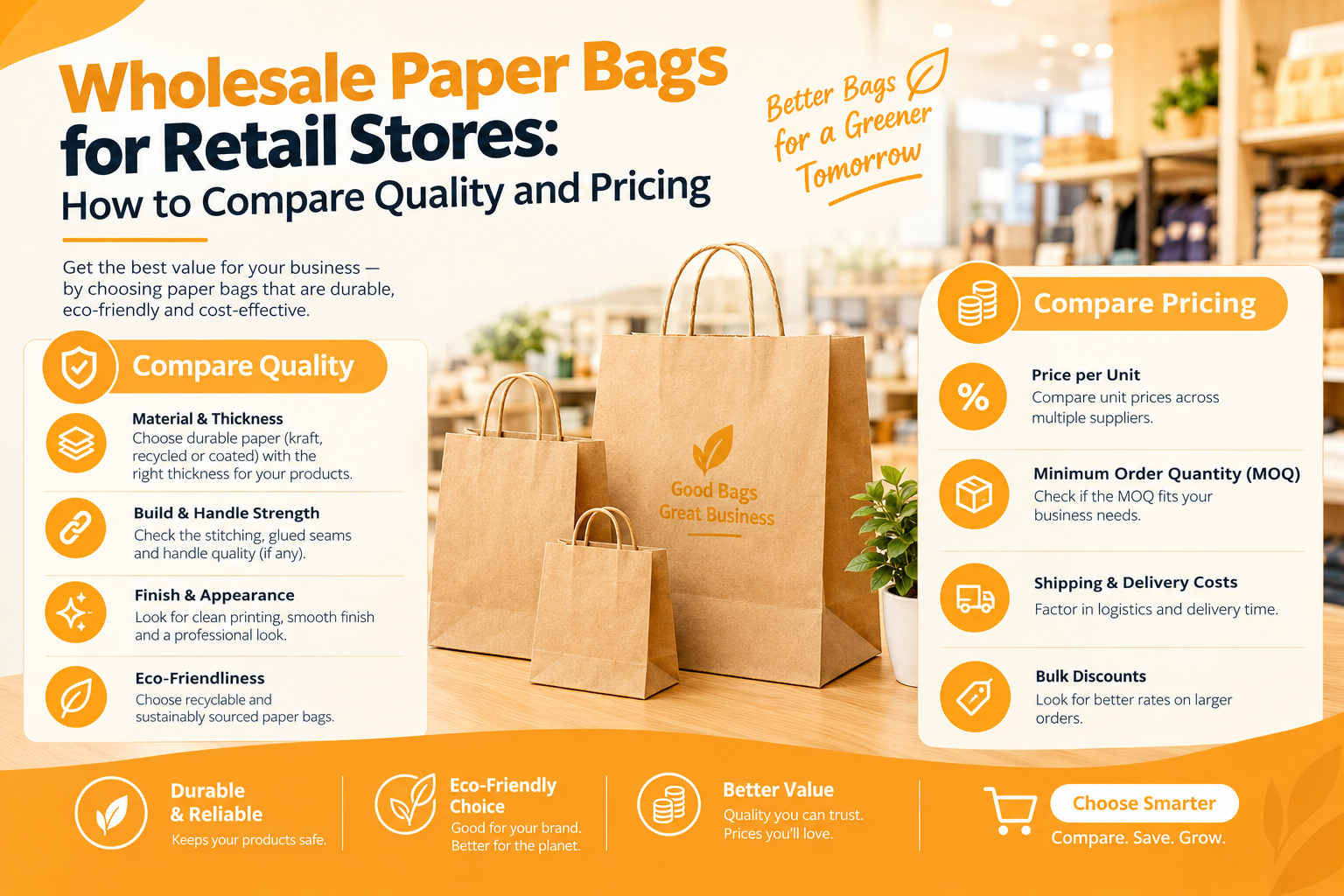
Retail stores need packaging that is practical, presentable, and affordable. Whether you operate a clothing shop, bookstore, boutique, cosmetic store, gift shop, or grocery business, choosing the right paper bags can influence daily operations and the customer experience.
Buying paper bags wholesale can help retailers maintain a consistent packaging supply and plan purchases around their sales volume. However, selecting bags based only on the lowest price can lead to problems such as weak handles, unsuitable dimensions, inconsistent quality, and unnecessary material costs.
To make a better purchasing decision, businesses should compare paper specifications, bag construction, size, handle strength, printing options, order quantity, and delivery costs.
This guide explains how retail businesses can compare wholesale paper bags and choose options that balance quality, functionality, presentation, and budget.
Why Retail Stores Buy Paper Bags Wholesale
Retail stores often use bags every day. Purchasing small quantities repeatedly can make procurement less convenient, especially when customer demand changes during busy periods.
Wholesale purchasing allows retailers to plan packaging requirements in advance and establish consistent specifications for regular orders.
Some potential advantages include:
-
Maintaining a regular packaging supply
-
Planning purchasing quantities
-
Standardizing commonly used bag sizes
-
Supporting consistent brand presentation
-
Preparing for seasonal sales
-
Simplifying repeat orders
-
Comparing supplier quotations more effectively
However, wholesale purchasing is most useful when the quantity matches actual business needs. Ordering excessive stock can occupy storage space and tie up working capital, particularly when bags have custom printing.
What Should Retailers Compare When Buying Paper Bags Wholesale?
Not all paper bags have the same specifications. Two bags that look similar may differ in paper quality, dimensions, handles, bottom construction, and printing.
Before comparing prices, retailers should make sure they are evaluating products with equivalent specifications.
The main factors to compare are:
-
Paper type and GSM
-
Bag dimensions
-
Product weight capacity
-
Handle construction
-
Bottom construction
-
Printing requirements
-
Order quantity
-
Delivery charges
-
Supplier consistency
Understanding these details helps retailers compare quotations more accurately instead of choosing a supplier based only on the quoted price per bag.
1. Compare Paper Quality and GSM
Paper quality is one of the first factors to evaluate when buying wholesale paper bags.
GSM stands for grams per square metre and indicates the weight of the paper. It can help businesses compare paper specifications, but it should not be treated as the only measure of bag strength.
The overall performance of a paper bag also depends on its dimensions, construction, handle attachment, adhesive quality, and manufacturing consistency.
What Retailers Should Check
Before placing an order, ask the supplier to confirm:
-
Paper type
-
Paper GSM
-
Bag dimensions
-
Handle construction
-
Bottom design
-
Intended application
For example, a bag carrying lightweight accessories may have different requirements from one used for several books or multiple clothing items.
The best approach is to select paper specifications according to the expected product weight and usage rather than automatically choosing the thickest paper available.
2. Choose the Right Bag Size for Your Products
Bag dimensions affect product fit, material usage, carrying convenience, and presentation.
A bag that is too small can make packing difficult. An oversized bag may use more material than necessary and create an untidy presentation.
Retailers should measure the products they sell most frequently and identify the bag sizes needed for common purchases.
Consider:
-
Product length
-
Product width
-
Product height
-
Product weight
-
Number of items per purchase
-
Space needed for comfortable packing
For example, a cosmetic store may need compact bags for individual purchases, while a clothing retailer may require medium and large bags for garments.
Businesses with several product categories can maintain a practical range of sizes instead of using one bag for every order.
3. Check Handle Strength and Construction
Handles are an important consideration because they directly affect how customers carry their purchases.
A bag may have suitable paper quality but still perform poorly if the handles are weak or improperly attached.
Common handle options include:
Flat Paper Handles
Flat paper handles can be suitable for many everyday retail applications when the bag construction matches the expected load.
Twisted Paper Handles
Twisted handles are commonly used for retail carry bags and can combine carrying convenience with a neat appearance.
Rope-Style Handles
Rope-style handles may be suitable for boutiques, gift shops, and businesses that want a more distinctive presentation.
Die-Cut Handles
Die-cut handles are formed directly into the bag and may suit selected lightweight applications, depending on the bag's construction and intended use.
When comparing suppliers, check whether the handle type and attachment method are included in the quoted price. Test samples with actual products before committing to a large order.
4. Compare Brown and White Paper Bags
The colour of the bag can influence product presentation and branding, but it does not determine the bag's strength.
Brown Paper Bags for Everyday Retail Use
Brown Paper Bags offer a natural, straightforward appearance and can be suitable for clothing, books, stationery, gifts, and general retail merchandise.
They may be a practical choice for businesses that prefer simple packaging or want to use minimal branding.
White Paper Bags for Brand Presentation
White Paper Bags provide a clean background for logos, graphics, and brand colours.
They may suit boutiques, cosmetic stores, gift shops, and retailers that place greater importance on packaging presentation.
Which Option Offers Better Value?
The choice depends on the intended use, required construction, printing, and budget.
When comparing brown and white bags, check the complete specifications rather than assuming one colour is cheaper or stronger than the other.
5. Evaluate Printing and Customization Costs
For many retailers, paper bags are also an opportunity to display their brand.
Custom printing can include:
-
Business logo
-
Brand name
-
Brand colours
-
Website address
-
Contact information
-
Promotional messages
-
Simple graphics
However, customization can affect the overall price and production schedule.
When requesting quotations, ask whether the price includes artwork preparation, printing, the number of colours, print placement, and any setup charges that may apply.
Businesses should also confirm whether the quoted quantity refers to plain or printed bags.
Before approving a large order, review a proof or sample where available. This helps identify problems with logo placement, colour appearance, alignment, and readability.
A simple, recognizable design can often work better than a crowded layout containing too much information.
6. Compare the Total Price, Not Just the Price Per Bag
The lowest quoted price does not always represent the best overall value.
A supplier may quote a lower price because the bag has different dimensions, paper specifications, handle construction, printing, or order terms.
To compare quotations fairly, calculate the total cost of obtaining and using the bags.
Consider:
-
Price per bag
-
Printing charges
-
Customization costs
-
Delivery charges
-
Minimum order quantity
-
Sample costs, where applicable
-
Storage requirements
-
Potential packaging wastage
For example, a slightly more expensive bag may offer a better fit for the products and reduce unnecessary material use.
Retailers should compare quotations for bags with the same specifications before deciding which supplier offers better value.
7. Understand Minimum Order Quantities
Minimum order quantity, or MOQ, is the smallest quantity a supplier is willing to accept for a particular order.
The MOQ may differ between standard bags and customized products.
A retailer purchasing plain bags for regular use may have different requirements from a business ordering bags printed with its logo.
Before placing an order, confirm:
-
Minimum quantity
-
Price at the quoted quantity
-
Availability of different sizes
-
Custom printing requirements
-
Repeat-order conditions
-
Production lead time
Choose an order quantity that matches your expected usage and storage capacity.
A large order may offer a lower unit price, but that advantage can be offset if the bags remain unused for a long time or the design needs to change.
8. Calculate Your Monthly Paper Bag Requirements
Retailers should estimate their packaging consumption before buying wholesale.
A simple calculation is:
Average monthly bag usage × planned stock period = estimated stock requirement
For example, if a store uses approximately 1,200 bags per month and wants to maintain two months of stock, its basic requirement would be 2,400 bags before accounting for existing inventory or changes in demand.
The final quantity should also consider:
-
Seasonal sales
-
Festivals and holidays
-
Promotional campaigns
-
New product launches
-
Existing stock
-
Supplier lead time
-
Available storage space
Tracking bag usage by size can help retailers avoid shortages without purchasing excessive inventory.
9. Test Samples Before Placing a Bulk Order
A product photograph or written specification cannot show every aspect of how a bag performs in actual use.
Sample testing is particularly important when changing suppliers, introducing custom sizes, or ordering a new construction.
Use the actual products to check the following.
Product Fit
Confirm that the bag holds the intended products comfortably.
Carrying Performance
Check whether the handles and overall construction are suitable for the expected load.
Bottom Stability
Make sure the bottom construction supports the products during normal carrying.
Paper and Finishing Quality
Look for inconsistent dimensions, visible defects, poor adhesive application, or other construction problems.
Printing Quality
For customized bags, check the logo, colours, alignment, and readability.
Testing samples before purchasing large quantities can help retailers identify problems before they affect daily operations.
10. Consider Storage and Delivery Costs
Buying paper bags wholesale requires space to store the inventory before use.
Retailers should consider whether they have enough room to keep the bags clean, dry, organized, and accessible.
Before placing an order, evaluate:
-
Available storage space
-
Quantity of each bag size
-
Monthly usage
-
Delivery charges
-
Supplier lead time
-
Seasonal demand
-
Packaging protection during storage
Bags should generally be kept away from excessive moisture, dust, and direct water exposure.
Businesses should also consider delivery costs when comparing suppliers. A low unit price may not provide the lowest total cost if transportation charges are significantly higher.
11. How to Compare Paper Bag Suppliers Fairly
A reliable purchasing decision starts with comparing equivalent products.
Retailers can request quotations from suppliers using the same specifications.
| Comparison factor | What to confirm |
|---|---|
| Paper specification | Paper type and GSM |
| Dimensions | Width, height, and gusset |
| Construction | Handle and bottom design |
| Printing | Colours, placement, and artwork |
| Quantity | Order size and MOQ |
| Pricing | Unit price and additional charges |
| Delivery | Charges and expected timeline |
| Samples | Availability for testing |
| Consistency | Specifications for repeat orders |
This makes it easier to understand differences between quotations and avoid comparing products that are not equivalent.
12. Match the Bag to Your Retail Business
Different retailers have different packaging priorities.
Clothing Stores
Clothing retailers may need several sizes for accessories, individual garments, and multiple-item purchases.
Bookstores
Books can become heavy when several are packed together, so handle strength, paper specification, and bottom construction deserve particular attention.
Cosmetic Stores
Compact bags may be suitable for smaller products, while printing and presentation may be important for brand identity.
Gift Shops
Gift retailers may prioritize colours, handles, and design to complement the products being purchased.
Grocery and General Retail Stores
These businesses may prioritize practical dimensions, carrying convenience, and reliable stock availability.
Selecting bags according to product requirements can help retailers avoid paying for features they do not need or choosing specifications that do not perform adequately.
Common Mistakes When Buying Wholesale Paper Bags
Retailers can avoid several purchasing problems by checking requirements before confirming an order.
Choosing Only by Price
The lowest quotation may not include equivalent paper, handles, printing, or delivery terms.
Ignoring Product Weight
A bag should be suitable for the products it needs to carry.
Using One Size for Everything
Different products often require different dimensions.
Skipping Sample Testing
Samples can reveal problems with fit, handles, construction, and printing.
Ordering Too Much Stock
Excessive inventory can occupy valuable space and tie up working capital.
Failing to Confirm Specifications
Dimensions, GSM, handle type, printing, quantity, and delivery details should be agreed upon before the order is finalized.
A Practical Checklist Before Ordering
Before purchasing wholesale paper bags, retailers should confirm:
-
Product dimensions and weight
-
Required bag sizes
-
Paper type and GSM
-
Handle and bottom construction
-
Printing and customization requirements
-
Minimum order quantity
-
Unit price and additional charges
-
Delivery costs and timeline
-
Storage capacity
-
Sample performance
-
Seasonal demand
-
Repeat-order specifications
Keeping these details documented can make future purchases more consistent and easier to manage.
Final Thoughts
Comparing wholesale paper bags for retail stores involves more than finding the lowest price. Paper quality, GSM, bag dimensions, handle strength, bottom construction, printing, order quantity, delivery, and storage can all influence the value of a purchase.
Retailers should begin by identifying their product and packaging requirements, then compare supplier quotations using equivalent specifications. Testing samples with actual products can help confirm whether the bag is suitable before a large order is placed.
Businesses can consider Brown Paper Bags for practical everyday retail packaging or White Paper Bags when a clean surface for branding and presentation is important.
By comparing total costs, planning quantities carefully, and checking quality before bulk purchasing, retailers can establish a packaging supply that supports customer convenience and day-to-day operations.
Frequently Asked Questions
1. What should retailers compare when buying paper bags wholesale?
Compare paper type, GSM, dimensions, handle strength, bottom construction, printing, order quantity, delivery charges, and supplier consistency.
2. Is a higher GSM paper bag always better?
No. GSM indicates paper weight, but overall performance also depends on bag dimensions, paper properties, handle attachment, bottom construction, and manufacturing quality.
3. How can retailers compare wholesale paper bag prices accurately?
Request quotations using the same bag dimensions, paper specifications, handles, printing requirements, quantity, and delivery terms. Then compare the total cost rather than the unit price alone.
4. Should retailers test paper bag samples before ordering in bulk?
Yes. Testing samples with actual products helps evaluate fit, carrying performance, handle strength, bottom construction, and printing quality.
5. How many wholesale paper bags should a retail store order?
Estimate monthly usage, account for existing stock and seasonal demand, and consider storage capacity and supplier lead time before deciding on the quantity.

 English
 Arabic
 Spanish
 Portuguese
 Deutsch
 Turkish
 Dutch
 Italiano
 Russian
 Romaian
 Portuguese (Brazil)
 Greek