


Voice of Customer Research: How Businesses Can Understand Customers and Make Better Decisions
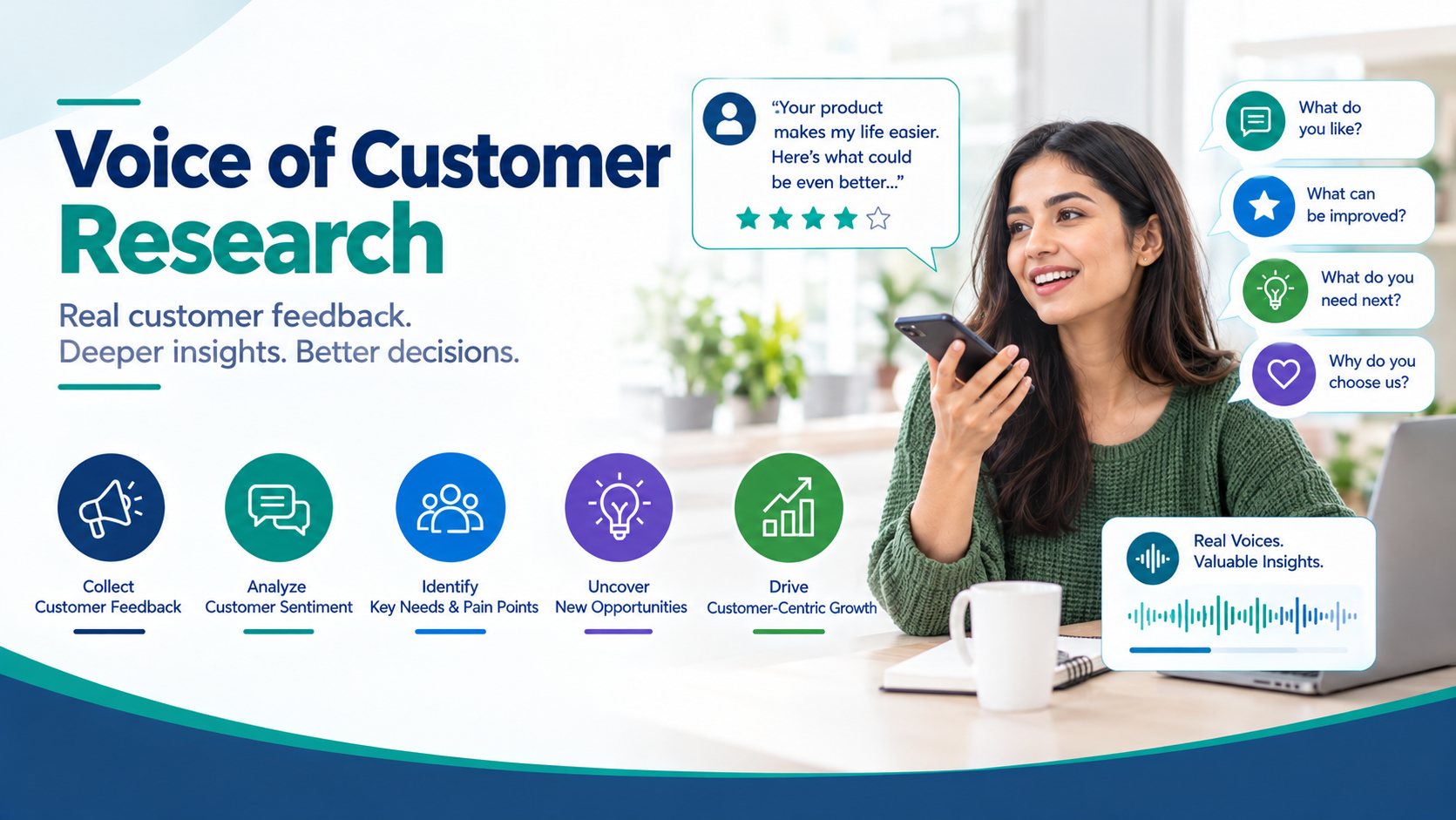
Customers influence nearly every aspect of business success, from product development and purchasing decisions to service expectations and long-term brand relationships. Yet, understanding what customers genuinely want can be challenging. Businesses may have access to sales figures, customer enquiries, and satisfaction ratings, but these sources do not always explain the reasons behind customer preferences or the problems they encounter.
Voice of Customer Research helps bridge this gap by systematically collecting and analysing customer opinions, expectations, experiences, and needs. It enables organizations to understand how customers perceive their offerings, identify unmet requirements, and recognize opportunities to improve products and services.
In competitive markets, listening to customers is not simply about collecting feedback. It involves understanding the context behind customer opinions and translating those findings into meaningful business decisions. A structured research approach can help companies evaluate existing offerings, identify customer experience gaps, and develop solutions that better reflect market expectations.
This article explores the meaning of Voice of Customer Research, its business benefits, commonly used research methods, the role of customer needs analysis, and the steps involved in developing an effective Voice of Customer Programme.
What Is Voice of Customer Research?
Voice of Customer Research is a systematic approach to understanding customer expectations, preferences, experiences, and concerns through structured feedback collection and analysis.
Often referred to as VoC Research, this approach helps businesses understand what customers value, which problems they experience, and how they evaluate products, services, and interactions with a company.
Rather than relying exclusively on internal assumptions, organizations use direct customer input to investigate the factors influencing satisfaction, purchasing decisions, product usage, and customer relationships.
For example, a software company may discover through customer interviews that users find its product valuable but struggle with the onboarding process. A follow-up survey could help determine how widely this issue affects the target customer base. Together, these findings could inform improvements to onboarding materials, product guidance, or support processes.
Voice of Customer Research can address several business questions:
-
What do customers expect from a product or service?
-
Which product features or service attributes matter most?
-
What problems do customers experience with existing solutions?
-
Why do customers prefer one offering over another?
-
Which aspects of the customer experience require improvement?
-
What unmet needs could create opportunities for innovation?
-
How do customer priorities differ across market segments?
By answering these questions, businesses can develop a more detailed understanding of customer perspectives and use that understanding to guide decisions.
Why Is Voice of Customer Research Important for Businesses?
Customer preferences, expectations, and experiences can change as markets evolve. Businesses that do not regularly investigate these changes may continue making decisions based on outdated assumptions.
Voice of Customer Research provides a structured way to understand these changes and identify areas where business offerings may need to evolve.
1. Understand Customer Expectations More Clearly
Customers evaluate products and services according to their individual needs, priorities, and experiences. These expectations may differ significantly across customer groups.
For example, one customer segment may prioritize affordability, while another may place greater importance on convenience, reliability, or personalized support.
VoC Research helps organizations identify these differences and understand which factors influence customer perceptions. This information can support decisions about product features, service delivery, communication, and customer experience improvements.
2. Identify Unmet Customer Needs
Existing products and services may not fully address the challenges customers face.
Through structured interviews, surveys, and other research methods, businesses can explore customer frustrations, identify recurring problems, and understand where existing solutions fall short.
These findings can help organizations discover opportunities for product improvements, new service features, or alternative approaches to meeting customer requirements.
3. Improve Product and Service Development
Product development becomes more focused when decisions are informed by customer needs rather than assumptions about what customers might prefer.
Voice of Customer Research can help businesses evaluate product concepts, understand feature priorities, investigate usability concerns, and assess how well existing offerings meet customer expectations.
This allows organizations to identify which improvements deserve attention and which proposed features may offer limited value to the intended audience.
4. Strengthen Customer Experience
Customer experiences are shaped by multiple interactions, including product discovery, purchasing, delivery, product usage, and customer support.
Problems at any of these stages can influence overall perceptions of a business.
Customer feedback can help identify where expectations are not being met and which interactions create unnecessary difficulties. Businesses can use these insights to investigate service gaps and develop more consistent experiences.
5. Support Better Business Decisions
Research findings can provide evidence for decisions involving product positioning, service improvements, customer communication, and market development.
For example, if customers consistently identify a particular service feature as important, the organization can investigate whether improving that feature should become a priority.
However, customer feedback should be interpreted alongside relevant business constraints, operational information, and strategic objectives. Not every customer request will be equally feasible or beneficial.
Comparing Common VoC Research Methods
| Research Method | Main Objective | Key Benefit | Important Consideration |
|---|---|---|---|
| Customer Surveys | Measure opinions and preferences | Enables structured comparisons | Requires appropriate sampling and question design |
| In-Depth Interviews | Explore motivations and experiences | Provides detailed explanations | Findings are not automatically representative |
| Focus Groups | Explore group perceptions | Encourages discussion of different viewpoints | Group dynamics can influence responses |
| Customer Feedback Research | Identify recurring customer themes | Helps uncover repeated concerns | Available feedback may be incomplete or biased |
| Customer Journey Research | Examine experiences across touchpoints | Reveals journey-level problems | Requires a clearly defined customer journey |
| Observational Research | Understand actual product or service usage | Identifies practical difficulties | Observed behaviour may vary by context |
The most effective research design is one that fits the business question. A study focused on discovering unmet needs may begin with interviews, while a study intended to measure the prevalence of known issues may require a structured survey.
Understanding Customer Needs Through Customer Needs Analysis
Customer Needs Analysis is the process of identifying and evaluating the problems, expectations, preferences, and outcomes that customers seek from products or services.
It is an important part of Voice of Customer Research because it helps businesses understand the reasons behind customer requests rather than simply recording what customers say they want.
Key Categories of Customer Needs
- Functional needs: The practical tasks or problems customers want a product or service to address.
- Emotional needs: The feelings customers seek, such as confidence, reassurance, or peace of mind.
- Service needs: Expectations concerning support, responsiveness, communication, and reliability.
- Financial needs: Requirements related to affordability, pricing, and perceived value.
- Experience needs: Preferences concerning usability, convenience, accessibility, and consistency.
These categories may overlap, and their importance varies according to the customer, product, and market.
How Customer Needs Analysis Supports Business Decisions
A structured needs analysis can help businesses:
-
Identify problems that existing products do not adequately solve.
-
Understand which product attributes customers consider important.
-
Investigate the causes of dissatisfaction.
-
Compare priorities across different customer groups.
-
Evaluate proposed product concepts.
-
Identify opportunities to improve service delivery.
-
Support product planning and strategic prioritization.
Businesses should also consider the context behind customer responses. A stated preference may not always translate into a purchasing decision, so research findings should be interpreted alongside relevant behavioural evidence and market conditions where available.
What Is a Voice of Customer Programme?
A Voice of Customer Programme is a coordinated approach to collecting, analysing, and applying customer feedback over time.
Instead of conducting isolated studies without a consistent process, a programme establishes a repeatable framework for understanding customer perspectives and using them to guide business decisions.
The scope of a programme depends on organizational needs. Some businesses may begin with a focused survey or interview study, while others may require research across multiple customer groups, markets, or customer journey stages.
Essential Elements of a Voice of Customer Programme
1. Clear Objectives
- The programme should have defined goals, such as understanding unmet needs, evaluating service quality, improving customer experiences, or informing product development.
- These objectives help determine which feedback is necessary and how the resulting insights will be used.
2. Appropriate Feedback Collection
- Organizations should identify the most suitable methods and points at which to collect feedback.
- Depending on the objectives, this may involve periodic surveys, interviews, customer experience studies, or targeted research into specific problems.
- The approach should provide useful information without placing unnecessary demands on customers.
3. Consistent Research Procedures
- Documented research methods, appropriate sampling, and data quality checks help maintain consistency.
- When measurement procedures change, those changes should be considered during comparisons across different periods or customer groups.
4. Integrated Analysis
- A programme should connect feedback from relevant research activities to identify broader patterns.
- For example, customer interviews may reveal a problem with product onboarding, while survey findings help determine how widely the issue occurs across the target audience.
- Combining these insights can provide a clearer basis for deciding which improvements deserve attention.
5. Clear Responsibility for Action
- Organizations should define who reviews the findings, who is responsible for addressing identified issues, and how progress will be assessed.
- Depending on the subject, responsibility may sit with product development, customer support, marketing, operations, or other relevant teams.
6. Ongoing Evaluation
- The programme should be reviewed periodically to determine whether it continues to address important business questions.
- Organizations can assess the relevance of the research, the quality of collected data, the usefulness of the findings, and whether the results lead to appropriate action.
Common Challenges in Voice of Customer Research
Collecting customer feedback can reveal valuable insights, but research quality depends on recognizing the limitations of the data and the methods used.
1. Unrepresentative Customer Feedback
- Customers who participate in research may differ from those who do not respond. Similarly, feedback from complaints or online reviews may disproportionately reflect particular experiences.
- Businesses should consider whether the participants represent the population relevant to the research question.
- Suitable respondent recruitment, appropriate sampling, and transparent interpretation can help reduce the risk of drawing conclusions that extend beyond the available evidence.
2. Overreliance on One Research Method
- Surveys can quantify responses but may not explain complex motivations. Interviews provide detailed perspectives but do not automatically establish how widespread a particular opinion is.
- Relying exclusively on one method may leave important questions unanswered.
- Combining methods can help organizations explore the reasons behind customer opinions and assess how common those opinions are among relevant customer groups.
3. Poorly Designed Questions
- Ambiguous or leading questions can influence responses and make findings difficult to interpret.
- Researchers should use neutral language, avoid combining multiple issues into one question, and test questionnaires or discussion guides where appropriate.
4. Difficulty Interpreting Large Volumes of Feedback
- A large collection of customer comments does not automatically produce useful insights.
- Researchers need a systematic approach to organizing feedback, identifying themes, comparing customer groups, and linking findings to business objectives.
- The analysis should distinguish between recurring evidence, isolated observations, and interpretations that require additional validation.
5. Limited Implementation of Research Findings
- Research may have little practical value if its conclusions do not influence decisions.
- Businesses should establish a process for prioritizing findings, assigning responsibilities, implementing improvements, and reviewing outcomes.
6. Privacy and Data Management
- Customer research should account for privacy, consent where applicable, data security, and relevant legal requirements.
- Organizations should collect only the information necessary for the research and communicate how responses will be used.
How Customer Insights Research Supports Strategic Planning
Customer Insights Research focuses on analysing customer information to understand preferences, motivations, behaviours, and needs that may influence business decisions.
While Voice of Customer Research provides a structured way to gather and understand customer perspectives, Customer Insights Research can place those findings within a broader context, depending on the study objectives and available information.
This helps organizations move from collecting responses to identifying patterns that are relevant to product, service, and market decisions.
Identify Customer Segments With Different Needs
- Customer groups may differ in how they evaluate products, which features they value, and what challenges they experience.
- Research can help identify these differences and support more relevant decisions about product development, service design, and communication.
- Segment-level findings should be based on an appropriate research design and sufficient evidence for the comparisons being made.
Understand Purchase Decision Factors
- Customer research can investigate the factors that influence how people evaluate alternatives and select products or services.
- These may include price, quality, convenience, perceived risk, service expectations, and the suitability of an offering for a particular need.
- Understanding these factors can help businesses evaluate their offerings from the customer's perspective.
Identify Opportunities for Improvement
- Customer feedback may reveal recurring problems, unmet needs, or expectations that existing solutions do not adequately address.
- These findings can help organizations identify areas for further investigation and prioritize potential improvements.
Support Product and Service Positioning
- Research can help businesses understand how customers perceive an offering and which attributes they consider most relevant.
- These insights can inform positioning decisions, provided they are considered alongside competitor information, market conditions, and organizational capabilities.
When Should Businesses Use Professional Voice of Customer Research Services?
Organizations may be able to manage straightforward feedback activities internally. However, studies involving complex audiences, multiple research methods, or specific fieldwork requirements may benefit from specialized support.
Voice of Customer Research Services can support organizations that need structured respondent recruitment, quantitative and qualitative fieldwork, data collection, and research quality processes.
Professional research support may be useful when:
-
The study involves several customer groups or markets.
-
The target audience is difficult to recruit.
-
Both quantitative and qualitative research are required.
-
The research needs consistent data collection procedures.
-
The organization is investigating complex customer needs.
-
Internal teams require additional fieldwork capacity.
-
Research findings will inform significant product or service decisions.
What to Evaluate When Selecting a Research Partner
- Research design: The proposed approach should match the business objectives, target population, and information requirements.
- Respondent recruitment: The provider should have an appropriate process for identifying participants who meet the study's eligibility criteria.
- Fieldwork capabilities: The provider should be able to support the required collection methods and target markets.
- Data quality: Quality checks should be appropriate to the study design and collection process.
- Analytical approach: The analysis should address the research questions and clearly distinguish findings from interpretation.
- Reporting and communication: The results should be presented clearly, with relevant context and limitations.
Choosing a suitable research partner helps businesses establish a structured approach to customer feedback and build a more reliable evidence base for their decisions.
How IMARC Pulse Supports Voice of Customer Research
IMARC Pulse specializes in primary research and global fieldwork, helping organizations connect with the people who shape their markets. Its services include respondent recruitment, quantitative and qualitative fieldwork, data collection, and research quality services across industries and global markets.
These capabilities can support Voice of Customer Research projects that require access to relevant respondents, structured fieldwork, and attention to research quality.
Depending on the research objectives, quantitative fieldwork can help organizations measure customer opinions across respondents, while qualitative fieldwork can explore customer experiences, motivations, and unmet needs in greater depth.
Conclusion
Voice of Customer Research provides businesses with a structured way to understand customer expectations, preferences, experiences, and unmet needs. By gathering and analysing customer feedback, organizations can identify recurring problems, evaluate opportunities for improvement, and develop a clearer understanding of what matters to their audiences.
An effective research approach combines clear objectives, relevant respondent recruitment, appropriate data collection methods, and reliable analysis. Surveys can help measure customer opinions, while interviews, focus groups, and observational research can reveal the motivations and experiences behind those opinions.
Frequently Asked Questions About Voice of Customer Research
1. What Is the Main Purpose of Voice of Customer Research?
The main purpose of Voice of Customer Research is to understand customer expectations, needs, preferences, and experiences through systematic feedback collection and analysis. The findings help organizations identify improvement opportunities and make decisions that better reflect customer priorities.
2. What Is the Difference Between VoC Research and Customer Feedback Research?
VoC Research is a broader approach to understanding customer perspectives and connecting them with business decisions. Customer Feedback Research focuses on collecting and analysing customer opinions, comments, and experiences. Feedback research can form an important part of a wider Voice of Customer Programme.
3. Which Methods Are Used in Voice of Customer Research?
Common methods include customer surveys, in-depth interviews, focus groups, customer feedback analysis, customer journey research, and observational studies. The most suitable method depends on whether the business needs to measure opinions, explore motivations, understand behaviour, or investigate customer experiences.
4. What Is a Voice of Customer Programme?
A Voice of Customer Programme is a structured approach to collecting, analysing, and applying customer feedback over time. It may include defined research objectives, respondent recruitment, feedback collection, analysis, action planning, and follow-up evaluation.
5. Why Is Customer Needs Analysis Important?
Customer Needs Analysis helps organizations identify the problems customers want to solve, the outcomes they expect, and the limitations of existing solutions. It can support product development, service improvement, concept evaluation, and decisions about which customer requirements deserve priority.

 English
 Arabic
 French
 Spanish
 Portuguese
 Turkish
 Dutch
 Italiano
 Russian
 Romaian
 Portuguese (Brazil)
 Greek