


Network Performance Monitoring Market to Reach US$ 5.76 Billion by 2034 at 6.21% CAGR
The Network performance monitoring (NPM) tools exist to prevent that. They collect and analyze data on traffic, latency, packet loss, bandwidth use and device health, so IT teams can find and fix problems before users notice them.
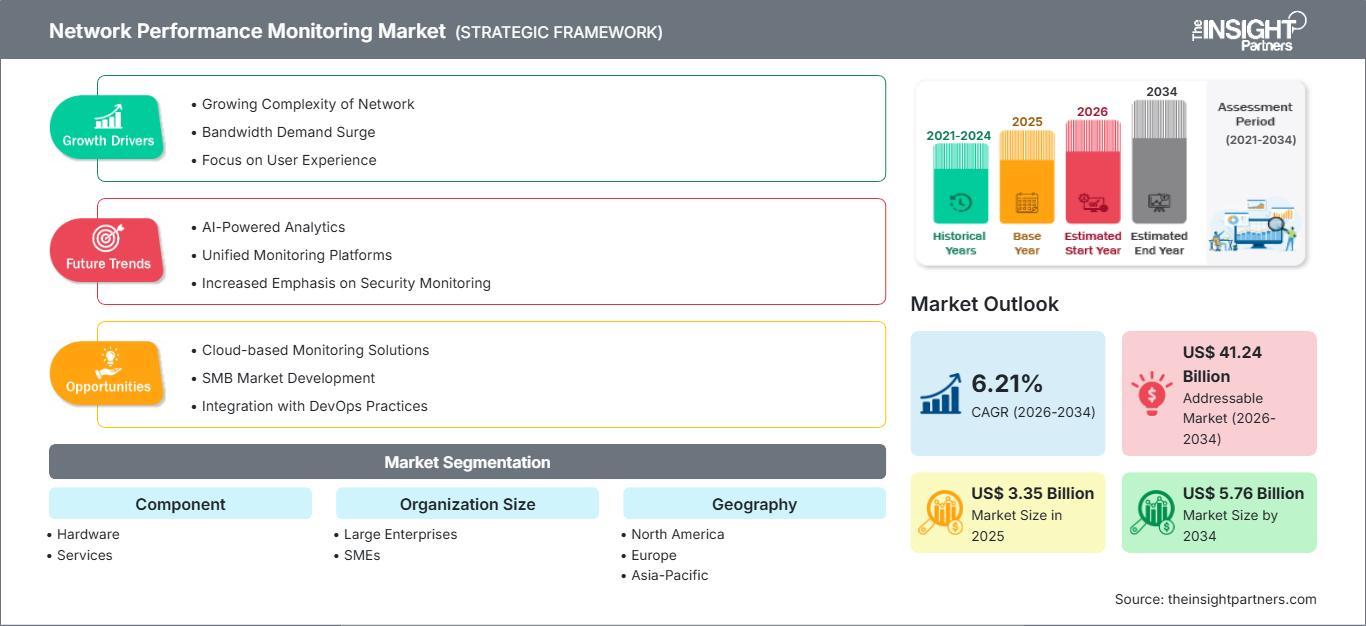
The Network Performance Monitoring market was valued at US$ 3.35 billion in 2025 and is expected to reach US$ 5.76 billion by 2034; it is estimated to record a CAGR of 6.21% during 2026-2034.
Market Overview
NPM covers the hardware, software and services that give organizations visibility into how their networks behave. Early tools mostly reported whether a device was up or down. Modern platforms go much further. They combine packet and flow analysis, performance analytics, reporting and, increasingly, automated diagnostics. Many of them also estimate the quality of the end-user experience from network-derived data.
That shift matters because the network itself has changed. Traditional on-premises setups have given way to a mix of data centers, public clouds, branch offices, remote workers and edge locations. A tool built for a single data center cannot see enough of this environment, which is why demand has moved toward scalable, flexible monitoring.
Get Sample PDF @ https://www.theinsightpartners.com/sample/TIPRE00023417
Key Growth Drivers
- Growing network complexity:- Enterprises now run hybrid and multi-cloud architectures, software-defined networking, virtualized functions and large numbers of connected devices. Each layer adds a point of failure and makes root-cause analysis harder. Teams that once traced a fault across a few switches now have to follow traffic across several environments and vendors. NPM platforms give them a unified view, and that visibility becomes more valuable as complexity grows.
- Increased bandwidth demand:- Video conferencing, streaming, cloud-based applications, large file transfers and data-hungry workloads such as analytics and AI all push traffic volumes up. The rollout of 5G and faster fixed-line connectivity raises expectations further. Higher volumes leave less room for inefficiency, so organizations need to know where congestion occurs and how to plan capacity before bottlenecks appear.
- Focus on user experience:-Employees and customers judge a service by how it feels to use, not by how the network is built. A few seconds of delay on a payment page or a choppy video call can cost money and trust. Businesses increasingly tie network metrics to experience metrics, and they want monitoring that shows the impact on real users rather than raw device statistics.
Market Segmentation
The report segments the market by component, into hardware and services, and by organization size, into large enterprises and small and medium-sized enterprises (SMEs). It also breaks the market down geographically, covering North America, Europe and Asia Pacific, with country-level analysis for markets such as the United States, Canada, Germany, France, Italy, the United Kingdom, China, India, Japan, Australia and South Korea.
- By component:- The hardware segment includes dedicated appliances, network taps and probes that capture and analyze traffic, and it remains important where high-speed, lossless packet capture is required, such as data centers and telecom networks. The services segment covers implementation, integration, managed monitoring, consulting and support. Services tend to gain ground as environments grow more complicated and in-house teams struggle to keep up. Many organizations would rather buy monitoring as a managed offering than hire scarce specialists.
- By organization size:- Large enterprises account for the heaviest spending because they operate sprawling, distributed networks with strict uptime requirements. SMEs are a growing opportunity. They face the same expectations for reliability and security but have smaller IT teams and tighter budgets. Cloud-delivered and subscription-based tools lower the barrier for them, giving smaller firms access to capabilities that once required a large investment.
Key Trends Shaping the Market
- Cloud and hybrid visibility:- As workloads move across clouds and data centers, monitoring tools need to follow them. Vendors are extending support to cloud-native environments, containers and virtual networks, and many now offer SaaS delivery models.
- AI and automation:- Machine learning is being built into NPM platforms to establish baselines, detect anomalies and predict failures. Instead of flooding administrators with alerts, these systems aim to surface the few issues that matter and sometimes suggest or trigger remediation. This reduces mean time to resolution and eases pressure on stretched IT teams.
- Convergence with observability:-The line between network monitoring, application performance monitoring and broader observability is blurring. Buyers increasingly want to correlate network data with application and infrastructure data, which pushes vendors toward integrated platforms or tighter partnerships.
- Security integration:-Network telemetry is useful for security operations. Vendors are linking performance data with threat detection so that one set of sensors serves both purposes.
- Remote and branch networks:- Distributed workforces and branch offices connected over internet-based links need monitoring that reaches beyond the corporate perimeter, including visibility into the connections and services that organizations do not own.
Challenges and Restraints
The market faces several hurdles. Cost is a common one. Advanced monitoring, especially hardware-based packet capture at very high speeds, can be expensive to deploy and maintain. Integration is another. Organizations often run tools from multiple vendors, and stitching their data into a coherent picture takes effort. Data volume is a third. Modern networks generate enormous telemetry, and storing, processing and making sense of it requires capable analytics and sufficient skills. Encrypted traffic adds a further complication, since it limits what can be inspected without decryption, and a shortage of skilled network and data professionals slows adoption in some regions.
Opportunities
Several areas offer room for growth. Managed and cloud-based NPM services can reach SMEs and organizations lacking internal expertise. Emerging markets in Asia Pacific, the Middle East and Latin America are expanding their digital infrastructure and will need monitoring as networks scale. Telecommunications operators rolling out 5G and edge computing need performance visibility across new architectures. Vertical industries such as banking, healthcare, retail, government and manufacturing all depend on reliable connectivity and have strong reasons to invest. Finally, vendors that pair monitoring with predictive analytics and security insight can differentiate themselves in a crowded field.
Regional Perspective
North America has traditionally been the largest and most mature market, supported by early adoption of cloud services, a concentration of technology vendors and heavy enterprise IT spending. Europe follows, with demand shaped by regulatory requirements and digital transformation programs in major economies. Asia Pacific is generally expected to be among the faster-growing regions, driven by rapid internet adoption, expanding data center capacity, government digitization efforts and the rise of large online businesses in countries such as China and India. The report’s country-level coverage reflects this broad geographic spread.
Competitive Landscape
- Cisco Systems, Inc.
- Juniper Networks, Inc.
- Keysight Technologies, Inc.
- LogicMonitor Inc.
- Microsoft Corporation
- Nagios Enterprises, LLC
- Niagara Networks
- Paessler AG
- Profitap HQ B.V.
- SolarWinds Worldwide, LLC
Future Outlook
The Insight Partners projects growth for the market through 2034, based on the drivers above. The underlying logic is straightforward. Networks will keep becoming more complex, traffic will keep rising, and tolerance for poor performance will keep falling. Organizations that treat monitoring as optional will struggle to keep services reliable, while those that invest in it gain faster troubleshooting, better capacity planning and stronger security.
About The Insight Partners
The Insight Partners delivers market intelligence and consulting services to help clients make informed decisions. The firm covers industries such as Aerospace and Defense, Automotive and Transportation, Semiconductor and Electronics, Biotechnology, Healthcare IT, Manufacturing, Medical Devices, Technology, Media, and Chemicals and Materials.
Contact Us:
If you have any queries about this report or if you would like further information, please contact us:
Contact Person: Ankit Mathur
E-mail: [email protected]
Phone: +1-646-491-9876
Also Available in :

 Arabic
 French
 Spanish
 Portuguese
 Deutsch
 Turkish
 Dutch
 Italiano
 Russian
 Romaian
 Portuguese (Brazil)
 Greek