


Top Benefits of Logistics Analytics for Supply Chain Optimization
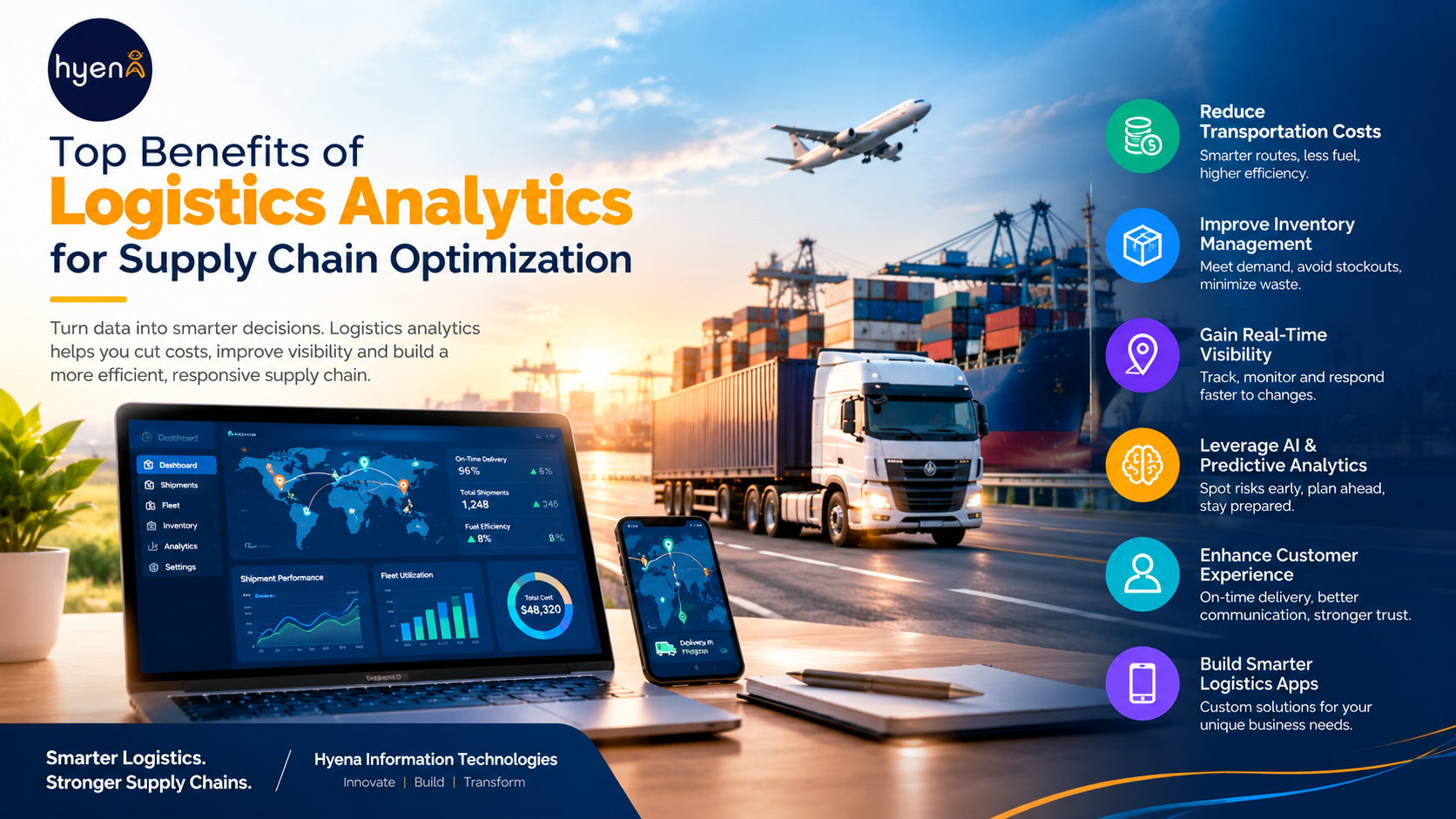
Logistics analytics plays a vital role in supply chain management by allowing companies to take advantage of their data on transportation, inventory and warehousing and delivery to make intelligent business decisions. Companies can discover opportunities to minimize fuel costs and strategize ways to enhance delivery window performance, among other advantages. The right combination of technology and a solid partnership with a reputable logistics app development company can position companies to accomplish their supply chain management goals.
What Is Logistics Analytics?
Imagine a delivery truck stuck in traffic. Now picture a situation where a warehouse runs out of stock. Last, imagine a shipment arriving too late due to poor planning. The examples listed above can occur and recur daily. However, if they happen repetitively, they can increase operational costs rapidly.
Historical and real-time data are the keys to patterns, performance and predictability in logistics analytics. A centralized system allows companies to monitor the movements of vehicles and deliveries, and helps to track the levels of inventory and the expenses associated with transportation.
Instead of waiting to address problems after they happen, companies can identify disruptions and make informed decisions to disrupt them.
1. Improving Route Planning
A critical component of keeping costs down in logistics is good route planning. Poor plans can result in unnecessary fuel consumption and increase the overall miles driven by a delivery vehicle.
Route analytics enables a delivery company to take a customer order, determine the optimal route to take to deliver the order and group nearby deliveries to eliminate unnecessary trips.
Modern Fleet Management Applications make various features available to fleet managers. These may include, but are not limited to, tools for fuel management, GPS vehicle tracking, route optimization, and driver performance evaluation.
These features allow managers to plan and optimize routes to minimize vehicle idle time, fuel waste, and unnecessary miles driven. As a result, delivery windows can be made more predictable and reliable.
2. Improve Inventory Management and Demand Forecasting
The capital tied up in inventory can be significant. But so can the consequences of having insufficient stock, such as lost sales and dissatisfied customers. Each business must find the optimal balance between the two.
With the help of historical, seasonal, and forecasted data, businesses can make informed decisions regarding inventory. Analytics can assist a business in identifying the products most likely to be in-demand during a promotional period or sale. This helps the business strategically position inventory to maximize order fulfillment and minimize stockout.
3. Achieve Real-Time Visibility of the Supply Chain
Realigning the logistics supply chain can be challenging. Real-time analytics can help improve visibility into shipments, trailers, cargo, vehicles, and deliveries.
Connected supply chain platforms increase visibility into the movement of goods. This, in turn, helps personnel better coordinate with each other and makes supply chain processes more transparent.
4. Better Decision-Making with AI and Predictive Analytics
Delays in logistics analytics are a thing of the past. AI makes analytics more proactive. Instead of merely showing past performance, models can estimate future delays in logistics, unusual consumption patterns of fuel, and potential maintenance needs.
For instance, recurring maintenance issues with vehicles can be predicted and addressed with an inspection before a breakdown occurs. Although predicting these issues does not eliminate the possibility of a breakdown, it can be an early warning.
There is a wide range of capabilities with AI. Businesses can develop their logistics apps with features of predictive analytics and intelligent alerts. The key is identifying a clear operational issue.
5. Better Customer Experience and Delivery Performance
Predictive analytics can be used to track customer orders, deliveries, and the number of complaints. It can estimate the average fulfillment time.
If multiple deliveries to a particular region are estimated to miss their projected arrival times, managers can review and adjust the scheduling of the deliveries and/or staffing.
These small improvements lead to better experiences for both customers and employees.
6. Logistics App Tailored to Your Business
While general purpose apps work for basic functions, growing businesses need solutions specifically designed to meet the needs of their operations.
To design a successful Logistics app, developers need to understand the day to day challenges their target users face. Some features a good logistics app might have include GPS tracking, digital assignments of drivers, proof of delivery, integrated inventory, analytics, and automatic notifications.
As logistics apps simplify processes, save time and improve speed and accuracy of work, businesses should assess the cost of logistics app development which is determined by the complexity of features, the level of security, the platform and framework used, and the level of integration. Building an app for both Android and iOS requires additional testing.
Working with a Logistics App Development Company like Hyena Information Technologies enables businesses to gain a competitive edge through superior logistics solutions. With integrated systems and the right partner, businesses can prioritize and develop features that add value to their business.
Why Hyena Information Technologies?
As a leading Logistics Digitalization Partner, we partner with our clients to identify viable technologies to improve their logistics operations. Working with the right partner, businesses can gain insights on how to integrate practical features and design scalable architecture in their applications to address current and future needs of their customers.
Start small by addressing one measurable challenge and scale the solution based on the results. Some challenges may include high levels of inventory and/or delivery delays.
Logistics Analytics help businesses understand risks and performance of their supply chains and so help make informed decisions.
Book an executive AI briefing to explore AI use cases for your business.

 English
 Arabic
 French
 Spanish
 Portuguese
 Deutsch
 Turkish
 Dutch
 Italiano
 Russian
 Romaian
 Portuguese (Brazil)