


The Requested REST Limit Is Not a Completion Signal
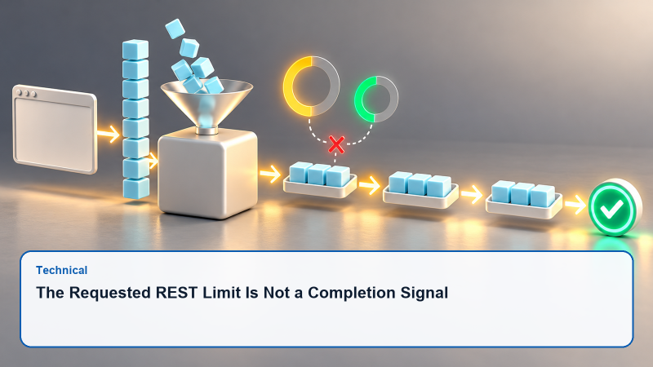
An awareness-first exercise in oracle fusion cloud technical training should challenge a common integration assumption: the number requested by a client does not prove how many records the service will return, and the size of one response does not prove that a collection is complete. A client may ask for a large page while the service applies a smaller effective limit. If the integration stops whenever the returned count is below the requested value, it can abandon valid records after the first call. Reliable extraction treats pagination metadata and stable ordering as part of the response contract, not as optional performance details.
Consider a nightly worker-reference sync that requests 5,000 rows. The service returns 500 items because that is the permitted page size, reports that more rows exist, and provides the information needed to continue. A simplistic loop compares 500 with 5,000, declares the collection finished, and publishes a clean success message. Nothing crashes, authentication works, and the payload is valid, yet most records never reach the downstream system. The dangerous feature of this defect is its quietness: a partial extract can look technically healthy unless the design reconciles continuation state and business counts.
Separate request preference from response fact
The limit parameter expresses how many resources the client would like in a collection response. It should be treated as a request preference bounded by service behavior, not as a promise. The response count describes the items actually present in that page. The offset identifies the starting position used for an offset-based request, while the continuation indicator reports whether another page remains. These values answer different questions. Good client code records the requested limit, observed limit, offset, count, and continuation state for each page so support teams can distinguish service capping from data loss or malformed parsing.
Let continuation state control the loop
A collection loop should continue according to the service's documented continuation signal. Supported HTTP Methods describes collection parameters such as limit, offset, totalResults, ordering, finders, and links, and illustrates response metadata including count and hasMore. A practical loop submits the first request, processes every returned item, checks the continuation value, and advances using the effective page behavior. It stops only when the response says no additional page remains or when a documented terminal condition is reached. It should not infer completion from a short page, a full page, an expected total, or the absence of a client-side error.
Make ordering part of the extraction contract
Offset pagination also needs deterministic ordering. Without an explicit, supported order, records inserted or updated during extraction can shift positions between calls. One item may move behind an offset and appear twice; another may move ahead and never appear. Choose an order that is stable for the extraction window and includes a unique tie-breaker when the primary field can repeat. If the resource does not support a suitable order, reduce the consistency window, extract during controlled activity, or use a supported change-oriented mechanism. Pagination logic cannot manufacture snapshot semantics that the endpoint does not provide.
Keep filters identical across pages
Every page in one logical run must use the same finder or query expression, field selection, expansion choices, and relevant headers. Rebuilding the request from mutable configuration between iterations can turn page two into a different result set. Persist a normalized request fingerprint before starting, excluding only the changing continuation component. Compare that fingerprint on every call and fail safely if business filters drift. When date boundaries are used, resolve them once for the run rather than recalculating a moving current time. This prevents a long extraction from continuously extending its own scope.
Design retries around page commits
A timeout creates uncertainty about the response, not necessarily about server processing, although collection retrieval is normally read-only. The client should retry the same logical page with the same filters and ordering, then make downstream handling idempotent. Commit page output and its checkpoint together. If records are written but the checkpoint is not, a retry may repeat them; if the checkpoint advances before records are durable, a restart may skip them. A staging table keyed by the resource identity and run identifier can absorb repeats while retaining evidence of which page observed each record.
Reconcile completeness without making totals mandatory
Requesting a total can help estimate progress and support reconciliation, but it may add cost and may represent the collection at a different moment from later pages. Treat it as evidence, not as the loop controller. Record page counts, unique resource identities, duplicate observations, first and last ordering values, and the terminal continuation state. Compare the extracted population with an independent business expectation when one exists. Large unexplained changes should trigger review rather than an automatic declaration that pagination failed; legitimate business events can alter volume. The objective is an explainable completion decision supported by technical and business evidence.
Test the boundaries that happy paths miss
Useful tests include a service cap below the requested limit, an exact multiple of the effective page size, an empty collection, one remaining record, repeated ordering values, a transient failure after data is staged, and a record change during extraction. Add a run in which the service changes its effective cap between calls, because robust continuation logic should survive that adjustment without reinterpreting completion. Verify that the client follows continuation metadata, preserves request identity, and neither skips nor duplicates durable results after restart. Also test malformed or missing pagination metadata. The integration should stop as unresolved and retain its checkpoint rather than guessing that the collection ended. A successful test proves more when it covers quiet truncation than when it merely downloads one convenient page.
Conclusion
Pagination is a data-completeness control, not a cosmetic way to divide a large response. Distinguish the requested limit from the effective response, let documented continuation state govern progress, hold filters and ordering stable, and commit each page with its checkpoint. Reconcile unique identities and terminal evidence instead of trusting a success status or one plausible row count. These habits turn a collection loop into an auditable extraction process and make quiet truncation easier to detect before incomplete data reaches reporting or operations. A lab for oracle fusion hcm technical training can demonstrate the risk by applying a server-side cap below the requested page size and requiring the client to retrieve every continuation page.

 English
 Arabic
 French
 Spanish
 Portuguese
 Deutsch
 Turkish
 Dutch
 Russian
 Romaian
 Portuguese (Brazil)
 Greek