


Stone Paper Manufacturing Plant Cost 2026: Business Plan, DPR and Project Evaluation
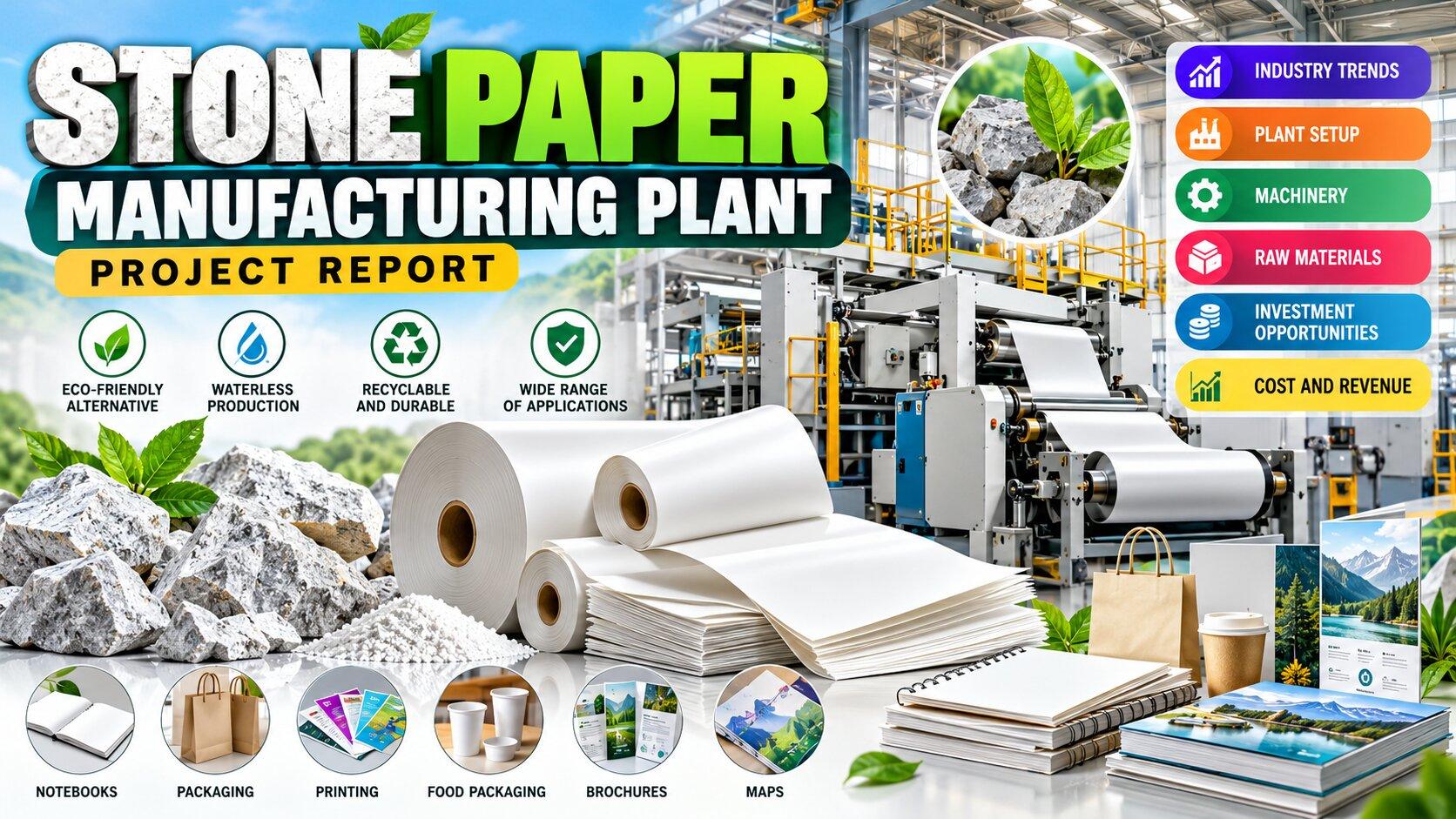
IMARC Group’s “Stone Paper Manufacturing Plant Project Report” provides a comprehensive roadmap for establishing a stone paper manufacturing unit, including detailed insights into stone paper manufacturing plant cost, machinery requirements, raw materials, production processes, utilities, infrastructure, manpower, packaging, and transportation. The report also explores industry trends, market opportunities, and investment considerations across packaging, printing, publishing, labelling, stationery, and consumer goods applications, helping investors evaluate project feasibility and plan manufacturing operations effectively.
The report also provides a detailed feasibility study and project economics, including capital investment, project funding, operating expenses, income and expenditure projections, fixed and variable costs, direct and indirect expenses, return on investment (ROI), net present value (NPV), profit and loss projections, and financial analysis. These insights help investors evaluate the commercial viability of the project and develop a structured business plan.
What is Stone Paper?
Stone paper is an innovative, tree-free paper alternative made primarily from calcium carbonate obtained from limestone and a resin binder, commonly high-density polyethylene (HDPE). It offers several functional benefits, including water resistance, tear resistance, durability, and a smooth texture. These properties make it suitable for a wide range of applications, including printing, packaging, labels, notebooks, and stationery products that require enhanced resistance to moisture and everyday wear.
Market Trends and Drivers of the Stone Paper Industry:
The stone paper industry is attracting growing interest as manufacturers and businesses seek alternatives to traditional wood-pulp paper. Increasing demand for sustainable packaging materials, premium printing solutions, waterproof labels, and long-lasting stationery is creating new opportunities for industry participants. Technological advancements in mineral compounding, extrusion, calendaring, and surface finishing are further improving product quality and manufacturing efficiency. Additionally, the expansion of e-commerce packaging and rising corporate sustainability initiatives are supporting industry development. However, manufacturers must carefully assess production expenses, resin availability, recycling compatibility, and application-specific performance requirements to establish commercially viable operations.
Stone Paper Manufacturing Process:
The manufacturing process generally involves the following stages:
- Calcium Carbonate Preparation: Limestone-derived calcium carbonate is sourced, inspected, and ground to achieve the required particle size and consistency.
- Raw Material Blending: Calcium carbonate is blended with HDPE resin and suitable additives to achieve the desired composition and material properties.
- Compounding: The mixture is processed under controlled conditions to ensure uniform dispersion of the mineral filler and polymer binder.
- Pelletizing: The compounded material may be converted into pellets for consistent feeding into the sheet-forming equipment.
- Extrusion: The prepared material is heated and processed through an extrusion system to form a continuous sheet.
- Calendaring and Sheet Formation: The material passes through rollers to achieve the required thickness, surface finish, and dimensional consistency.
- Surface Treatment: Appropriate surface treatment or coating is applied when required to improve printability and other product characteristics.
- Winding and Cutting: The finished sheet is wound into rolls or cut into specified sizes.
- Quality Control and Packaging: Products are inspected for thickness, surface quality, strength, and other specifications before packaging and dispatch.
The precise production configuration depends on the product grade, sheet thickness, machinery design, and intended application.
Key Investment Highlights:
- Process Used: Calcium carbonate grinding, raw material blending, compounding, extrusion, calendaring, surface treatment, and sheet winding.
- End-use Industries: Packaging, printing and publishing, stationery, labelling, advertising, food and beverage packaging, and consumer goods.
- Applications: Notebooks, books, maps, labels, shopping bags, packaging materials, wallpapers, and waterproof printing media.
- Market Outlook: Growing interest in alternative paper materials and durable packaging applications supports opportunities for specialized stone paper production.
Request For a Sample Report: https://www.imarcgroup.com/stone-paper-manufacturing-plant-project-report/requestsample
Stone Paper Plant Capacity:
The proposed manufacturing facility in the report has an annual production capacity ranging from 5,000 to 15,000 metric tons. The appropriate capacity depends on the target market, product specifications, machinery configuration, raw material availability, and planned level of automation.
Stone Paper Plant Profit Margins:
According to the project report, the proposed facility demonstrates the following indicative margins under its stated operating assumptions:
- Gross Profit Margin: 28–38%
- Net Profit Margin: 12–20%
Actual profitability depends on raw material prices, resin consumption, production efficiency, capacity utilization, product mix, selling prices, and operating expenses. These figures should be assessed against the assumptions in the detailed financial model.
Stone Paper Plant Cost Analysis:
The principal operating expenses of a stone paper manufacturing plant include calcium carbonate, HDPE resin, utilities, packaging, transportation, labor, and maintenance. The report identifies the following indicative cost structure:
- Raw Materials: 50–58% of operating expenditure
- Utilities: 14–18% of operating expenditure
Capital expenditure also depends on land, site development, civil works, machinery procurement, installation, plant layout, and the required level of automation. Reliable sourcing arrangements and efficient material handling can help manufacturers manage production costs.
Major Applications:
- Packaging: Shopping bags, food packaging, labels, wrapping materials, and premium packaging solutions.
- Printing and Publishing: Notebooks, books, maps, brochures, posters, magazines, and calendars.
- Stationery: Writing materials, business cards, envelopes, folders, and office supplies.
- Industrial and Commercial: Waterproof tags, labels, banners, technical manuals, and durable documentation.
- Advertising and Promotional Materials: Printed materials requiring durability and resistance to moisture.
Why Invest in Stone Paper Manufacturing?
Stone paper manufacturing offers opportunities for businesses seeking to serve specialized packaging, printing, and stationery markets. Its mineral-based composition and water-resistant characteristics can differentiate it from conventional paper in selected applications. Manufacturers can explore customized sheet thicknesses, roll formats, labels, bags, and specialty printing materials. However, investment decisions should consider the cost of HDPE resin, machinery requirements, product acceptance, recycling infrastructure, environmental claims, and competition from conventional and alternative materials. A detailed feasibility study helps evaluate these factors before committing capital.
Key Aspects to Setup a Stone Paper Manufacturing Plant:
- Location Selection and Site Assessment
- Market Research and Demand Analysis
- Plant Layout and Production Planning
- Construction and Infrastructure Development
- Machinery and Technology Procurement
- Raw Material Sourcing and Supplier Development
- Quality Assurance and Testing Systems
- Documentation and Regulatory Compliance
- Packaging and Distribution Planning
- Feasibility Study and Financial Planning
Requirements to Setup a Facility:
- Funds: Capital for land, construction, machinery, installation, and working capital.
- Machinery: Calcium carbonate grinding mills, mixers, compounding units, twin-screw extruders, calendaring machines, surface treatment systems, winding machines, cutting units, and packaging equipment.
- Land: Adequate space for raw material storage, production, quality control, finished goods storage, utilities, and transportation access.
- Raw Materials: Calcium carbonate, HDPE resin, and suitable additives.
- Skilled Manpower: Production operators, process engineers, maintenance technicians, quality-control personnel, and administrative staff.
- Utilities: Reliable electricity and other utilities required by the selected machinery and process configuration.
- Quality Testing Infrastructure: Equipment for assessing thickness, surface finish, dimensional accuracy, strength, and printability.
- Environmental and Safety Systems: Appropriate ventilation, dust management, material-handling procedures, and compliance with applicable environmental and workplace requirements.
Types of Costs to Setup a Factory:
- Land, Location and Site Development Cost
- Plant Layout and Engineering Cost
- Machinery Procurement and Installation Costs
- Raw Material Requirements and Procurement Costs
- Packaging Requirements and Costs
- Transportation and Logistics Costs
- Utility Requirements and Costs
- Human Resource Requirements and Costs
- Quality Control and Testing Costs
- Maintenance and Compliance Costs
- Working Capital and Inventory Costs
Project Economics:
- Capital Investments: Land, site development, civil works, machinery, installation, and other capital expenditure.
- Operating Costs: Calcium carbonate, HDPE resin, additives, utilities, labor, packaging, transportation, and maintenance.
- Expenditure Projections: Forecasts of capital and operating expenditure over the project period.
- Revenue Projections: Estimated sales based on manufacturing capacity, utilization, product mix, and selling prices.
- Taxation and Depreciation: Assessment of applicable tax obligations and depreciation expenses.
- Profit Projections: Forecast gross profit, net profit, and operating performance.
- Financial Analysis: ROI, NPV, payback period, liquidity, profitability, and sensitivity analysis.
Key Questions Answered in the Report:
- How has the global stone paper market performed, and what are its future prospects?
- What are the major market segments and regional opportunities?
- What are the capital costs involved in setting up a stone paper manufacturing plant?
- What are the expected operating costs?
- Which raw materials are required for production?
- What machinery and technology are needed?
- What should the pricing mechanism for the finished product be?
- What are the projected income, expenditure, and profit margins?
- What is the expected break-even period?
- What are the key success factors and operational risks?
- Which regulatory procedures and certifications may be required?
- How can the project be customized according to location and production capacity?
Key Features:
- Customization Scope: The report can be customized according to customer requirements.
- Post-Sale Analyst Support: 10–12 weeks.
- Report Delivery Format: PDF and Excel through email.
- Editable Format: PPT or Word versions may be available on special request.
Ask Analyst for Customized Report: https://www.imarcgroup.com/request?type=report&id=23709&flag=C
How IMARC Can Help?
IMARC Group provides market research, feasibility studies, project reports, and techno-economic analysis to support investment decisions. Its services cover market assessment, plant location analysis, manufacturing processes, machinery and raw material requirements, project cost estimation, financial projections, and risk analysis. These insights can help businesses develop a structured business plan and assess the commercial viability of a stone paper manufacturing venture.
Services:
- Plant Setup
- Factory Auditing
- Regulatory Approvals and Licensing
- Company Incorporation
- Incubation Services
- Recruitment Services
- Marketing and Sales
Contact Us:
IMARC Group
134 N 4th St. Brooklyn, NY 11249, USA
Email: [email protected]
Tel No:(D) +91 120 433 0800
United States: +1–201971–6302

 English
 Arabic
 French
 Spanish
 Portuguese
 Deutsch
 Turkish
 Italiano
 Russian
 Romaian
 Portuguese (Brazil)
 Greek