


When Should You Replace a Hydraulic Variable Vane Pump?
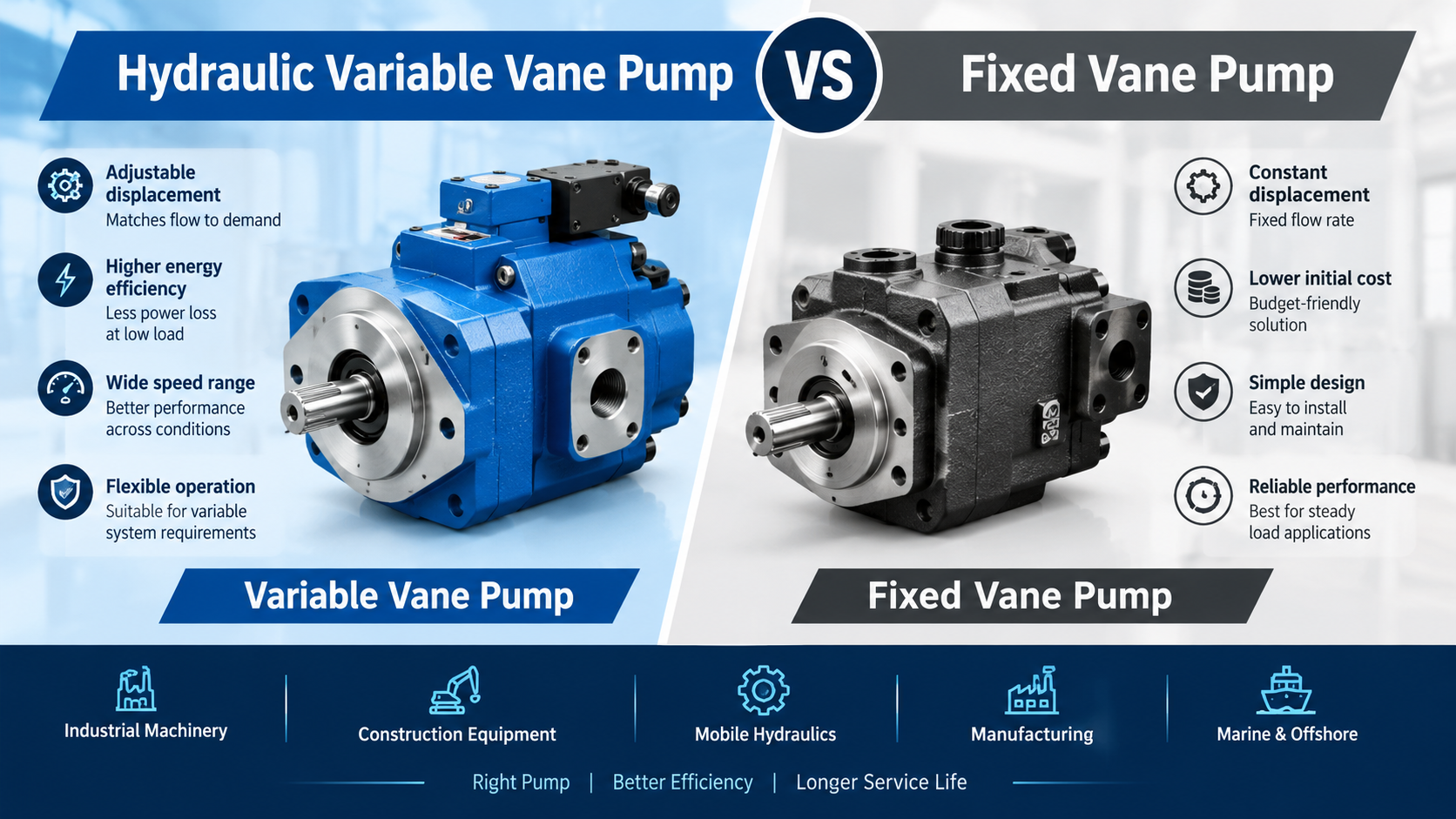
A hydraulic system that takes longer to build pressure, produces inconsistent movement, or overheats repeatedly can create costly production delays. Before ordering a replacement Hydraulic Variable Vane Pump, buyers should determine whether the pump has actually deteriorated or whether contamination, incorrect settings, oil problems, or another component is responsible.
Replacing a pump too early wastes procurement budget; replacing it too late can increase downtime and damage connected components. A structured inspection helps maintenance teams make the decision using operating evidence rather than guesswork.
Specifications to Check Before Replacing a Hydraulic Variable Vane Pump
Start by comparing actual operating conditions with the original pump requirements.
-
Flow and pressure: Check whether the pump meets the machine's required flow and pressure under the specified operating conditions. Reduced output alone does not prove pump failure.
-
Displacement and control mechanism: Confirm the pump's displacement range and control arrangement match the existing system. A replacement with incompatible controls may not respond correctly.
-
Drive and mounting: Verify shaft configuration, rotation direction, mounting dimensions, and coupling compatibility against the manufacturer's documentation.
-
Oil condition: Inspect fluid cleanliness, viscosity suitability, aeration, and signs of overheating. Contaminated oil can damage a replacement pump as well as the existing unit.
-
Operating history: Record noise, temperature changes, pressure fluctuations, and maintenance findings before approving a purchase.
One commonly overlooked detail is the original control setting. A variable vane pump may reduce output intentionally as demand changes, so low flow at one operating point does not automatically indicate wear.
Criteria for Evaluating a Replacement Pump Supplier
When sourcing a Hydraulic Variable Vane Pump, buyers should evaluate technical compatibility before comparing quotations.
1. Specification matching
Check: Request confirmation of the required model, displacement, pressure rating, rotation, mounting, and control configuration.
Why it matters: A dimensional or control mismatch can delay installation.
Warning sign: A supplier recommends an alternative without reviewing the existing pump details.
2. Documentation and traceability
Check: Ask for applicable datasheets, model identification, and available batch or product traceability records.
Why it matters: Purchasing needs evidence that the supplied item matches the approved specification.
Warning sign: The quotation uses a broad product description without identifying the actual configuration.
3. Sample or drawing approval
Check: For a new supplier or alternative model, establish whether drawings, samples, or technical confirmation are available before bulk purchasing.
Why it matters: Early approval can reveal mounting and interface differences before dispatch.
Warning sign: The supplier expects the buyer to resolve compatibility after delivery.
Benefits of Replacing a Worn Pump at the Right Time
Replacing a pump after confirming its condition can offer several practical advantages.
-
Fewer unplanned stoppages: Addressing verified pump deterioration before complete failure can reduce the risk of production interruptions.
-
Better pressure and flow control: A correctly specified replacement can restore expected operating performance when internal wear is the confirmed cause.
-
Lower risk to connected equipment: Timely action may prevent a deteriorating pump from contributing to further system problems.
-
More predictable maintenance budgets: Planned replacement allows procurement to compare quotations and arrange freight instead of relying on emergency purchasing.
-
Improved quality control: Reviewing the replacement model, documentation, and incoming condition reduces the risk of installing an unsuitable component.
-
Clearer maintenance records: Recording the failure symptoms and corrective action helps teams identify recurring problems and assess future replacement decisions.
There is a trade-off: a new pump cannot correct a blocked suction line, faulty control valve, or unsuitable hydraulic fluid. Diagnose the underlying cause before committing the budget.
Availability and Replacement Planning in India
For Indian industrial buyers, the sourcing decision should account for the machine's location, supplier location, dispatch arrangements, and transport time. A nearby supplier may simplify communication and freight coordination, but proximity alone does not prove technical suitability or stock availability.
Plan the replacement around the machine's maintenance window. Confirm the dispatch estimate in writing, clarify packaging requirements, and check whether the pump needs protective caps or other measures to prevent contamination during transit.
Buyers should also avoid approving a shipment based only on a product photograph. Verify the model identification and agreed configuration before dispatch, then inspect the received item for transit damage and mismatched connections.
About N.T Associates
We are N.T Associates, based at Plot No. 1, Shop No. 1, Bonjha, Patel Marg, Ghaziabad, Uttar Pradesh, India. Our website lists Hydraulic Variable Vane Pump products alongside other hydraulic components, including hydraulic power packs, motors, and valves.
We encourage buyers to establish their operating requirements and confirm technical compatibility before finalising a replacement order.
Request a Replacement Pump Quote
We invite industrial buyers to share the information needed to assess their requirements. Send us the existing pump model, required quantity, flow and pressure requirements, mounting dimensions, application details, target market, packaging requirements, and delivery location.
If an alternative model is under consideration, include available drawings or photographs of the nameplate and connections. We can then review the enquiry details and clarify which specifications require confirmation before ordering.
Contact us at +91-76786-03764 or [email protected].
Conclusion
A Hydraulic Variable Vane Pump should be replaced when inspection and operating measurements indicate deterioration that cannot be addressed through appropriate maintenance or repair. Confirm the root cause, verify the replacement specifications, and evaluate the documentation provided by Hydraulic Variable Vane Pump Manufacturers before issuing a purchase order. For industrial buyers, disciplined sourcing can reduce avoidable downtime and the cost of receiving an incompatible component.
Frequently Asked Questions
1. What are the common signs that a Hydraulic Variable Vane Pump needs replacement?
Persistent flow loss, abnormal noise, overheating, and unstable pressure may indicate wear. Confirm the cause through system checks before replacing the pump.
2. Can a variable vane pump be repaired instead of replaced?
Yes, depending on the damage, model, spare-part availability, and repair cost. Compare the repair estimate and expected reliability with the cost of a compatible replacement.
3. Does low hydraulic pressure always mean pump failure?
No. Incorrect settings, leakage, suction restrictions, and control-valve problems can also cause low pressure. Diagnose the circuit before ordering a new pump.
4. How do I select a replacement Hydraulic Variable Vane Pump?
Match the original model or verify flow, pressure, displacement, rotation, mounting, and control requirements against technical documentation.
5. What should buyers check before approving a bulk order?
Confirm the approved model, MOQ, lead time, inspection requirements, packaging, documentation, and delivery terms. Sampling or drawing approval may reduce specification risks, although it can add time before production or dispatch.

 English
 Arabic
 French
 Spanish
 Portuguese
 Deutsch
 Turkish
 Dutch
 Italiano
 Russian
 Romaian
 Greek