


MNRE Compliance for Solar Components: A Guide for Manufacturers and Importers
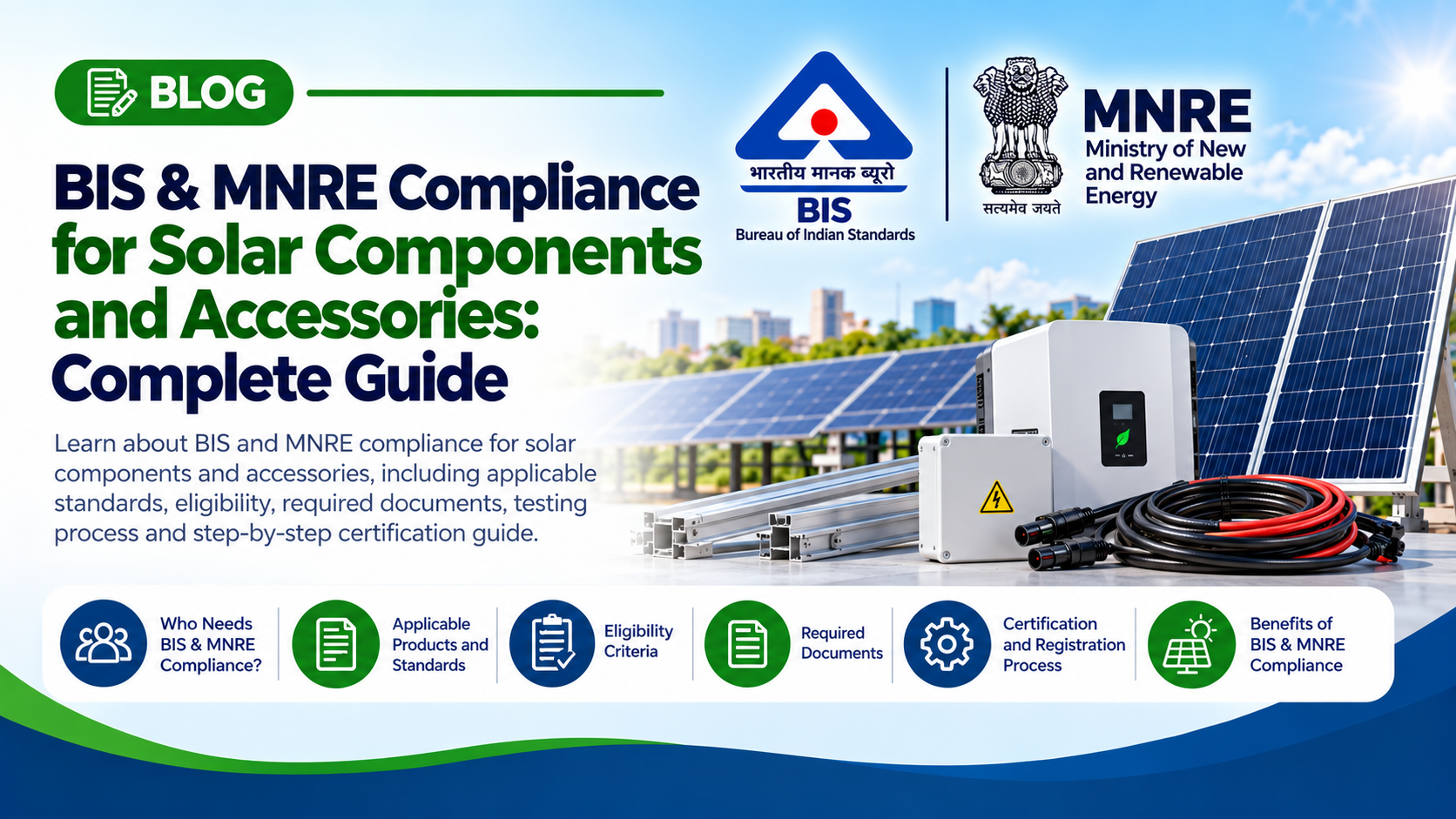
India's solar energy sector is growing rapidly, creating new opportunities for manufacturers, importers, suppliers, and distributors of solar equipment. However, businesses entering this market must understand the applicable product quality standards and regulatory requirements. BIS Certification for Solar Components and compliance with relevant Ministry of New and Renewable Energy (MNRE) requirements can be important for ensuring product conformity and meeting applicable market-access conditions.
The requirements depend on the type of solar product, its intended application, the relevant Indian Standard, and the applicable government orders or schemes. Businesses should verify the current requirements before manufacturing, importing, or selling solar products in India.
What Is BIS Certification for Solar Components?
The Bureau of Indian Standards (BIS) is India's national standards body, responsible for developing Indian Standards and operating product certification schemes. BIS Certification for Solar Components helps establish that products covered by applicable certification requirements conform to the relevant Indian Standard.
Solar products may include photovoltaic (PV) modules, inverters, batteries, and other electrical components. However, not every solar component automatically requires the same BIS certification. Applicability depends on the specific product category, the relevant Quality Control Order (QCO), and any applicable compulsory registration or licensing scheme.
For example, certain photovoltaic modules and other solar-related products may be covered by specific standards or government notifications. Manufacturers and importers should identify the applicable Indian Standard, testing requirements, and certification route before proceeding.
Obtaining the appropriate approval can support product quality assurance, regulatory compliance, and customer confidence. Businesses must also ensure that certification details and product markings are used only as permitted under the applicable scheme.
Understanding MNRE Compliance for Solar Components
The Ministry of New and Renewable Energy (MNRE) is responsible for promoting renewable energy development in India, including solar power. It issues policies, guidelines, and requirements that may apply to solar equipment used in particular projects, programmes, or government-supported installations.
MNRE Compliance for Solar Components may involve checking whether products meet applicable technical specifications, quality requirements, approved-list conditions, or scheme-specific eligibility criteria.
For example, solar photovoltaic modules used in certain government programmes or projects may need to satisfy the applicable Approved List of Models and Manufacturers (ALMM) requirements, where relevant. ALMM applicability is distinct from BIS certification, and the two should not be treated as interchangeable approvals.
Manufacturers and suppliers should review the latest MNRE notifications, project tender conditions, and relevant technical requirements to determine which obligations apply to their products.
Maintaining accurate product specifications, test reports, manufacturing details, and supporting documents can help businesses demonstrate compliance when required.
BIS & MNRE Compliance for Solar Components and Accessories
BIS & MNRE Compliance for Solar Components and Accessories involves identifying and meeting the regulatory requirements applicable to each product and its intended use. These requirements can differ for solar modules, photovoltaic inverters, storage batteries, and other accessories.
On 29 January 2025, MNRE announced the Solar Systems, Devices and Components Goods Order, 2025, revising the earlier compulsory registration framework. The order covers solar PV modules, inverters used in solar PV applications, and storage batteries. Businesses should check the applicable provisions, amendments, implementation dates, and product-specific requirements before applying.
A practical compliance process generally includes the following steps:
-
Product identification: Confirm the product category, model, specifications, and intended use.
-
Standard verification: Identify the applicable Indian Standard and the relevant QCO or certification scheme.
-
Product testing: Arrange testing through an appropriate laboratory as required by the applicable scheme.
-
Documentation: Prepare technical specifications, manufacturer details, test reports, and supporting documents.
-
Application and approval: Follow the prescribed BIS registration or licensing procedure, as applicable.
-
MNRE requirement review: Verify ALMM eligibility, project-specific conditions, or other relevant MNRE requirements.
Not every accessory requires separate BIS certification, and an approval for one product should not be assumed to cover another product or model.
BIS Certification for Solar Products: Key Requirements
BIS Certification for Solar Products is an important consideration for manufacturers and importers seeking to supply regulated solar equipment in India. The certification route depends on the product and the applicable regulatory notification.
For example, photovoltaic modules may be subject to relevant module standards, while solar inverters and storage batteries have their own applicable technical and safety requirements. The correct standards and conformity route must be confirmed against the current BIS and government notifications.
Businesses should also maintain consistency between the product submitted for testing and the product intended for sale. Changes in model specifications, manufacturing arrangements, or product design may require a review of existing approvals under the applicable scheme.
Importers should verify the certification status of the actual manufacturer and product rather than relying only on supplier claims. Proper documentation can help reduce compliance delays and support smoother procurement and distribution.
Understanding MNRE Solar Compliance and ALMM
MNRE Solar Compliance may involve additional conditions beyond product certification, particularly when solar modules are intended for government-supported projects, specified government schemes, open-access projects, or net-metering installations.
The Approved List of Models and Manufacturers (ALMM) is an important part of this framework. MNRE publishes relevant lists and updates, and the applicability of ALMM requirements depends on the project category and current orders. Certain projects must use eligible models and manufacturers listed under the applicable provisions.
Manufacturers should therefore distinguish between BIS conformity requirements and ALMM enlistment. A BIS certificate alone does not automatically establish ALMM eligibility. Likewise, ALMM listing should not be treated as a substitute for any separately applicable mandatory certification.
Before supplying solar modules for a particular project, businesses should check the latest official lists, relevant amendments, tender conditions, and applicable exemptions.
Benefits of Proper Solar Compliance
Meeting applicable certification and regulatory requirements offers several practical advantages:
-
Regulatory readiness: Helps businesses identify mandatory obligations before entering the market.
-
Product quality assurance: Supports conformity with applicable technical and safety standards.
-
Buyer confidence: Provides customers with documented evidence of relevant approvals.
-
Procurement efficiency: Helps project developers and distributors verify product eligibility.
-
Reduced compliance risks: Can minimise delays caused by missing documents or incorrect certification assumptions.
These benefits depend on maintaining valid approvals and meeting the requirements applicable to the specific product and project.
How a BIS and MNRE Compliance Consultant Can Help
A professional compliance consultant can assist manufacturers, importers, and suppliers with identifying applicable standards, reviewing documentation, coordinating product testing, preparing applications, and understanding relevant MNRE requirements.
Consultants can also help businesses determine whether ALMM conditions apply to their intended projects and track relevant regulatory updates. However, certification and enlistment decisions remain with the competent authorities, and no consultant can guarantee approval.
Conclusion
Understanding BIS & MNRE Compliance for Solar Components and Accessories is essential for businesses seeking to manufacture, import, or supply solar equipment in India. The correct approach is to assess each product individually, verify the latest applicable standards and government orders, and distinguish BIS certification from MNRE-specific requirements such as ALMM.
With accurate documentation, appropriate testing, and timely regulatory checks, businesses can improve compliance readiness and serve India's growing solar energy market more confidently.

 English
 Arabic
 French
 Spanish
 Portuguese
 Deutsch
 Turkish
 Dutch
Dutch
 Russian
 Romaian
 Portuguese (Brazil)
 Greek
Greek