


When Does a Robotics Company Need a Non-Infringement Opinion? A Robotics Patent Attorney Explains
Key Takeaways
-
A non-infringement opinion is a written legal analysis from a patent attorney concluding whether a specific product infringes a specific patent.
-
It comes up in two situations: defensively, after a cease-and-desist letter, or offensively, when a patent holder wants to confirm a case exists before asserting its patent against a competitor.
-
It is different from a freedom-to-operate (FTO) search. FTO is preventive and happens during development. A non-infringement opinion is reactive and tied to one specific dispute.
-
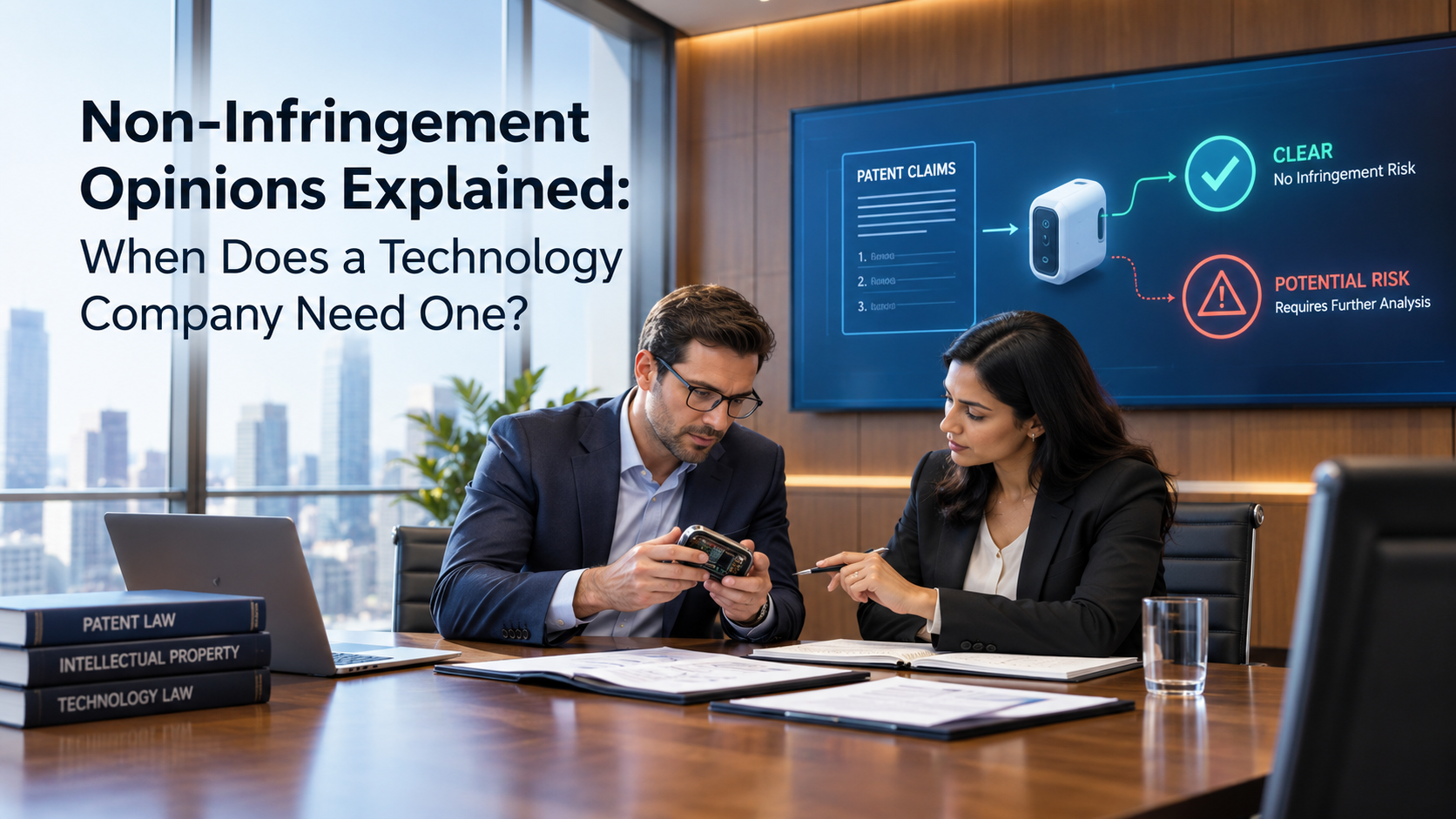
The core work is a claim chart that maps the product’s actual features against each element of the patent’s claims, starting with the independent claims.
-
Its biggest practical value is helping protect against a willful infringement claim, which can expose a company to up to treble damages.
-
A well-reasoned opinion in the file is generally a positive signal in investor due diligence.
-
The most common mistake is ignoring a cease-and-desist letter and hoping it goes away.
A non-infringement opinion is a written analysis from a patent attorney concluding whether your product does or does not infringe a particular patent. Technology companies usually need one in two situations: when they receive a cease-and-desist letter, or when they own a patent and want to assert it against a competitor. For robotics companies, the stakes are often higher, because one product can touch dozens of patents.
Why Robotics Companies Face Unusual Patent Risk
A robot is rarely one invention. It combines mechanical design, sensors, motion control, embedded software, machine vision, and often machine learning. A patent might cover a gripper mechanism, a navigation method, a calibration routine, or a software workflow. A competitor’s letter could target any layer.
That’s why companies in this space often work with a robotics patent attorney who understands both the claim language and the engineering. Reading a claim correctly takes legal training. Knowing how your actuator, firmware, or perception stack actually works takes technical depth. A good opinion needs both.
What Is a Non-Infringement Opinion?
It’s a focused legal analysis tied to one patent (or a short list) and one product. It comes up in two scenarios.
Scenario one: you’ve been accused
Your company is selling a robot or a robotic component. A competitor’s attorney sends a cease-and-desist letter claiming it infringes their patent. In response, your counsel reviews the product, maps it against the claims cited in the letter, and gives a reasoned legal opinion on whether the product falls inside those claims.
Scenario two: you’re the one asserting
Your company holds a patent and notices a competitor selling something that looks like it falls within the claims. Before you send a demand letter or pursue licensing or litigation, you get an analysis prepared. It starts with your patent and maps it against the competitor’s product to confirm there’s a real case. Technically, this is an infringement analysis of the competitor’s product, but it relies on the same method.
In both scenarios, the underlying work is a claim mapping exercise.
How a Robotics Patent Attorney Builds the Analysis
The process follows a clear path:
-
Identify the patent and the product. Which patent is at issue, and whose product is being compared, yours or a competitor’s?
-
Gather detailed product information. For your own robot, that means engineering documents and a candid conversation with your technical team. For a competitor’s product, it means publicly available information, since you don’t control it.
-
Build a claim chart. The chart sets each element of the patent’s claims beside the matching feature of the product, starting with the independent claims. In general, if a product is missing even one element of a claim, it doesn’t literally infringe that claim. The analysis also has to consider whether a missing element could still be covered under the doctrine of equivalents.
-
Reach a reasoned conclusion. The attorney explains whether the product falls within what the patent actually covers.
A note for robotics teams: software updates can change how a product works. An opinion should be tied to a specific version and configuration of your product. If a later update changes the feature in question, the analysis may need a refresh.
Non-Infringement Opinion vs. Freedom-to-Operate Search
The two tools sound alike but serve different moments.
A freedom-to-operate search is preventive. It’s run during product development, before any threat exists, to check whether a planned launch is likely to run into existing patents. For hardware startups, it’s often smart to do this early, before design choices get expensive to change.
A non-infringement opinion is situational. It’s prepared once a specific infringement question is already on the table, either because someone has accused you or because you’re considering accusing someone else. It’s not a broad sweep across a technology area. It’s a focused analysis of one patent and one product.
What Triggers the Need for One?
For a company on the receiving end, the clearest trigger is a cease-and-desist letter. The other side is telling you they believe you’re infringing their patent. Ignoring that message isn’t a strategy.
For a patent holder, the trigger is more proactive. Once you’ve invested in getting a patent, using it, including enforcing it, is part of getting value from that investment. The analysis is the first step before you send a demand letter of your own.
Why a Non-Infringement Opinion Matters Legally
An opinion earns its cost mainly through its role in willful infringement. If a court finds infringement was willful, it can increase damages up to three times the base award. That’s treble damages.
If you keep selling a product after learning of a possible conflict, a written opinion from counsel that the product doesn’t infringe is evidence that you acted on the advice of counsel and didn’t recklessly disregard the other side’s rights. That documentation can shape how a court views your conduct if litigation follows. It’s evidence, not an absolute shield, and it doesn’t prevent a lawsuit from being filed. But it can meaningfully reduce your exposure.
A Common Pattern: Avoiding a Costly Fight
Here’s a pattern that plays out often. A company receives a cease-and-desist letter. Its own patent position is thin, or its patent doesn’t cover the elements in dispute. It comes in for an opinion specifically to manage willfulness risk. Once the claim mapping is done, the company frequently finds that the other side’s case wasn’t strong to begin with. With the opinion in hand, it can push back with confidence instead of settling out of caution.
How Investors View a Non-Infringement Opinion
A well-reasoned opinion on file generally sends a good signal to investors and acquirers. It shows the company takes its IP position seriously.
Investors don’t usually ask founders to obtain one as a checklist item. What tends to happen is that diligence turns up a past cease-and-desist letter and the opinion prepared in response. That may prompt the investor to look more closely at the competitor and the dispute. It isn’t a red flag by itself. It’s more information for them to weigh, and a documented, thoughtful opinion usually works in your favor.
Are There Times You Don’t Need One?
Yes. A company with a well-developed patent portfolio that effectively ring-fences its product, and that actively monitors competitor filings, may be advised that an opinion isn’t necessary in a given situation. That’s especially true when there’s no active threat and the company already understands where it stands. Most robotics and hardware companies without that level of coverage should treat a cease-and-desist letter as an automatic trigger.
The Biggest Mistake: Ignoring the Letter
The most common mistake is not taking a cease-and-desist letter seriously and hoping it disappears. It rarely does. Even a company with its own patents needs to confirm whether those patents actually cover the disputed elements. That’s why Evergreen Valley Law Group encourages clients to get a letter reviewed the day it arrives, not after they’ve decided how worried to be.
Read More: Non-Infringement Opinions Explained: When Does a Technology Company Need One?
Frequently Asked Questions
What is a non-infringement opinion?
It’s a written legal analysis from a patent attorney concluding whether a specific product infringes the claims of a specific patent. It’s used defensively after a cease-and-desist letter and offensively before a patent holder asserts its patent.
When should a robotics company get one?
The two clearest triggers are receiving a cease-and-desist letter, and, for patent holders, spotting a competitor’s product that may infringe a patent you own and want to enforce.
Can a robotics patent attorney help before a dispute starts?
Yes. A freedom-to-operate analysis during development can flag risky patents early, when design changes are still affordable.
Does an opinion stop me from being sued?
No. But it can meaningfully reduce exposure to willful infringement claims and treble damages by documenting that you relied on advice of counsel.
What information does the attorney need?
The patents at issue, a detailed understanding of the product being compared, and, when the competitor’s product is the subject, public information about how it works.
Do investors expect startups to have one?
Not as a standing requirement. A thoughtful opinion in the data room, especially one tied to a past cease-and-desist matter, is generally viewed as a positive signal.
What should I do the moment I receive a cease-and-desist letter?
Contact counsel promptly. Waiting to see if the matter resolves itself is the most common and most costly mistake.

 Arabic
 French
 Spanish
 Portuguese
 Deutsch
 Turkish
 Dutch
Dutch
 Italiano
 Russian
 Romaian
 Portuguese (Brazil)
 Greek
Greek