


AI Fire and Smoke Detection: How Video Analytics Enables Early Fire Risk Identification
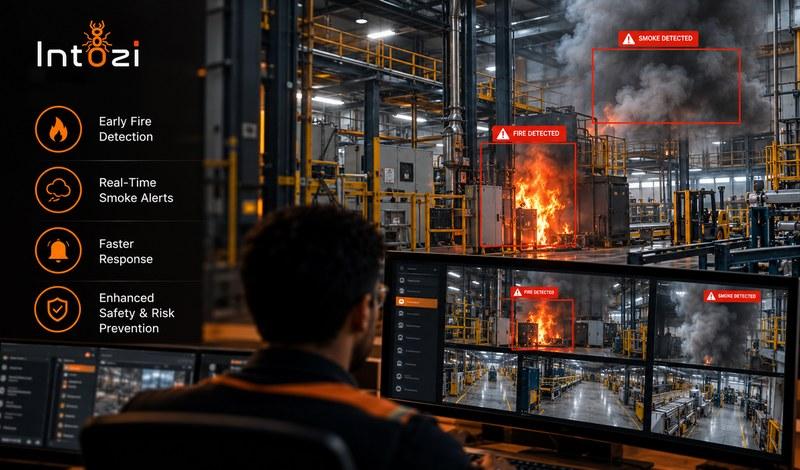
Fire incidents in factories, warehouses, commercial buildings, and industrial facilities can escalate rapidly when smoke or flames go unnoticed. In large environments, relying only on manual inspections or conventional fire alarms may leave gaps in visibility, particularly in areas monitored by CCTV cameras. How can organizations identify potential fire risks earlier and improve incident response? An AI smoke detection system can analyze video feeds to identify visual signs of smoke or flames and alert designated teams. Intozi addresses these monitoring needs through Ikshana, its intelligent video analytics platform.
Why Early Fire and Smoke Detection Matters
Smoke can appear before a fire becomes visibly large, making early identification important for limiting damage and protecting people. Industrial environments may contain combustible materials, electrical equipment, machinery, and other potential ignition sources. A delayed response can result in production interruptions, equipment damage, property loss, and safety risks.
Traditional CCTV systems record events but generally require someone to observe the footage or review recordings after an incident. Intelligent video monitoring adds another layer of awareness by analyzing camera feeds for defined visual events.
How an AI Smoke Detection System Works
An AI smoke detection system uses computer vision models to analyze video footage for visual patterns associated with smoke. Depending on the configured analytics, systems may also identify visible flames and generate alerts when a potential fire-related event is detected.
When an event is identified, the system can notify designated personnel and provide access to relevant camera footage for verification. This helps teams assess the situation and follow established emergency procedures.
Detection performance depends on camera positioning, lighting, environmental conditions, visibility, and the characteristics of the smoke or flame. Dust, steam, fog, shadows, and changing light conditions may affect detection, so testing under actual site conditions is essential.
The Role of Video Fire Detection Software
Video fire detection software can use existing compatible CCTV infrastructure to support visual monitoring across selected areas. Rather than depending exclusively on manual observation, it can help security and facility teams identify potential fire events across multiple camera feeds.
Common applications include:
-
Manufacturing facilities: Monitor production areas and equipment zones for visible smoke or flames.
-
Warehouses: Improve visibility in storage areas containing packaging, inventory, and combustible materials.
-
Data centres: Support visual monitoring around equipment rooms and other designated areas.
-
Oil and gas facilities: Help identify visible fire-related events in suitable monitored locations.
-
Commercial buildings: Assist monitoring teams in identifying potential incidents in corridors, service areas, and common spaces.
Video analytics should complement, not replace, certified fire alarms, smoke detectors, sprinkler systems, and emergency response procedures.
What Is Intelligent Fire and Smoke Detection?
Intelligent fire and smoke detection combines automated video analysis with event alerts and operational workflows. Instead of merely recording footage, the system helps identify visual events that may require attention.
Depending on the deployment, organizations can configure notifications, route alerts to responsible personnel, and review recorded footage to understand what happened. These capabilities can improve situational awareness and help teams prioritize verification and response.
Integrating video analytics with existing safety systems and escalation procedures can further support coordinated incident management.
Benefits of AI-Based Fire and Smoke Detection
An AI-enabled approach to fire and smoke detection can offer several operational benefits:
-
Earlier visual awareness: Identify potential smoke or flame events in monitored camera feeds.
-
Wider monitoring coverage: Support observation across multiple areas without requiring personnel to watch every feed continuously.
-
Faster alerting: Notify designated teams when a potential event is detected.
-
Incident investigation: Provide relevant video footage to support event review.
-
Infrastructure reuse: Use compatible existing cameras, potentially reducing the need for a separate video surveillance setup.
Actual performance and benefits depend on the analytics configuration, site conditions, and response processes.
How Intozi Supports Fire and Smoke Monitoring
Intozi provides intelligent video analytics through Ikshana, its video analytics platform. Using compatible existing camera infrastructure, organizations can implement visual monitoring for selected safety and security use cases.
Ikshana can help teams identify defined events, receive alerts, and review relevant footage. Its suitability for fire and smoke detection depends on the configured capabilities, camera conditions, and deployment requirements. Organizations should evaluate detection performance in their specific environment before implementation.
Conclusion
An effective approach to fire and smoke detection combines early identification, reliable alerting, and well-defined emergency procedures. An AI smoke detection system can improve visual awareness across monitored environments, while video fire detection software can help teams identify potential incidents and investigate them more efficiently. Choosing an analytics company that understands operational safety, system integration, and deployment requirements is important. Intozi , that a leading company provides intelligent video analytics through Ikshana to help organizations strengthen monitoring across existing camera infrastructure.
Frequently Asked Questions
1. What is an AI smoke detection system?
An AI smoke detection system analyzes video feeds using computer vision to identify visual patterns associated with smoke and alert designated personnel when a potential event is detected.
2. How does video fire detection software work?
Video fire detection software analyzes camera footage for visual signs of fire or smoke. When configured detection criteria are met, it can generate alerts for verification and response.
3. Where can intelligent fire and smoke detection be used?
It can support monitoring in factories, warehouses, data centres, oil and gas facilities, commercial buildings, and other suitable environments.
4. Can AI video analytics replace conventional fire alarms?
No. Video analytics should complement certified fire detection systems and established emergency procedures, not replace them.
5. What should organizations consider before deployment?
Organizations should assess camera coverage, lighting, environmental conditions, integration requirements, alert workflows, and detection performance under real operating conditions

 English
 Arabic
 French
 Spanish
 Portuguese
 Deutsch
 Turkish
 Dutch
Dutch
 Russian
 Romaian
 Portuguese (Brazil)
 Greek
Greek