


Hyperspectral Imaging Systems Market Growth: Cameras and Sensors Lead
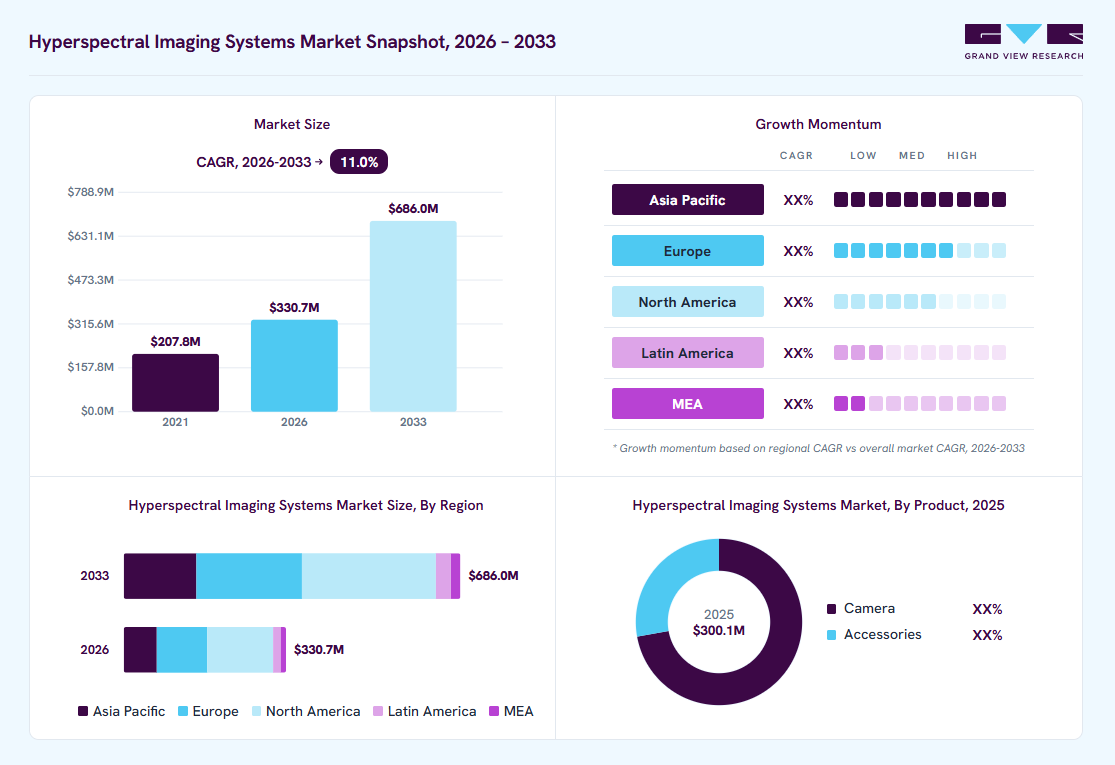
Industries increasingly need imaging technologies that reveal information beyond what conventional cameras can capture. Hyperspectral imaging systems address this requirement by collecting information across multiple spectral bands, helping users identify materials, assess conditions, and examine objects with greater detail. These capabilities are creating opportunities in defense, healthcare, remote sensing, agriculture, and industrial inspection. The hyperspectral imaging systems market was valued at USD 300.1 million in 2025 and is projected to grow from USD 330.7 million in 2026 to USD 686.0 million by 2033, registering a CAGR of 11.0% from 2026 to 2033.
Advanced Imaging Capabilities Expand Market Opportunities
Hyperspectral imaging systems provide detailed spectral information that supports the identification and analysis of objects and materials. Improvements in sensor design, spectral and spatial resolution, and compact device development are helping expand their potential applications.
Demand is supported by the need for precise imaging in research and development, healthcare, defense, food inspection, and remote sensing. These systems can help users distinguish materials that may appear similar in conventional images, making them relevant to specialized monitoring, testing, and analytical tasks.
As manufacturers improve imaging hardware and data-processing capabilities, hyperspectral systems are becoming more suitable for a broader range of operational environments. However, adoption also depends on equipment costs, system integration, and the ability to interpret large volumes of spectral data.
Camera Systems Lead Product Demand
The camera segment accounted for more than 72.2% of market revenue in 2025 and is expected to register the fastest CAGR from 2026 to 2033. Hyperspectral cameras collect light information across a range of spectral bands, producing detailed spectral data for individual image pixels. This helps users analyze the characteristics of materials and objects with greater precision.
Advances in sensor development, high-speed and low-cost circuits, manufacturing technologies, and signal-processing methods are supporting the evolution of these products. Improvements in camera quality, reliability, and economic efficiency may also encourage adoption among industrial and research users.
Accessories represent another product category within the market. Together, cameras and supporting equipment serve different imaging requirements across scientific, industrial, and specialized field applications.
Military Applications Maintain a Leading Position
The military segment accounted for more than 33.6% of market revenue in 2025, making it the largest application segment. Hyperspectral imaging supports the identification and tracking of personnel and objects by analyzing detailed spectral characteristics. Improvements in data management and component fabrication are helping strengthen the usefulness of these systems in military surveillance.
Remote sensing is another important application, with uses in environmental monitoring, mineral exploration, and observation from aircraft or satellites. Push broom sensors scan scenes line by line from moving platforms, making them suitable for collecting continuous spectral information across larger areas.
Medical diagnostics is expected to be the fastest-growing application segment, with a 12.0% CAGR from 2026 to 2033. Hyperspectral imaging can support the examination of tissue characteristics and changes in tissue structure and physiology. Potential uses include ophthalmology, digestive-system procedures, tissue diagnosis, fluorescence microscopy, and vascular imaging.
Machine vision and optical sorting also provide opportunities, particularly where detailed material identification and inspection are important. These varied applications broaden the market's potential beyond defense and conventional imaging.
North America Leads While Asia Pacific Accelerates
North America held more than 40.7% of market revenue in 2025, supported by advanced healthcare infrastructure, defense investment, research and development activity, and the presence of established industry participants. Demand across healthcare and industrial applications contributes to the region's market position.
Asia Pacific is projected to be the fastest-growing region during the forecast period. Growing interest in precision farming, remote sensing, mining exploration, healthcare research, and advanced imaging technologies is supporting opportunities across the region. China held the largest country-level share within Asia Pacific in 2023, while Japan is projected to experience the fastest CAGR in the region from 2026 to 2033.
The United States held the largest country-level market share in 2025, reflecting its established role in the adoption of hyperspectral imaging systems.
Technology Development Shapes Competitive Strategies
Competition increasingly depends on improvements in imaging accuracy, sensor performance, compactness, and system integration. Companies are pursuing product innovation and strategic transactions to strengthen their technological capabilities and expand their market reach. For example, Headwall Photonics acquired inno-spec GmbH in January 2024, expanding its position in industrial hyperspectral imaging applications.
Overall, expanding applications in medical diagnostics, remote sensing, defense, and industrial inspection are expected to support market growth through 2033. Continued progress in sensor technology and practical deployment will remain important to broader adoption.
Frequently Asked Questions
How large is the hyperspectral imaging systems market expected to become by 2033?
The market is projected to reach USD 686.0 million by 2033, growing at a CAGR of 11.0% from 2026 to 2033.
Which segment dominated the hyperspectral imaging systems market in 2025?
The camera segment led by product, with more than 72.2% of market revenue. The military segment was the largest application segment, accounting for more than 33.6%.
Key Hyperspectral Imaging Systems Companies:
· Corning Inc.
· Specim
· Spectral Imaging Ltd.
· Resonon Inc.
About us:
Grand View Research, a market research and consulting company, provides syndicated research reports, customized research reports, and consulting services. Grand View Research database is used by the world's renowned academic institutions and Fortune 500 companies to understand the global and regional business environment. Our database features thousands of statistics and in-depth analysis on 46 industries in 25 major countries worldwide.

 English
 Arabic
 French
 Spanish
 Portuguese
 Deutsch
 Turkish
 Dutch
Dutch
 Italiano
 Russian
 Romaian
 Greek
Greek