


Why Manufacturers Are Investing in Nanocellulose-Based Materials
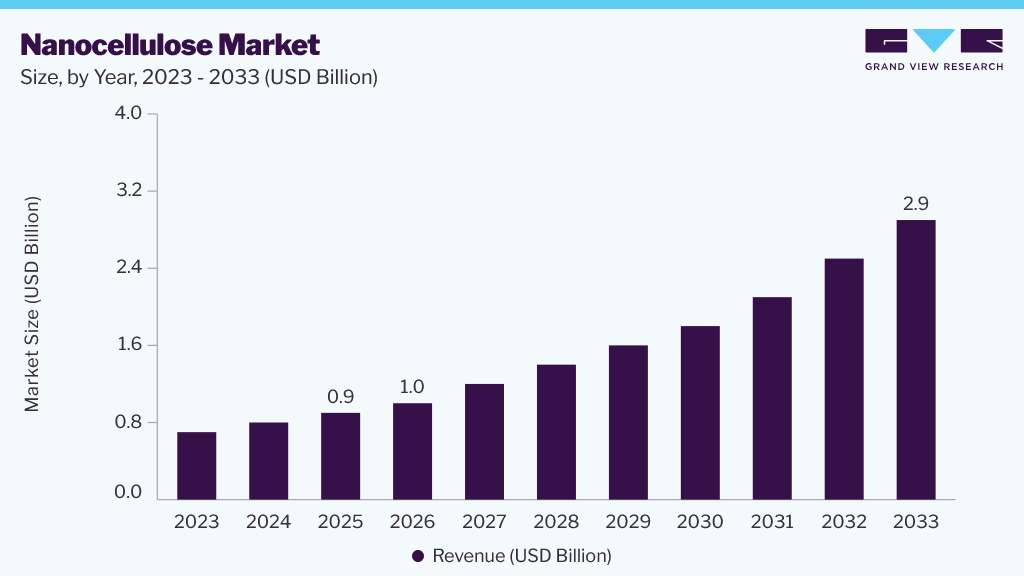
Industries are increasingly looking for materials that combine performance with environmental responsibility, creating new opportunities for advanced bio-based solutions. Nanocellulose is attracting attention because of its strength, lightweight structure, biodegradability, and suitability for applications ranging from packaging to biomedical products. The nanocellulose market was valued at USD 0.9 billion in 2025 and is projected to grow from USD 1.0 billion in 2026 to USD 2.9 billion by 2033, registering a CAGR of 15.9% from 2026 to 2033.
Sustainable Material Demand Supports Market Expansion
The shift toward renewable and environmentally responsible materials is a major factor supporting demand for nanocellulose. Businesses across packaging, paper, construction, automotive, textiles, and electronics are exploring alternatives that can reduce dependence on conventional materials while maintaining useful performance characteristics.
Nanocellulose can contribute to lightweight products, strong material structures, and improved barrier performance. Its potential use in recyclable films and coatings is particularly relevant as manufacturers seek packaging options that align with sustainability goals and restrictions on single-use plastics. Growing interest in bio-based products is therefore creating opportunities for nanocellulose producers to serve a wider range of industrial applications.
However, commercial adoption depends on more than environmental benefits. Manufacturers must also consider production economics, processing requirements, and the ability to deliver consistent material quality at scale.
Cellulose Nanofibers Maintain a Leading Position
By type, cellulose nanofibers (CNF) accounted for more than 50% of market revenue in 2025, making it the leading segment. Their availability and tensile properties contribute to their use across multiple applications. Microfibrillated cellulose and nanofibrillated cellulose can be produced from wood through mechanical and chemical processing, while the availability of wood-based pulp supports manufacturing.
Bacterial cellulose offers another set of useful properties, including high purity, water-retention capacity, mechanical strength, and biocompatibility. These characteristics support potential uses in products such as biomedical materials and personal hygiene applications.
The range of nanocellulose types allows manufacturers to develop materials suited to different performance requirements. Continued product development and wider industrial awareness may support further commercialization across established and emerging end uses.
Pulp and Paperboard Drive Application Demand
The pulp and paperboard segment held more than 25% of market revenue in 2025, supported by the material's potential to improve paper performance and enable more sustainable product development. Nanocellulose can be used in paper production, surface coatings, packaging, and hygienic or absorbent products.
Its properties, including strength, low density, and oxygen-barrier performance, make it relevant to paper-based packaging and other products that require functional material characteristics. Nanocellulose can also help create smoother paper surfaces, supporting print quality.
Beyond pulp and paperboard, the market includes composites, pharmaceuticals and biomedical products, electronics, food and beverages, and other applications such as textiles, paints, cosmetics, oil and gas, and cement. These varied end uses create opportunities for producers to diversify their customer base as the material moves into more commercial applications.
Europe Leads as Industrial Interest Broadens
Europe accounted for more than 35% of market revenue in 2025, supported by demand from pulp and paper industries and interest in packaging alternatives to single-use plastics. The region's emphasis on sustainable packaging and material innovation contributes to its leading position.
The United States held the largest country-level market share in 2025, according to the report. Demand in the country is supported by applications across paper and pulp, food and beverages, and other industries seeking advanced, sustainable materials.
Asia Pacific is also expected to experience significant growth during the forecast period. Increasing adoption of environmentally friendly coatings and composites, alongside demand for lightweight materials, may create additional opportunities in countries including India and South Korea.
Production Costs Remain a Key Challenge
Despite strong growth prospects, high production costs and difficulties in scaling from laboratory research to commercial manufacturing remain important restraints. Production can require energy-intensive processes, specialized equipment, and substantial investment in facilities and product development. These requirements may make nanocellulose less competitive than conventional materials in price-sensitive applications.
Overall, the market outlook reflects growing demand for sustainable, high-performance materials alongside ongoing challenges in production economics and commercialization. Progress in scaling manufacturing and expanding practical applications will be important to the market's continued development.
Frequently Asked Questions
What is the projected size of the nanocellulose market by 2033?
The nanocellulose market is projected to reach USD 2.9 billion by 2033, growing at a CAGR of 15.9% from 2026 to 2033.
Which segment held the largest share of the nanocellulose market in 2025?
Cellulose nanofibers led by type with more than 50% of market revenue, while pulp and paperboard was the leading application segment with more than 25%.
Key Nanocellulose Companies:
· CelluForce
· FiberLean
· Nippon Paper Industries Co., Ltd.
· Kruger Inc.
About us:
Grand View Research, a market research and consulting company, provides syndicated research reports, customized research reports, and consulting services. Grand View Research database is used by the world's renowned academic institutions and Fortune 500 companies to understand the global and regional business environment. Our database features thousands of statistics and in-depth analysis on 46 industries in 25 major countries worldwide.

 English
 French
 Spanish
 Portuguese
 Deutsch
 Turkish
 Dutch
Dutch
 Italiano
 Russian
 Romaian
 Portuguese (Brazil)
 Greek
Greek