


Why Militaries Are Consolidating on Multi-Band Antennas
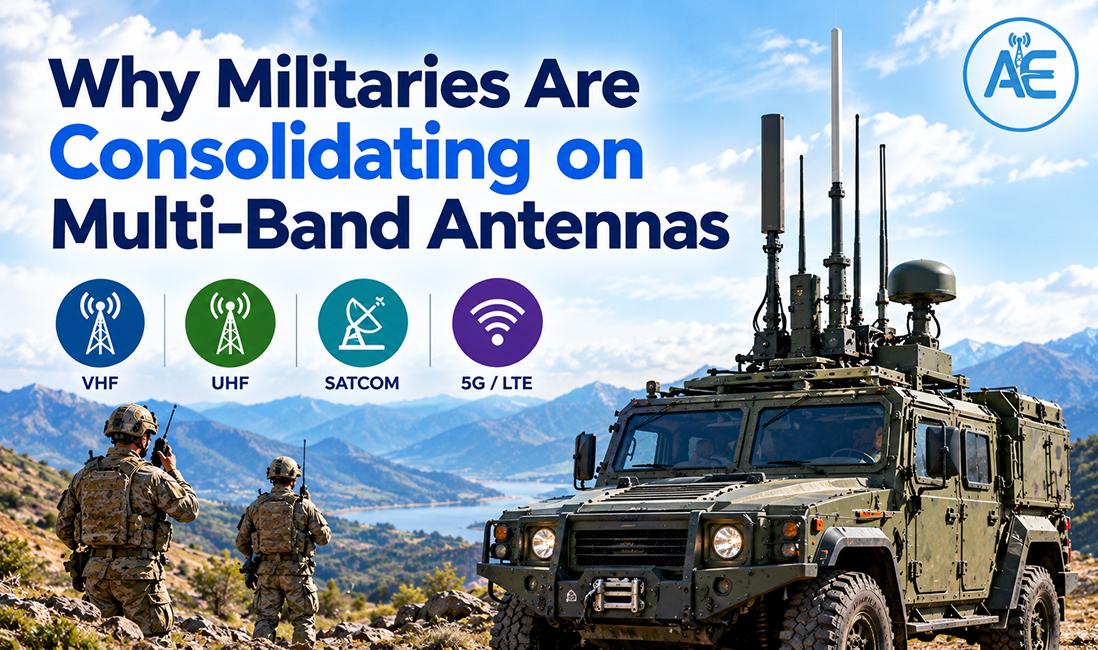
Why Militaries Are Consolidating on Multi-Band Antennas
A military vehicle can carry four or five radios and each one wants its own antenna. Every antenna takes roof space. It needs a cable and a connector and it adds weight. Put them close together and they start interfering with each other. Antenna Experts, a Military Multi Band Antenna manufacturer in India, helps platform teams cut the count by covering several bands from one unit. Space and weight limits keep tightening, which is why multi band designs get more attention.
Why Every Extra Antenna Costs You Twice
An antenna never comes alone. It needs a cable, a connector and a mount and the roof is already full. Each one adds weight and installation time. Each one can also fail.
More antennas mean more things to inspect, service and ultimately replace, so the maintenance effort also grows with the number of antennas. There is a weight and structural loading issue for vehicles where every kilogram counts in terms of performance. Mast or vehicle congestion is an actual physical problem when a few antennas are fighting for the same limited space. Antenna to antenna interaction and co site interference concerns also increase as closely spaced antennas can impact each other’s performance in ways that aren’t always obvious until the system is actually deployed. Consolidating antenna numbers can simplify a platform greatly but consolidation does not remove the need for proper RF planning. Swapping several single-band units for one Military Multi Band Antenna eases the space and weight problem, but only if the RF side is planned with it.
How Multi Band Designs Hold VSWR Across Wide Ranges
VSWR (voltage standing wave ratio) shows how well the antenna matches the cable and the radio. With a poor match, part of the power bounces back toward the transmitter instead of being radiated. That wastes power and can stress the transmitter.
Holding a good match across several bands is hard. The feed, the matching network and the resonant elements all have to work together and the bands can be far apart. Inside one structure, the elements also couple to each other. Bandwidth, band spacing and that coupling decide whether a Military Multi Band Antenna performs across its range. [Add your VSWR figure, for example “better than 2:1 across 30-512 MHz”, only if your datasheet supports it.].
· Bandwidth Ratio and Element Design
The ratio of the highest to the lowest frequency shapes the whole design. A narrow ratio is one problem. A wide one is another. Different bands may need different radiating elements, loading or feeds inside the same antenna and designers solve this in different ways. The bands you need and how far apart they sit, decide the approach.
Trade-offs: Gain, Pattern and Power per Band
A multi-band antenna does not necessarily deliver identical performance across every band it covers. Gain can vary noticeably from one band to another and radiation pattern shape sometimes shifts as well. Polarization considerations, power handling capability, physical size and overall efficiency can all differ by band too and isolation between bands needs checking rather than assumed.
The practical takeaway is that antenna selection should be based on actual radio requirements for each specific band rather than simply choosing whichever antenna claims the widest bandwidth on its datasheet.
· Co-location and Isolation
Multiple transmitters operating in close proximity to one another can cause RF interference, regardless of whether there is a single antenna or separate antennas. This risk is mitigated by physical and frequency separation. Filtering, antenna isolation, careful routeing of cables and proper grounding and bonding all play supporting roles.
However problems of interference often only become apparent when the complete system is assembled rather than isolated testing of components, if a number of radios are in close proximity. Co-site analysis at the platform level is necessary. Multi-band antennas can reduce the number of radiating structures on a platform but still require the same careful RF system engineering that a multi-antenna setup would require.
Where a Multi Band Antenna Fits and Where It Does Not
Multi-band antennas tend to make sense on military vehicles, tactical communication platforms, portable or otherwise constrained systems and installations carrying several radios where reducing antenna count genuinely matters for space or weight reasons.
Separate antennas can still be the better choice in other situations. For a single band on a roof-mounted platform, a Military Ground Plane Antenna is often the simpler option Very different frequency ranges sometimes cannot be served efficiently by a single design. Different polarization requirements between systems complicate consolidation. High-power transmitters with demanding isolation needs may require physical separation that a shared antenna cannot provide and applications needing highly directional patterns often perform better with dedicated antennas placed independently. Choosing the best Military Multi Band Antenna therefore depends on the platform's frequency, isolation, radiation pattern, power and mounting requirements rather than simply selecting the antenna with the widest coverage.
How Antenna Experts Approaches Multi Band Needs
Antenna Experts, based in New Delhi, India, brings more than 35 years of antenna design experience with in-house design, manufacturing and testing capabilities under one roof. Multi-band antenna selection requires working through frequency coverage, radiation pattern, impedance matching, isolation, mounting requirements and platform constraints together, which is exactly the kind of connected engineering problem in-house capability supports.
The company holds ISO 9001:2015, ISO 14001:2015 and ISO 45001:2018 certifications, along with NATO NCAGE registration relevant to defence procurement. Export experience and installations across more than 60 countries reflect exposure to varied platform requirements across different markets. As a Military Multi Band Antenna manufacturer in India, this structure supports addressing bandwidth ratio, element design and isolation requirements specific to each platform rather than applying one generic design to every use case, Related ranges include the Military Ground Plane Antenna and the Military Vehicle Mount Antenna.
Conclusion
Multi-band antennas can genuinely help reduce antenna count and simplify constrained platforms, but the right design still depends on frequency coverage, impedance matching, isolation, radiation pattern, power requirements and mounting constraints specific to each application. Platform integrators and RF engineers working through these trade-offs are welcome to discuss their frequency bands, platform type, mounting limitations and radio requirements with Antenna Experts, or see the High Gain Yagi Antenna range for single-band, directional links.
FAQs
1. What is a military multi band antenna?
An antenna designed to cover more than one frequency band within a single physical unit, reducing the total antenna count needed on a platform.
2. Does a multi band antenna lose gain?
Gain can vary by band compared to a dedicated narrowband antenna, depending on the specific design and frequency ratio involved.
3. When should I still use separate antennas?
When bands differ significantly, polarization needs vary, or high-power isolation and directional pattern requirements demand independent placement.
4. Can a multi band antenna be vehicle mounted?
Yes, many multi-band designs suit vehicle mounting, though mounting requirements depend on the platform and antenna configuration.

 English
 Arabic
 French
 Spanish
 Portuguese
 Deutsch
 Turkish
 Dutch
Dutch
 Russian
 Romaian
 Portuguese (Brazil)
 Greek
Greek