


Medical Tourism Market Size, Trends, Growth and Forecast 2026–2034
Market Overview
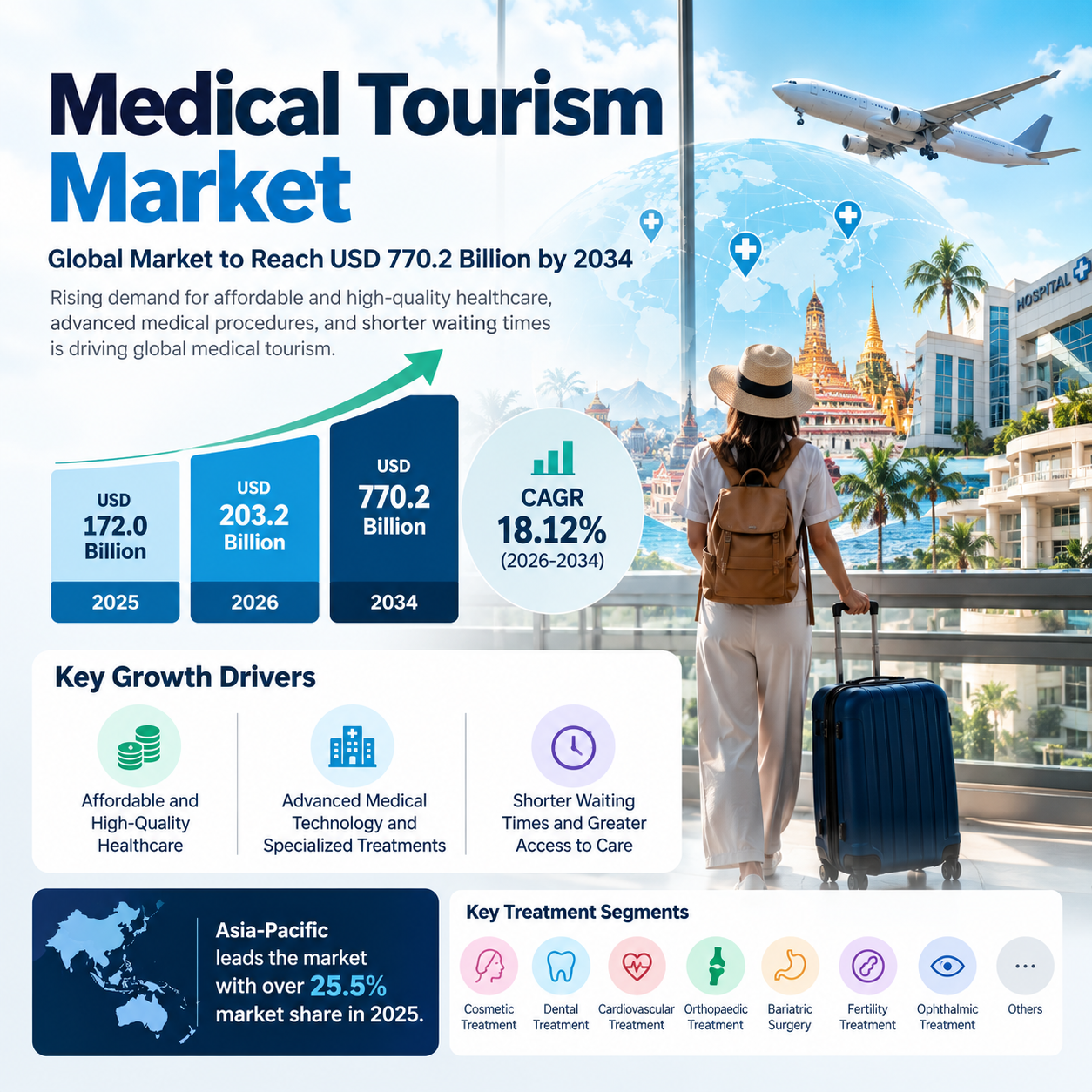
The global medical tourism market is experiencing significant growth as patients increasingly travel internationally to access affordable healthcare, specialized medical treatments, advanced technologies, and high-quality clinical services. The market reached USD 172.0 Billion in 2025 and is estimated to reach USD 203.2 Billion in 2026. Looking forward, it is projected to reach USD 770.2 Billion by 2034, expanding at a CAGR of 18.12% during 2026–2034. Asia Pacific dominated the market in 2025, accounting for more than 25.5% of the global market share.
The industry is being influenced by rising healthcare costs in developed countries, increasing demand for affordable and effective treatments, advances in medical technology, and growing interest in cosmetic procedures. Internationally accredited hospitals, shorter waiting times, specialized healthcare services, and comprehensive medical travel packages are further contributing to the expansion of medical tourism worldwide.
Medical Tourism Market Snapshot
-
Base Year: 2025
-
Historical Period: 2020–2025
-
Forecast Period: 2026–2034
-
Market Size (2025): USD 172.0 Billion
-
Market Size (2026): USD 203.2 Billion
-
Market Forecast (2034): USD 770.2 Billion
-
CAGR (2026–2034): 18.12%
-
Leading Region: Asia Pacific
-
Dominant Treatment Type Segment: Cosmetic Treatment
-
Cosmetic Treatment Market Share (2025): 23.9%
Asia Pacific accounted for more than 25.5% of the global medical tourism market in 2025, supported by affordable medical procedures, skilled healthcare professionals, advanced hospital infrastructure, and growing international demand for specialized treatments.
Request a Sample Report: https://www.imarcgroup.com/medical-tourism-market/requestsample
What Is Driving Medical Tourism Market Growth?
Increasing Demand for Affordable and Effective Healthcare
The rising cost of healthcare in developed countries is encouraging patients to explore medical treatment options abroad. Procedures such as dental treatments, cosmetic surgeries, orthopedic interventions, and certain specialized medical services can be considerably less expensive in selected international destinations.
Medical tourism allows patients to compare treatment costs and access healthcare providers that offer appropriate medical expertise, modern facilities, and internationally recognized standards. Countries such as India, Thailand, Malaysia, and Turkey have become important destinations for patients seeking a combination of affordability and specialized care.
In addition to treatment expenses, travel and accommodation packages can make international healthcare more accessible for patients and their companions. Medical tourism providers increasingly coordinate consultations, hospital appointments, transportation, accommodation, and post-treatment support to simplify the patient journey.
The growing availability of specialized healthcare services, coupled with the potential for cost savings, is strengthening demand for cross-border medical travel.
Rising Healthcare Costs in Developed Countries
Increasing healthcare expenditure is another important factor supporting medical tourism market growth. According to the Centers for Medicare & Medicaid Services, US healthcare spending increased by 4.1% to reach USD 4.5 Trillion in 2022.
High treatment costs, insurance limitations, and long waiting periods can encourage patients to investigate healthcare options in other countries. Medical tourism destinations may offer more accessible pricing for selected procedures while providing access to experienced medical professionals and modern healthcare facilities.
Patients may also travel internationally to access treatments that are unavailable, restricted, or difficult to obtain in their home countries. Specialized procedures, advanced diagnostic services, and particular treatment approaches can influence destination selection.
However, patients generally need to consider the qualifications of healthcare professionals, hospital accreditation, treatment suitability, and the availability of follow-up care when evaluating overseas medical services.
Technological Advancements in the Healthcare Industry
Technological innovation is transforming healthcare delivery and strengthening the appeal of international medical destinations. Advances in surgical techniques, diagnostic equipment, robotic assistance, telemedicine, and digital patient management are expanding treatment options and improving coordination between patients and healthcare providers.
According to the World Economic Forum data cited in the supplied report, global health spending reached USD 9.8 Trillion in 2021, equivalent to 10.3% of global GDP.
Medical tourism destinations are investing in modern facilities, specialized treatment departments, and digital healthcare systems to attract international patients. Technologies that support minimally invasive procedures, precision treatment, and remote consultations can improve convenience and help patients access specialized medical expertise.
Digital tools also facilitate pre-travel consultations, medical record sharing, treatment planning, and post-treatment communication. These capabilities can help patients coordinate care before departure and maintain contact with healthcare professionals after returning home.
The development of advanced medical technologies, combined with the expertise of specialized clinicians, is creating additional opportunities for medical tourism providers.
Medical Tourism Market Trends to Watch
Three major trends are shaping the future of the global medical tourism industry.
Increasing preference for cosmetic procedures: Patients are increasingly exploring international destinations for aesthetic treatments that combine specialized medical expertise with comparatively affordable pricing. Cosmetic surgery, minimally invasive procedures, and other aesthetic treatments are contributing to demand for cross-border healthcare.
Growing interest in affordable specialized treatments: Rising healthcare expenses and waiting times in certain countries are encouraging patients to consider destinations offering specialized medical services, shorter treatment timelines, and comprehensive patient support.
Technology-enabled healthcare and personalized services: Telemedicine, digital consultations, online appointment systems, and advanced treatment technologies are making it easier for international patients to evaluate providers and coordinate their healthcare journeys.
Wellness tourism is also contributing to market development by combining medical services with recovery-focused experiences. Depending on the treatment and destination, patients may seek rehabilitation, wellness programs, or supportive accommodation alongside clinical care.
Healthcare providers and medical tourism facilitators are increasingly developing services that address the complete patient journey, from initial consultation and travel coordination to treatment and follow-up care.
Medical Tourism Market Segmentation
IMARC Group provides an analysis of the key trends in each segment of the global medical tourism market, along with forecasts at the global, regional, and country levels from 2026 to 2034. The market is categorized by treatment type and region.
By Treatment Type
-
Cosmetic Treatment
-
Dental Treatment
-
Cardiovascular Treatment
-
Orthopaedic Treatment
-
Bariatric Surgery
-
Fertility Treatment
-
Ophthalmic Treatment
-
Others
Cosmetic treatment dominated the treatment-type segment in 2025, accounting for approximately 23.9% of the market. Its leading position is supported by demand for aesthetic procedures, comparatively affordable treatment options, and the availability of specialized medical professionals in established medical tourism destinations.
Countries such as Thailand, South Korea, and Turkey attract international patients seeking procedures including rhinoplasty, liposuction, and facelifts. Skilled surgeons, modern healthcare facilities, and shorter waiting times can strengthen their appeal among patients considering treatment abroad.
Medical tourism packages may also combine treatment arrangements with accommodation, transportation, and patient assistance services, making the process more convenient for international visitors.
Dental treatment represents another important area of medical tourism, with patients traveling for procedures such as implants, restorative dentistry, and other specialized services. Destinations offering comparatively affordable treatment and qualified dental professionals can attract patients from countries where similar procedures are more expensive.
Cardiovascular and orthopaedic treatments also contribute to international medical travel. Patients may seek specialized hospitals, advanced diagnostic capabilities, and experienced clinical teams for complex procedures.
Bariatric surgery, fertility treatment, ophthalmic procedures, and other specialized services provide additional opportunities for healthcare providers serving international patients.
Regional Medical Tourism Market Outlook
Asia Pacific
Asia Pacific accounted for more than 25.5% of the global medical tourism market in 2025, making it the leading regional market. Its position is supported by comparatively affordable treatment costs, internationally recognized hospitals, skilled healthcare professionals, and growing investment in medical infrastructure.
Countries such as India, Thailand, Singapore, Malaysia, South Korea, Indonesia, China, and Taiwan contribute to the region's medical tourism landscape.
India is an important destination for cardiovascular procedures, orthopaedic treatments, organ transplantation, and other specialized medical services. Its combination of medical expertise, hospital infrastructure, and comparatively affordable pricing attracts patients from various international markets.
Thailand has developed a strong reputation in cosmetic and wellness-related medical tourism, while Singapore attracts patients seeking specialized treatment at established healthcare institutions. Malaysia and South Korea also appeal to international patients through their medical facilities and specialized treatment offerings.
Government initiatives, medical travel facilitation, international hospital partnerships, and improved digital booking systems are supporting the region's appeal. The opportunity to combine medical treatment with cultural attractions and tourism experiences can provide an additional incentive for patients and their companions.
North America
North America remains an important region in the global medical tourism industry, supported by advanced healthcare infrastructure, specialized medical professionals, and access to innovative treatment technologies.
The United States is a major market within the region, attracting international patients seeking complex medical procedures, advanced diagnostics, and specialized clinical expertise.
The country benefits from the presence of internationally recognized healthcare institutions, advanced research capabilities, and access to certain treatments and clinical trials. Patients may travel to the United States for selected cardiovascular procedures, cancer treatments, orthopaedic care, and other specialized services.
Canada also participates in the regional medical tourism landscape, although international healthcare travel patterns vary according to treatment availability, cost, and patient requirements.
At the same time, patients from North America frequently travel to other countries for dental procedures, cosmetic treatments, and selected elective services when they identify suitable providers and potential cost advantages.
Europe
Europe benefits from established healthcare systems, specialized medical institutions, advanced treatment technologies, and a broad range of clinical services. Countries including Germany, Switzerland, the United Kingdom, France, Italy, Spain, Hungary, Poland, and the Czech Republic contribute to the region's medical tourism market.
Germany attracts international patients seeking specialized care, including orthopaedic, cardiovascular, and oncology services. Its medical institutions are recognized for advanced equipment and specialized clinical expertise.
Hungary and Poland are popular destinations for selected dental procedures, while Turkey attracts patients seeking cosmetic and other elective treatments. These destinations can appeal to patients seeking a combination of medical expertise, comparatively accessible pricing, and convenient travel arrangements.
Wellness and rehabilitation services also contribute to European medical tourism, with certain destinations offering spa facilities, recovery programs, and specialized wellness experiences.
The region's established transportation networks, diverse healthcare capabilities, and range of treatment options support its continued participation in international medical travel.
Latin America
Latin America's medical tourism market is supported by its proximity to North America, comparatively affordable treatment options, and the availability of qualified healthcare professionals.
Mexico, Costa Rica, Brazil, and Colombia are among the important destinations serving international patients.
Mexico attracts patients from the United States and Canada seeking dental treatment, cosmetic procedures, bariatric surgery, and other elective services. Geographic proximity can reduce travel time and make follow-up visits more manageable for some patients.
Costa Rica has developed a reputation for dental tourism and selected elective procedures. Colombia is known for cosmetic treatments, while Brazil offers a broad range of aesthetic and specialized medical services.
Healthcare providers in the region are increasingly emphasizing patient coordination, international marketing, and treatment packages that simplify arrangements for overseas visitors.
The combination of geographic accessibility, treatment choices, and competitive pricing creates opportunities for medical tourism providers throughout Latin America.
Middle East and Africa
The Middle East and Africa region presents opportunities through healthcare infrastructure investment, specialized medical facilities, and government initiatives designed to attract international patients.
The United Arab Emirates, particularly Dubai and Abu Dhabi, is an important medical tourism destination. Modern healthcare facilities, specialist services, international connectivity, and premium patient support contribute to the region's appeal.
According to the Dubai Health Authority figures cited in the supplied report, Dubai welcomed more than 691,000 international health tourists in 2023, who spent over AED 1.03 Billion (USD 280 Million) on medical care.
The region offers a range of services, including cosmetic procedures, wellness treatments, dental care, and specialized medical services. Continued investment in healthcare infrastructure and international partnerships can support further market development.
South Africa also attracts international patients seeking selected medical, cosmetic, and dental procedures. Its established healthcare providers and tourism offerings can allow some visitors to combine treatment with leisure travel, subject to medical suitability and recovery requirements.
Government support, international marketing, and collaboration between healthcare providers and travel services are expected to remain important factors shaping the region's medical tourism landscape.
Key Regional Takeaways
United States Medical Tourism Market Analysis
In 2025, the United States accounted for 75.0% of the North American medical tourism market, according to the supplied report. The country's position is supported by advanced medical facilities, specialized clinicians, innovative treatments, and internationally recognized healthcare institutions.
The United States attracted more than 1.9 million medical tourists in 2019, according to the industry data cited in the report. International patients may seek care in the country for complex medical procedures, cardiovascular conditions, cancer treatment, and specialized therapies.
Access to advanced medical technology is an important attraction. According to the National Association for Proton Therapy data cited in the supplied material, approximately 46 facilities in the United States provide proton therapy for cancer.
The country's medical research ecosystem and participation in clinical trials can also attract selected international patients seeking innovative treatment options. Healthcare institutions such as the Cleveland Clinic and Mayo Clinic have established international reputations for specialized care.
In addition, multilingual assistance, international patient departments, and support with appointments and treatment coordination can help facilitate cross-border healthcare journeys.
However, treatment costs in the United States can be comparatively high, making the country particularly relevant for patients whose primary priorities include access to specific specialists, advanced procedures, or treatments that may not be readily available elsewhere.
Europe Medical Tourism Market Analysis
The European medical tourism market benefits from specialized healthcare systems, advanced medical technologies, and a diverse range of treatment destinations.
Germany, Switzerland, and the United Kingdom attract patients seeking specialized services, including orthopaedic procedures, cardiovascular care, and oncology treatment. According to an industry news report cited in the supplied material, Germany received more than 65,000 foreign patients from 177 countries in 2020.
Other European destinations compete through comparatively affordable dental and cosmetic services. Hungary and Poland attract patients seeking dental treatment, while Turkey is a prominent destination for selected cosmetic procedures.
The supplied report notes that approximately 40% of dental tourism in Europe occurs in Hungary, where treatment costs may be substantially lower than in some Western European countries.
Wellness tourism and rehabilitation services also contribute to regional demand, particularly in destinations offering spa facilities and recovery-focused programs.
The availability of specialized care, established transportation networks, and a wide range of treatment options supports Europe's position in the global medical tourism industry.
Asia Pacific Medical Tourism Market Analysis
Asia Pacific is one of the most important regions for medical tourism because of its combination of affordable treatment options, skilled healthcare professionals, and established specialist hospitals.
India, Thailand, and Singapore are particularly important destinations, while Malaysia and South Korea also attract international patients seeking selected medical and elective procedures.
India is recognized for cardiovascular treatment, orthopaedic care, organ transplantation, and other specialized services. The supplied report estimates that India's medical tourism market could grow from INR 87,050 Crore (USD 10.33 Billion) in 2024 to INR 425,630 Crore (USD 50.50 Billion) by 2034.
The report also indicates that India may receive 7.3 million medical tourists in 2024, compared with 6.1 million in 2023. Its healthcare infrastructure, comparatively affordable treatment costs, and network of accredited hospitals contribute to its international appeal.
Thailand is known for cosmetic and wellness-related services, while Singapore attracts patients seeking specialized medical treatment at established healthcare institutions. South Korea is another destination for aesthetic procedures and advanced healthcare services.
Digital consultations, medical travel facilitators, international patient departments, and regional healthcare partnerships are helping simplify the process of seeking treatment abroad.
Latin America Medical Tourism Market Analysis
Latin America's medical tourism market is supported by its proximity to North America, comparatively affordable procedures, and growing international recognition of healthcare providers.
Mexico, Costa Rica, and Colombia are particularly relevant destinations for patients seeking dental treatment, cosmetic procedures, and selected elective surgeries.
The supplied report estimates that Mexico receives between 1.4 million and 3 million medical tourists annually, with approximately 40%–60% originating from the United States.
The report also indicates that American patients may save approximately 40%–60% on common medical procedures in Mexico, although actual savings depend on the treatment, provider, travel expenses, and follow-up requirements.
Costa Rica has developed a strong presence in dental tourism, particularly for implants and related procedures. Colombia attracts international patients seeking cosmetic treatments, while Brazil offers a broad range of aesthetic and specialized medical services.
The region's geographic accessibility and range of healthcare options create opportunities for hospitals, specialist clinics, and medical tourism facilitators.
Middle East and Africa Medical Tourism Market Analysis
The Middle East and Africa medical tourism market is supported by healthcare infrastructure development, specialized treatment services, and initiatives designed to strengthen international patient flows.
The United Arab Emirates, particularly Dubai and Abu Dhabi, is an important destination for medical tourism. According to the Dubai Health Authority figures cited in the supplied report, Dubai received more than 691,000 international health tourists in 2023, generating medical spending of over AED 1.03 Billion (USD 280 Million).
The region offers modern healthcare facilities, selected cosmetic procedures, specialist services, and wellness-related treatments. International connectivity and premium accommodation options can further support the patient experience.
South Africa attracts international visitors seeking selected medical, dental, cosmetic, and rehabilitation services. Some patients also combine treatment with tourism activities, depending on their medical needs and recovery schedules.
Continued healthcare investment, strategic partnerships, and government-backed initiatives can strengthen the region's position in the global medical tourism industry.
Competitive Landscape
Medical tourism companies are adopting a range of strategies to expand their international reach, improve patient experiences, and respond to growing demand for cross-border healthcare.
A key approach involves developing comprehensive service packages that combine medical treatment with travel arrangements, accommodation, transportation, interpretation services, and post-treatment assistance. These services can simplify coordination for patients traveling internationally.
Healthcare providers are also establishing partnerships with hospitals, specialist clinics, insurance companies, travel agencies, and patient support organizations. Such collaborations can improve access to medical services and help patients navigate treatment arrangements.
Digital platforms and telemedicine are becoming increasingly important for pre-travel consultations, appointment coordination, medical record sharing, and follow-up communication. Personalized concierge services and multilingual support can further improve convenience for international patients.
Marketing and brand development also play an important role. Healthcare providers and medical tourism facilitators emphasize specialist expertise, treatment options, hospital credentials, and patient support capabilities to build confidence among prospective international visitors.
Major companies identified in the global medical tourism market include:
-
Aditya Birla Capital Ltd.
-
Apollo Hospitals
-
Asian Heart Institute
-
Barbados Fertility Center
-
BB Health Solutions
-
Bumrungrad International
-
Fortis Healthcare
-
Gleneagles Hospitals
-
KPJ Healthcare
-
Mount Elizabeth Hospitals
-
Prince Court Medical Centre
-
Raffles Medical Group
-
Samitivej PCL
Recent Industry Developments
September 2024: ViMUT Hospital, a private healthcare facility in Bangkok, opened its Maxillofacial Contouring Centre in response to increasing demand for facial contouring and related cosmetic procedures. The development expanded the hospital's services in Thailand's cosmetic healthcare sector.
September 2024: EaseMyTrip announced investments totaling INR 90 Crore to expand into medical tourism. The planned investments included INR 30 Crore for a 49% stake in Pflege Home Healthcare and INR 60 Crore for a 30% stake in Rollins International. The move aimed to expand its healthcare services and wellness offerings.
January 2024: Apollo Hospitals announced plans to invest INR 3,000 Crore to add 2,000 beds across its branches by 2028. The expansion was intended to increase its healthcare capacity and support its position in domestic and international patient services.
May 2024: Fortis Healthcare partnered with United We Care to establish Adayu Mindfulness, offering telemental health services and residential inpatient care covering psychiatry, addiction treatment, and rehabilitation.
Where Are the Biggest Medical Tourism Market Opportunities?
The global medical tourism industry presents opportunities across several areas:
-
Affordable specialized treatments: Cost differences between countries create opportunities for patients seeking suitable medical care at comparatively accessible prices.
-
Cosmetic and aesthetic procedures: Demand for cosmetic surgery and minimally invasive treatments supports growth in established medical tourism destinations.
-
Dental tourism: International patients seeking dental implants, restorative procedures, and other dental services create opportunities for specialist clinics.
-
Advanced medical technologies: Investments in diagnostics, surgical technologies, robotic assistance, and digital healthcare can strengthen destination competitiveness.
-
Cardiovascular and orthopaedic care: Specialized hospitals can attract international patients requiring complex treatment and rehabilitation services.
-
Fertility and ophthalmic treatments: Specialist services create additional opportunities for hospitals and medical travel facilitators.
-
Integrated patient support: Packages covering consultations, travel, accommodation, interpretation, and follow-up coordination can improve the international patient experience.
-
Digital healthcare services: Telemedicine and online consultations can facilitate treatment planning and communication before and after travel.
-
Emerging medical tourism destinations: Investment in accredited hospitals, specialist facilities, and international patient services can help destinations attract additional demand.
-
Wellness and rehabilitation tourism: Appropriate recovery-focused services can complement clinical treatment and broaden the range of healthcare travel offerings.
These opportunities are particularly relevant as patients increasingly compare healthcare costs, treatment availability, specialist expertise, and travel convenience before choosing a medical destination.
Medical tourism providers that combine clinical quality, transparent pricing, appropriate patient support, and coordinated follow-up care can strengthen their competitiveness in the evolving international healthcare market.
Get Detailed Medical Tourism Market Intelligence
The headline market figures provide a useful overview of the industry's direction, but businesses evaluating market entry, hospital expansion, investment opportunities, treatment specialization, or international partnerships may require more detailed market intelligence.
A comprehensive medical tourism market report can help businesses assess:
-
Market size and growth forecasts
-
Treatment-type segmentation
-
Regional and country-level market performance
-
Market drivers and emerging trends
-
Cosmetic, dental, cardiovascular, and orthopaedic treatment opportunities
-
Healthcare infrastructure and technological developments
-
Competitive landscape and major company profiles
-
International patient demand and destination preferences
-
Digital healthcare and telemedicine developments
-
Recent industry developments
Access to detailed market insights can support strategic decisions involving healthcare investment, specialist service development, international patient acquisition, and expansion into high-potential medical tourism destinations.
Request a Sample Report: https://www.imarcgroup.com/medical-tourism-market/requestsample
Medical Tourism Market FAQs
What is the current size of the global medical tourism market?
The global medical tourism market reached USD 172.0 Billion in 2025 and is estimated to reach USD 203.2 Billion in 2026. It is projected to reach USD 770.2 Billion by 2034.
What is the expected CAGR of the medical tourism market?
The global medical tourism market is projected to expand at a CAGR of 18.12% during 2026–2034.
Which region leads the medical tourism market?
Asia Pacific was the leading regional market in 2025, accounting for more than 25.5% of the global market share. Affordable treatments, skilled medical professionals, and established healthcare infrastructure support its position.
Which treatment type dominates the medical tourism market?
Cosmetic treatment represented the largest treatment-type segment in 2025, accounting for approximately 23.9% of the market. Demand is supported by aesthetic procedures, specialized surgeons, and comparatively affordable treatment options in established destinations.
What are the major trends in the medical tourism market?
Key trends include affordable specialized healthcare, cosmetic procedures, advanced medical technologies, digital consultations, telemedicine, personalized patient support, and the integration of healthcare services with recovery and wellness experiences.
Which countries are popular medical tourism destinations?
Important destinations include India, Thailand, Singapore, Malaysia, South Korea, Turkey, Mexico, Costa Rica, Germany, and the United Arab Emirates. Destination suitability depends on the treatment required, provider qualifications, costs, travel considerations, and follow-up care arrangements.
Conclusion
The global medical tourism market is expanding as patients increasingly seek affordable healthcare, specialized medical expertise, advanced technologies, and convenient access to treatment across international borders. Valued at USD 172.0 Billion in 2025, the market is estimated to reach USD 203.2 Billion in 2026 and is projected to grow to USD 770.2 Billion by 2034, registering a CAGR of 18.12% during 2026–2034.
Opportunities are emerging across cosmetic procedures, dental care, cardiovascular treatment, orthopaedic services, fertility treatments, and technology-enabled healthcare. Asia Pacific maintains its leading regional position, while North America, Europe, Latin America, and the Middle East and Africa continue to offer opportunities through specialized medical services and international patient programs.
Healthcare providers and medical tourism facilitators that prioritize clinical quality, transparent pricing, personalized support, and coordinated follow-up care can strengthen their positions in the evolving global medical tourism industry.
About the Author
IMARC Group is a global market research company providing data-driven insights and expert consulting services to businesses seeking to achieve their strategic objectives. With a multidisciplinary team of industry experts, IMARC delivers market intelligence across sectors including healthcare, energy and mining, construction and manufacturing, automotive, chemicals and materials, and more.
Media & Sales Contact
IMARC Group
United States: +1-201-971-6302
India: +91-120-433-0800
United Kingdom: +44-753-714-6104

 English
 Arabic
 French
 Spanish
 Portuguese
 Deutsch
 Turkish
 Italiano
 Russian
 Romaian
 Portuguese (Brazil)
 Greek
Greek