


United States Population Health Management Market Forecast to Reach USD 124.9 Billion by 2034, Registering an 18.31% CAGR
IMARC Group has published a new research report titled “United States Population Health Management Market Report by Component (Software, Services), Mode of Delivery (Cloud-based, Web-based, On-premises), End User (Healthcare Providers, Healthcare Payers, Employer Groups, Government Bodies), and Region 2026-2034.” The report delivers an in-depth assessment of market dynamics, emerging trends, growth drivers, potential opportunities, market segmentation, and the competitive landscape, offering valuable insights into the industry's present conditions and future prospects.
United States Population Health Management Market Overview: Market Size, Growth, and Forecast (2026-2034)
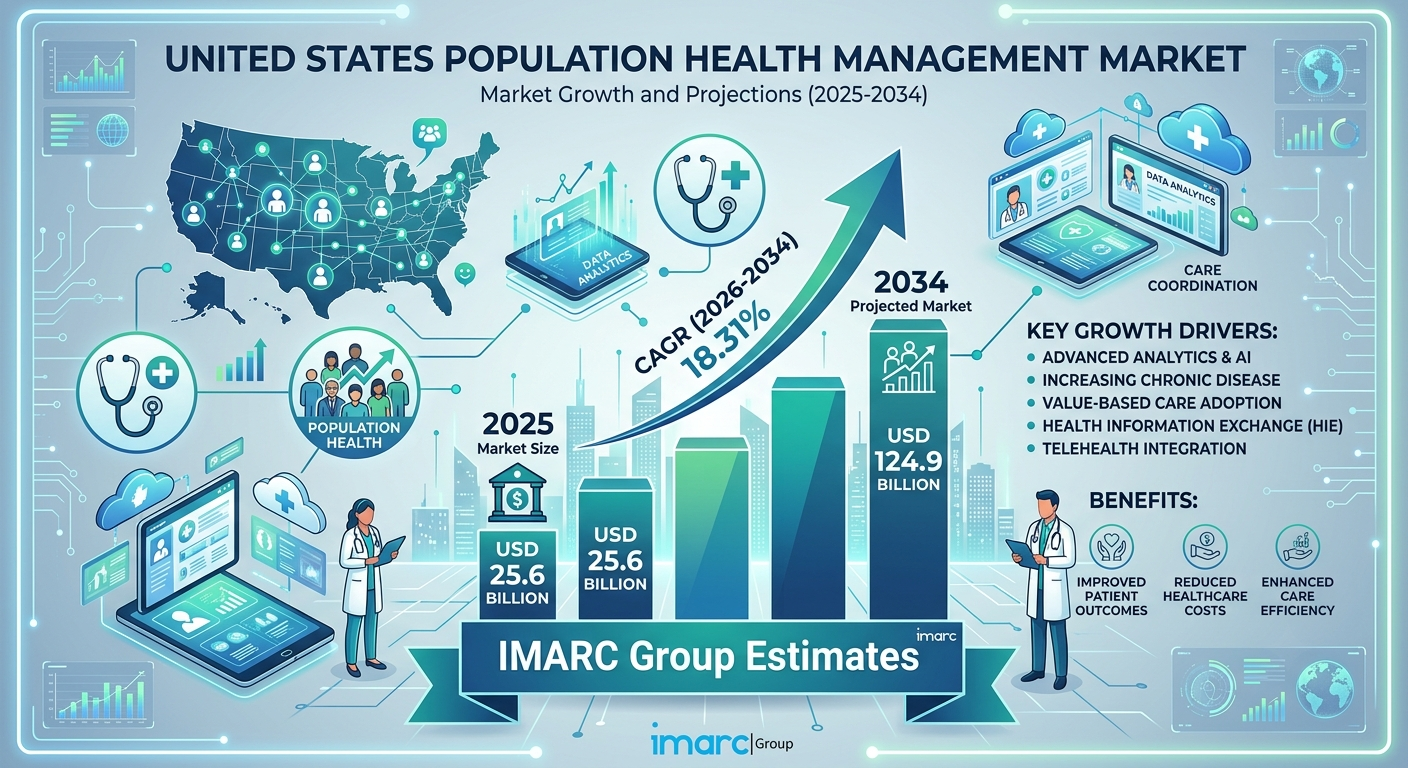
The United States population health management market reached a valuation of USD 25.6 Billion in 2025 and is expected to grow to USD 124.9 Billion by 2034, expanding at a CAGR of 18.31% during 2026-2034. This growth is largely attributed to the increasing emphasis on value-based healthcare delivery, which prioritizes better patient outcomes while controlling overall healthcare expenditures.
The growing burden of chronic illnesses, an aging population, and the widespread adoption of advanced healthcare information technology are further strengthening market demand. Technologies such as predictive analytics, electronic health record (EHR) integration, and data analytics are helping healthcare organizations improve patient monitoring and treatment planning. In addition, government initiatives supporting preventive healthcare, evolving regulatory frameworks, and the transition toward patient-centered care are encouraging hospitals, clinics, and healthcare payers across the country to implement population health management solutions.
The transition from traditional fee-for-service reimbursement models to value-based care is another major factor supporting market expansion. Healthcare organizations are increasingly focusing on treatment effectiveness, patient outcomes, and cost optimization rather than the volume of services delivered. Population health management platforms enable healthcare providers to evaluate population-level health indicators, recognize patients at elevated risk, and introduce personalized interventions to improve health outcomes.
Furthermore, the increasing prevalence of chronic conditions, including diabetes, cardiovascular diseases, and obesity, is generating a greater need for coordinated and preventive healthcare services. In 2023, approximately 93% of older Medicare beneficiaries were living with at least one chronic condition, emphasizing the importance of ongoing monitoring, timely medical intervention, and effective lifestyle management. Population health management solutions help address these requirements by supporting more proactive and coordinated approaches to care.
Explore growth opportunities in the United States population health management market. Access the sample report here: https://www.imarcgroup.com/united-states-population-health-management-market/requestsample
Key Trends Shaping the United States Population Health Management Market
Increasing adoption of value-based healthcare: The U.S. healthcare industry is progressively moving away from fee-for-service reimbursement toward value-based care models that emphasize improved clinical outcomes and greater cost efficiency. Initiatives such as the Hospital Readmissions Reduction Program demonstrate the potential of these approaches, with participating hospitals recording a 1.3% annual reduction in 30-day readmission rates.
Advancements in healthcare information technology: Continuous developments in electronic health records, artificial intelligence, predictive analytics, and big data technologies are supporting market growth. These solutions enable healthcare organizations to consolidate information from multiple sources, evaluate patient histories, and perform risk assessments with greater accuracy.
Growing burden of chronic diseases: The increasing incidence of diabetes, cardiovascular disorders, obesity, and respiratory illnesses is strengthening demand for population health management services. Nearly 60% of American adults were living with at least one chronic condition in 2023, with this figure projected to nearly double by 2050.
Expansion of cloud-based and interoperable platforms: Cloud-enabled technologies and interoperability standards are improving information exchange among healthcare providers, insurers, and clinical facilities. These capabilities support better coordination, facilitate timely access to patient information, and help healthcare organizations implement preventive interventions.
Increasing reliance on predictive analytics and risk assessment: Healthcare providers are increasingly adopting predictive modeling and risk stratification technologies to identify vulnerable patient groups before their conditions worsen. Early identification supports targeted treatment, timely follow-ups, and efforts to minimize preventable hospital admissions.
Greater emphasis on patient engagement technologies: Mobile healthcare applications, telehealth platforms, remote monitoring systems, and automated reminders are encouraging patients to take a more active role in managing their health. These technologies improve communication between patients and providers while supporting the wider implementation of population health management programs.
United States Population Health Management Market Segmentation
The IMARC Group report examines the United States population health management market across several important categories, including component, mode of delivery, end user, and region. This segmentation provides a detailed understanding of industry demand, technology adoption, and emerging opportunities throughout the U.S. healthcare ecosystem.
Component Insights
- Software: Population health management software includes applications for data integration, predictive analytics, patient risk assessment, and engagement management. These platforms help healthcare organizations evaluate population health trends, identify individuals requiring additional care, and develop targeted intervention strategies. Regular software enhancements and AI-enabled capabilities are also improving clinical decision-making and care coordination.
- Services: Services include consulting, implementation, employee training, technical assistance, and managed support. They help healthcare organizations integrate population health management systems into existing operations, streamline workflows, maintain regulatory compliance, and improve the effectiveness of their technology investments.
Mode of Delivery Insights
- Cloud-based: Cloud-based platforms provide scalable and remotely accessible solutions for healthcare data integration, analytics, and patient engagement. Their flexibility supports collaboration across multiple healthcare facilities while reducing the need for extensive physical infrastructure. Improved interoperability and centralized information management further increase their appeal among large healthcare networks.
- Web-based: Web-based solutions can be accessed through standard internet browsers, generally reducing the need for extensive software installation on individual devices. They support patient monitoring, reporting, and care coordination while offering relatively straightforward deployment and simplified IT maintenance.
- On-premises: On-premises solutions are deployed within an organization's own IT infrastructure, providing greater control over data management, system configuration, and security policies. These platforms can appeal to healthcare organizations with specific customization or compliance requirements, although implementation may involve higher initial infrastructure and maintenance costs.
End User Insights
- Healthcare Providers: Hospitals, clinics, and physician groups use population health management platforms to monitor patient populations, coordinate treatment, manage chronic conditions, and strengthen preventive healthcare programs. These applications can improve continuity of care and support efforts to reduce hospital readmissions.
- Healthcare Payers: Insurance companies and health plans use these platforms to assess member health information, evaluate clinical and financial risks, and develop more efficient care management programs. The technology supports expenditure management and aligns with reimbursement models that reward improved patient outcomes.
- Employer Groups: Employers implement population health management solutions to support workplace wellness initiatives, understand employee health patterns, and encourage preventive care. These programs can contribute to better workforce health management while helping organizations manage healthcare-related expenses.
- Government Bodies: Government agencies utilize population health management platforms to oversee public health initiatives, evaluate population-level health indicators, and improve the allocation of healthcare resources. These systems also support preventive health programs, monitoring activities, and compliance-related responsibilities.
Regional Insights
- Northeast: The Northeast benefits from a well-developed healthcare infrastructure, a high concentration of hospitals, and strong participation in value-based care initiatives. These factors support the adoption of population health management technologies to improve care coordination and resource utilization.
- Midwest: Demand across the Midwest is supported by healthcare providers and insurers seeking practical solutions for diverse urban and rural populations. Population health management platforms are increasingly being used to strengthen preventive care, improve coordination, and address avoidable hospital readmissions.
- South: The South presents opportunities for market expansion due to the prevalence of chronic health conditions, including obesity and diabetes. Healthcare organizations are adopting population health management tools to support targeted interventions and improve the delivery of coordinated care.
- West: The Western region benefits from technologically advanced healthcare systems and comparatively high levels of digital adoption. Healthcare organizations are utilizing population health management solutions to integrate electronic health records, apply predictive analytics, and improve data-driven care delivery.
Competitive Landscape of the United States Population Health Management Market
Competition in the United States population health management market is characterized by ongoing technological innovation and the development of increasingly integrated healthcare solutions. Major industry participants are concentrating on platforms that combine predictive analytics, patient risk assessment, care coordination, and engagement capabilities within unified systems.
Key competitive priorities include improving scalability, strengthening interoperability with electronic health record systems, and developing intuitive interfaces for healthcare professionals and patients. Strategic partnerships, mergers, and collaborations among technology providers, healthcare organizations, and insurance companies are also helping market participants expand their capabilities, enhance service offerings, and reach a broader customer base.
Recent Developments in the United States Population Health Management Market
ZeOmega and MedeAnalytics introduce an integrated platform: In July 2025, ZeOmega and MedeAnalytics launched Population Health Navigator, a platform that combines predictive analytics and care management capabilities. The solution is designed to simplify operational processes, improve cost efficiency, and support better healthcare outcomes for providers and payers.
Johns Hopkins introduces Illustra Health: In July 2025, Johns Hopkins launched Illustra Health, a population health analytics platform intended to support value-based care initiatives. The platform combines data analysis, decision-support capabilities, and predictive risk scoring to help address disparities in health equity.
Azara Healthcare and i2i Population Health complete a merger: In February 2025, Azara Healthcare and i2i Population Health merged, supported by an investment from Insight Partners. The combined organization aims to strengthen its population health management capabilities, with its platform serving more than 50 million patients across the United States.
Henry Ford Health launches Populance: In October 2024, Henry Ford Health established Populance, a nonprofit subsidiary focused on advancing population health. Its value-based care services include care management and patient monitoring for approximately 600,000 patients.
Panda Health introduces population health management software: In August 2024, Panda Health launched software designed to analyze patient data and support proactive healthcare delivery. The solution aims to improve care coordination and help hospitals and health systems reduce preventable readmissions.
Challenges Affecting the United States Population Health Management Market
Despite strong growth prospects, several challenges may influence the adoption of population health management technologies across the United States.
Interoperability limitations: Integrating population health management platforms with different electronic health record systems remains a significant challenge. Healthcare organizations often operate multiple legacy IT systems, making seamless data exchange and unified patient information management difficult.
Data privacy and security requirements: Healthcare organizations must address stringent data protection obligations and evolving regulatory requirements. Maintaining secure information systems, managing access controls, and ensuring compliance can increase the complexity and operating costs associated with these platforms.
High implementation and training expenses: Deploying comprehensive population health management solutions may require considerable upfront investment in software, infrastructure, integration, and workforce training. These costs can create adoption barriers for smaller healthcare providers and organizations operating with limited IT budgets.
Investment Opportunities in the United States Population Health Management Market
The United States population health management market presents substantial investment potential, supported by its projected CAGR of 18.31% through 2034 and the increasing emphasis on technology-enabled healthcare delivery.
Cloud-based and interoperable healthcare platforms represent an important area of opportunity as healthcare networks seek scalable systems that facilitate timely information exchange, coordinated care, and efficient data management. Solutions capable of connecting different healthcare environments may attract growing interest from providers and payers.
Artificial intelligence and predictive analytics offer further opportunities for technology developers and investors. Advanced risk stratification tools can help healthcare organizations identify vulnerable populations, prioritize interventions, and reduce avoidable hospitalizations through more informed decision-making.
Patient engagement and remote monitoring technologies also offer promising growth prospects. Mobile health applications, connected monitoring systems, and digital communication tools are supporting the transition toward proactive and patient-centered care. As healthcare organizations seek to improve patient participation and continuity of care, demand for these technologies is expected to remain an important market driver.
United States Population Health Management Market Outlook (2026-2034)
The outlook for the United States population health management market remains positive, supported by the transition toward value-based care, the rising prevalence of chronic diseases, and continued advancements in healthcare information technology. The market is projected to increase from USD 25.6 Billion in 2025 to USD 124.9 Billion by 2034, registering a CAGR of 18.31% during 2026-2034.
Over the coming years, advances in predictive analytics, cloud computing, and digital patient engagement are expected to strengthen the role of population health management in healthcare delivery. Hospitals, healthcare payers, employer groups, and government agencies are likely to continue exploring technology-driven approaches to improve care coordination, manage health risks, and optimize resource utilization through 2034.
Frequently Asked Questions (FAQs): United States Population Health Management Market
1. What is the current size of the United States population health management market?
The United States population health management market was valued at USD 25.6 Billion in 2025.
2. What is the projected growth of the United States population health management market?
The market is expected to grow at a CAGR of 18.31% between 2026 and 2034, reaching USD 124.9 Billion by 2034.
3. What are the major factors driving the United States population health management market?
The primary growth drivers include the adoption of value-based care, the increasing burden of chronic diseases, an aging population, and the growing use of healthcare IT solutions. Developments in predictive analytics, data integration, and electronic health records, along with government support for preventive care, are also contributing to market expansion.
4. How is the United States population health management market segmented by component?
The market is divided into software and services. Software solutions support data integration, patient risk assessment, and predictive analytics, while services include consulting, implementation, training, and managed support.
5. What are the different modes of delivery in the United States population health management market?
The market is categorized into cloud-based, web-based, and on-premises solutions. Cloud-based platforms are particularly attractive to healthcare networks seeking scalability, remote access, and improved data-sharing capabilities.
6. Which end-user categories are included in the market?
The major end-user categories are healthcare providers, healthcare payers, employer groups, and government bodies. Healthcare providers represent a leading segment, using these platforms to manage chronic conditions, coordinate care, and strengthen preventive healthcare services.
7. Which region demonstrates strong adoption of population health management solutions in the United States?
The Northeast demonstrates strong adoption, supported by its established healthcare infrastructure and high hospital concentration. The Midwest, South, and West also contribute to market demand through their respective healthcare technology and care management requirements.
8. What are the recent developments in the United States population health management market?
Notable developments include the July 2025 launch of Population Health Navigator by ZeOmega and MedeAnalytics, the introduction of Illustra Health by Johns Hopkins in July 2025, and the February 2025 merger of Azara Healthcare and i2i Population Health.
9. What challenges affect the United States population health management market?
Major challenges include integrating different electronic health record systems, meeting healthcare data privacy and security requirements, and managing the substantial initial costs associated with technology implementation and staff training.
About IMARC Group
IMARC Group is a leading global management consulting firm specializing in comprehensive market research, strategic advisory services, and feasibility studies. The company provides organizations worldwide with actionable market intelligence and data-driven recommendations to support informed business decisions and sustainable growth.
Contact Us
IMARC Group
Email: [email protected]
United States: +1-201-971-6302

 Arabic
 French
 Spanish
 Portuguese
 Deutsch
 Turkish
 Dutch
Dutch
 Italiano
 Russian
 Romaian
 Portuguese (Brazil)
 Greek
Greek