


Algae Products MarketOutlook 2026-2034: Size, Share, Trends, Demand and Forecast
Market Overview
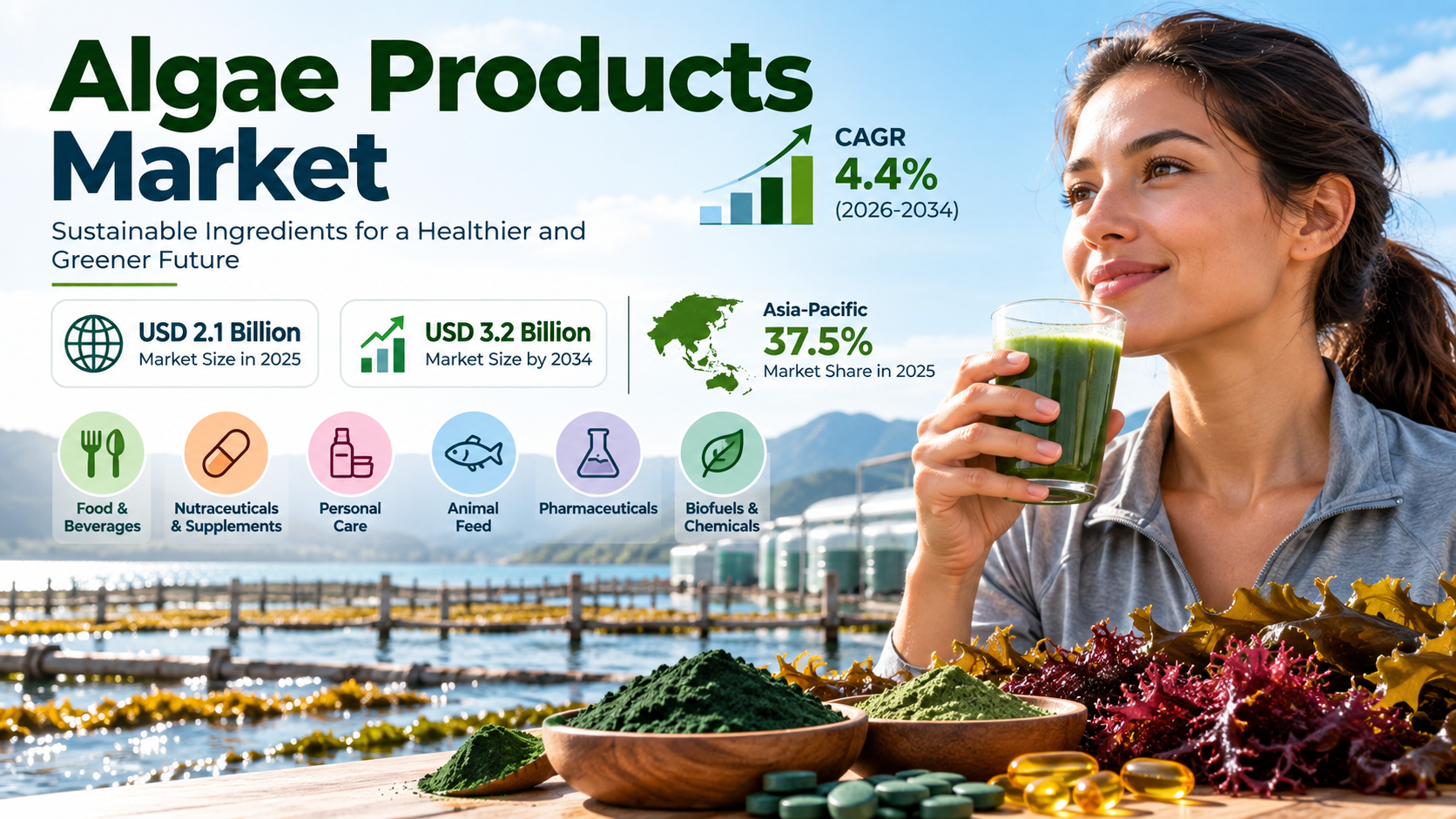
The global algae products market size is experiencing steady growth as industries increasingly adopt sustainable, nutrient-rich, and bio-based ingredients across food and beverages, nutraceuticals, personal care, pharmaceuticals, and animal feed. The market reached USD 2.1 Billion in 2025 and is projected to reach USD 3.2 Billion by 2034, expanding at a CAGR of 4.4% during 2026–2034. Asia-Pacific dominated the market in 2025, accounting for 37.5% of the global market share.
The industry is being influenced by growing demand for plant-based nutrition, increasing awareness of environmental sustainability, advancements in algae cultivation technologies, and expanding applications for algae-derived proteins, lipids, pigments, and hydrocolloids. Improvements in fermentation, extraction, and harvesting techniques are also helping manufacturers enhance production efficiency and develop high-value ingredients for diverse commercial applications.
What Is Driving Algae Products Market Growth?
Rising Demand for Plant-Based and Nutrient-Rich Ingredients
Growing consumer preference for plant-based diets, functional foods, and environmentally responsible ingredients is supporting demand for algae-derived products. Algae provide valuable nutrients, including proteins, omega-3 fatty acids, antioxidants, vitamins, and natural pigments, making them suitable for applications across food, nutraceuticals, dietary supplements, and personal care.
Microalgae and seaweed are increasingly being incorporated into nutritional formulations as consumers seek alternatives to conventional animal-derived ingredients. Algae-derived omega-3 fatty acids, particularly EPA and DHA, are gaining attention among consumers looking for vegan-friendly supplements and sustainable sources of essential fatty acids.
Algae also offer potential environmental advantages because cultivation can require less land and freshwater than many conventional agricultural crops. These characteristics are encouraging manufacturers to explore algae as a renewable source of ingredients for food production, nutritional supplements, cosmetics, and other industrial applications.
Expanding Applications Across Multiple Industries
The growing versatility of algae-derived ingredients is broadening their commercial applications. In food and beverages, algae-based compounds such as alginate, carrageenan, and agar are used as thickening, stabilizing, and gelling agents. Microalgae such as spirulina and chlorella are also used in nutritional powders, functional beverages, and protein-enriched products.
The nutraceutical industry represents another important area of demand. Algae-derived lipids, antioxidants, and other bioactive compounds are used in dietary supplements and specialized nutritional formulations. Meanwhile, the cosmetics industry incorporates marine-derived extracts into skincare and personal care products.
Additional opportunities are emerging in animal feed, aquaculture, pharmaceuticals, agriculture, and biofuels. Algae-based ingredients can support sustainable feed formulations, natural agricultural inputs, and bio-based manufacturing processes.
This broadening application base is encouraging companies to diversify their product portfolios and invest in technologies that improve the quality, consistency, and commercial scalability of algae-derived ingredients.
Technological Advancements in Algae Cultivation and Processing
Technological innovation is helping algae manufacturers improve production efficiency and expand commercial output. Controlled photobioreactors, optimized fermentation processes, improved harvesting techniques, and advanced extraction systems are supporting the development of higher-quality ingredients.
These technologies enable manufacturers to better manage cultivation conditions, improve biomass productivity, and maintain consistent product characteristics. Advances in lipid extraction and processing are also supporting the production of algae-derived omega-3 ingredients for nutraceuticals and functional nutrition.
Artificial intelligence, real-time monitoring, and data-driven cultivation management are creating additional opportunities to optimize algae production. By monitoring factors such as light exposure, temperature, nutrient availability, and carbon dioxide levels, manufacturers can improve process control and potentially reduce operating costs.
These developments are strengthening the commercial potential of algae-based products across established and emerging industries.
Request a Sample Report for Detailed Evaluation: https://www.imarcgroup.com/algae-products-market/requestsample
Algae Products Market Trends to Watch
Three major trends are shaping the future of the global algae products industry.
Plant-Based Omega-3 Nutraceutical Ingredients
Increasing consumer preference for sustainable and plant-based nutritional supplements is driving demand for algae-derived omega-3 ingredients. Microalgae provide a direct source of EPA and DHA, offering alternatives to conventional marine oils for consumers seeking vegan-friendly formulations.
Manufacturers are investing in advanced lipid extraction, stabilization, and processing technologies to improve product purity, consistency, and sensory performance.
In 2025, GC Rieber VivoMega launched Algae 1060 TG Premium, an algae-based omega-3 ingredient rich in EPA and DHA designed for nutraceutical formulations. The company also introduced technologies including VivoTech, VivoSure, and VivoSense to improve product stability, quality control, and sensory characteristics.
These developments reflect the growing emphasis on high-quality, plant-based omega-3 ingredients for dietary supplements and functional nutrition products.
Algae-Based Biostimulants in Sustainable Agriculture
The growing demand for sustainable agricultural inputs is creating opportunities for algae-derived biostimulants. These products contain bioactive compounds that can support plant metabolism, nutrient utilization, and stress tolerance, helping agricultural producers improve crop performance while reducing reliance on certain conventional chemical inputs.
In 2025, AlgaEnergy launched four CE-certified microalgae-based biostimulants designed to improve olive crop performance and oil quality. According to the supplied report, field trials indicated improvements in selected oil-quality characteristics and olive production outcomes.
These developments demonstrate the expanding role of algae beyond food and nutritional applications. Algae-based agricultural products can create additional commercial opportunities by combining biological innovation with sustainable farming practices, particularly in olive-producing markets such as Spain, Italy, and Greece.
Expansion of Algae-Based Nutrition Supply Chains
Growing demand for plant-based nutrition is encouraging investment in algae ingredient production, inventory management, and distribution networks. Manufacturers are expanding their capabilities to improve the availability of algae-derived lipids and proteins for nutraceutical and functional food producers.
Reliable supply chains are particularly important for ingredients that require consistent quality, specialized processing, or controlled storage conditions. Stronger distribution systems can help suppliers reach new markets while meeting the requirements of manufacturers operating across multiple regions.
In 2025, Canada-based Better Origin Ingredients secured USD 1.25 Million in funding to expand its portfolio of plant-based omega-3 ingredients. The company supplies algal DHA oils and other sustainable lipid products for dietary supplements and functional nutrition applications.
The funding was directed toward increasing inventory and strengthening distribution across North America, reflecting the growing importance of supply chain development in the algae-based nutrition sector.
Algae Products Market Segmentation
The global algae products market is analyzed by type, source, form, distribution channel, and application, with each segment reflecting different commercial uses and consumer requirements.
By Type
-
Lipids
-
Carrageenan
-
Carotenoids
-
Algal Protein
-
Alginate
-
Others
Lipids dominated the type segment in 2025, accounting for approximately 32.5% of the market. This leading position reflects the commercial importance of algae-derived fatty acids, particularly the long-chain omega-3 fatty acids EPA and DHA.
Algal lipids are used in dietary supplements, infant nutrition, functional foods, aquaculture feed, and pharmaceutical products. Their applications are supported by growing awareness of omega-3 fatty acids and their role in nutritional formulations.
Consumer interest in vegan-friendly and sustainably sourced supplements is encouraging manufacturers to develop alternatives to conventional fish oil. Algae-derived omega-3 ingredients offer an option for consumers seeking plant-based formulations without relying directly on marine fish resources.
Improvements in fermentation, lipid extraction, and purification technologies are also helping manufacturers improve product consistency and production efficiency. These developments are strengthening the position of algae-derived lipids across health and nutrition markets.
Other important product categories include carrageenan and alginate, which are widely used as hydrocolloids, carotenoids used as natural pigments and bioactive ingredients, and algal proteins used in food and nutritional formulations.
By Source
-
Brown Algae
-
Blue-Green Algae
-
Red Algae
-
Green Algae
Brown algae led the source segment in 2025, accounting for approximately 38.5% of the market. Their commercial importance is supported by the presence of valuable compounds, including alginate, fucoidan, laminarin, iodine, and mannitol.
Brown macroalgae species such as Laminaria, Undaria, Sargassum, and Ascophyllum are used in food processing, nutraceuticals, pharmaceuticals, and personal care products. Alginate is valued for its thickening and stabilizing properties, while other brown algae compounds are incorporated into functional and bioactive formulations.
The cosmetics and personal care industries also use marine-derived extracts from brown algae in skincare products.
In 2025, Origin by Ocean partnered with the CABB Group to develop a biorefinery in Finland intended to convert invasive brown algae biomass into industrial ingredients, including alginate and fucoidan.
This initiative highlights the potential to transform underutilized algae resources into commercially valuable materials for food and beverages, cosmetics, and pharmaceutical applications.
Blue-green algae, including spirulina, and green algae, including chlorella, also contribute to market development through their use in nutritional supplements, protein ingredients, and functional foods. Red algae remain important for hydrocolloids such as carrageenan and agar.
By Form
-
Solid
-
Liquid
Solid-form algae products dominated the market in 2025, accounting for approximately 58.5% of the market. Their leading position reflects their broad use across dietary supplements, food ingredients, pharmaceuticals, and nutritional products.
Solid algae products include powders, tablets, capsules, granules, and flakes. These formats offer practical advantages in storage, transportation, shelf life, and standardized dosing, making them suitable for commercial distribution.
Spirulina and chlorella powders are widely used in nutritional supplements and functional food formulations. Algae-derived omega-3 ingredients are also available in capsule formats, while carotenoids and other algae extracts can be incorporated into standardized nutritional products.
Manufacturers value solid ingredients because they can be blended, encapsulated, or incorporated into different product formulations. Powdered algae ingredients are particularly useful for contract manufacturing and private-label products.
Liquid algae products also serve important applications in specialized nutritional formulations, cosmetics, food processing, and industrial ingredients. Their use depends on the characteristics of the active compounds and the processing requirements of the end product.
By Distribution Channel
-
Online
-
Offline
Offline distribution dominated the market in 2025, accounting for approximately 72.5% of the market. The segment benefits from established retail networks, including pharmacies, health food stores, supermarkets, specialty nutrition retailers, and ingredient distributors.
Consumers often prefer purchasing nutritional supplements and functional products through physical stores, where they can examine packaging, ingredient labels, and product information before making a decision. Recommendations from pharmacists and retail staff can also influence the selection of algae-based supplements.
In business-to-business markets, food manufacturers and ingredient processors frequently procure algae-derived hydrocolloids, pigments, and extracts through established distributors and direct supplier relationships.
Offline networks can also support specialized logistics and storage requirements for certain algae ingredients.
Online distribution, meanwhile, is creating additional opportunities for manufacturers and retailers to reach consumers directly. E-commerce platforms enable broader product discovery, convenient purchasing, and access to specialized algae-derived supplements and functional nutrition products.
By Application
-
Food and Beverages
-
Nutraceuticals and Dietary Supplements
-
Personal Care
-
Feed
-
Pharmaceuticals
-
Chemicals
-
Others
Food and beverages dominated the application segment in 2025, accounting for approximately 35.5% of the market. This leading position reflects the widespread use of algae-derived ingredients in food processing, functional nutrition, and alternative food formulations.
Seaweed-derived hydrocolloids, including alginate, carrageenan, and agar, are used as thickening, stabilizing, and gelling agents in dairy products, bakery fillings, sauces, desserts, and plant-based beverages.
Microalgae such as spirulina and chlorella are also incorporated into nutritional bars, health drinks, protein products, and functional foods because of their nutritional composition.
In 2024, Brevel launched a demonstration facility in Israel to scale the production of microalgae proteins using fermentation technology. The facility supports the development of chlorella-derived protein concentrates for plant-based meat and dairy alternatives.
These developments demonstrate the potential of algae to support food innovation and provide additional ingredient options for manufacturers developing sustainable and nutrient-rich products.
Other applications, including nutraceuticals, personal care, animal feed, pharmaceuticals, and chemicals, are contributing to the diversification of algae-derived products across industrial value chains.
Regional Algae Products Market Outlook
Asia-Pacific
Asia-Pacific accounted for 37.5% of the global algae products market in 2025, making it the leading regional market. Growth is supported by extensive seaweed cultivation infrastructure, established dietary traditions, marine aquaculture activity, and increasing demand for algae-derived ingredients.
Countries across the region have developed significant macroalgae cultivation and processing capabilities, providing raw materials for food, nutraceutical, personal care, and industrial applications.
Growing consumer interest in plant-based nutrition and wellness products is also encouraging demand for algae-derived omega-3 fatty acids, proteins, antioxidants, and other functional ingredients.
The region's expanding manufacturing base and established seaweed supply chains provide important advantages for ingredient production and commercialization.
China, India, Japan, South Korea, Australia, and Indonesia represent important markets within the region. Increasing investments in nutritional ingredients, aquaculture feed, and sustainable food production are creating further opportunities for manufacturers.
North America
North America represents an important market for algae products, supported by biotechnology research, demand for functional foods, and the established dietary supplement industry.
The United States is a significant contributor, with applications spanning nutritional supplements, food ingredients, aquaculture feed, cosmetics, and emerging bio-based technologies.
In 2024, researchers at the University at Buffalo initiated a USD 2 Million project, financed by the U.S. Department of Energy, to improve algae-derived biofuel production. The project used artificial intelligence, polyculture farming methods, and genomic surveillance to identify infections and improve cultivation methods.
These initiatives demonstrate the potential of advanced research to improve algae production efficiency and broaden its industrial applications.
Canada also contributes to regional development through investments in sustainable nutrition ingredients and algae-derived omega-3 products. Continued innovation in cultivation, fermentation, and extraction is supporting the expansion of algae-based products across North America.
Europe
Europe represents an important market for algae products, supported by sustainability initiatives, demand for plant-based ingredients, and the development of bio-based manufacturing technologies.
Countries such as Germany, France, the United Kingdom, Italy, and Spain offer opportunities across food processing, nutraceuticals, cosmetics, and sustainable agriculture.
The region's focus on environmentally responsible products is encouraging the development of algae-derived proteins, natural pigments, hydrocolloids, and agricultural biostimulants.
In 2024, GreenCoLab presented algae-based food prototypes at Vitafoods Europe, including vegan caviar, algae-derived beer, and algae burger patties developed using microalgae species such as chlorella and tetraselmis.
These products illustrate the versatility of algae as an ingredient for food innovation and alternative protein development.
Europe is also seeing investment in the conversion of algae biomass into industrial materials. Such developments are helping expand the use of algae-derived ingredients across food, personal care, pharmaceutical, and agricultural applications.
Latin America
Latin America presents opportunities for algae products through its coastal resources, growing interest in sustainable nutrition, and developing capabilities in specialized ingredient production.
Brazil and Mexico are important markets for food, nutraceutical, and personal care applications. Increasing demand for sustainable omega-3 ingredients and functional nutrition products is creating opportunities for manufacturers and ingredient suppliers.
In 2025, Naturmega opened a supercritical fluid fractionation facility in South America dedicated to omega-3 production. The facility produces concentrated EPA and DHA ingredients, including plant-based alternatives such as EssentiOmega Algae for vegan nutrition products.
This development highlights the region's potential to strengthen its role in sustainable omega-3 production and expand the commercial use of algae-derived ingredients.
Continued investment in processing technologies and ingredient innovation can support further opportunities across the region's nutrition and biotechnology industries.
Middle East and Africa
The Middle East and Africa region is emerging as a promising market for algae products, supported by interest in sustainable nutrition, agricultural innovation, and the development of the blue economy.
Algae offer potential applications in food production, animal feed, agriculture, and bio-based manufacturing, particularly in environments where resource-efficient production methods are important.
In 2025, Flat6Labs invested in Green Desert Technologies, a Saudi startup developing algae-based biomanufacturing systems designed for desert conditions. The company uses chemical engineering, the Internet of Things, and machine learning to improve cultivation efficiency and reduce production costs.
These innovations highlight the potential for algae cultivation systems adapted to regional environmental conditions.
Growing investment in biotechnology and sustainable production methods may help broaden the commercial applications of algae across food, agriculture, and industrial markets throughout the region.
Competitive Landscape
Companies in the global algae products market are competing through production technology, ingredient innovation, capacity expansion, sustainability initiatives, and strategic partnerships.
Established ingredient manufacturers are leveraging advanced fermentation platforms, controlled cultivation systems, extraction technologies, and extensive distribution networks to strengthen their market positions. Product diversification into high-value ingredients, including astaxanthin, phycocyanin, algal proteins, and EPA/DHA concentrates, is also an important competitive strategy.
Partnerships with food manufacturers, nutraceutical companies, aquaculture operators, and pharmaceutical businesses enable suppliers to expand their applications and develop long-term commercial relationships.
Emerging companies are differentiating themselves through specialized cultivation technologies, innovative algae strains, organic certifications, and sustainability-focused product portfolios.
Investment in research and development is helping companies improve biomass productivity, product purity, and processing efficiency. At the same time, the development of reliable supply chains and scalable production facilities is becoming increasingly important for meeting demand across global markets.
Major companies identified in the global algae products market include:
-
ACCEL Carrageenan Corporation
-
Algatechnologies Ltd.
-
Algenol
-
Archer-Daniels-Midland Company
-
BASF SE
-
Caldic B.V.
-
Cargill Incorporated
-
Cellana Inc.
-
Corbion N.V.
-
Cyanotech Corporation
-
DuPont de Nemours Inc.
-
Koninklijke DSM N.V.
-
TBK Manufacturing Corporation
Latest Industry Developments
March 2026: Veramaris received the NASF Sustainability Award 2026 for its algae-based omega-3 innovation used in aquaculture feed. The company produces EPA and DHA oils from marine microalgae through fermentation, providing an alternative to conventional fish oil and helping reduce pressure on marine fish resources.
February 2026: GC Rieber VivoMega introduced Algae 1045 TG, a high-potency vegan omega-3 ingredient containing DHA and EPA in triglyceride form for nutraceutical products. The ingredient is designed for plant-based supplement formulations and is manufactured using the company's SuperLight algae-oil processing technology to improve oxidative stability and production efficiency.
January 2026: Kybele's Garden highlighted its algae biotechnology platform for producing bioactive ingredients for agriculture, food, and cosmetics. The company uses a co-culture fermentation process intended to improve bioavailability, stability, and functional performance while supporting zero-waste production. It is also expanding fermentation capacity and commercial partnerships.
Where Are the Biggest Algae Products Market Opportunities?
The global algae products industry presents opportunities across several areas:
-
Plant-based omega-3 ingredients: Algae-derived EPA and DHA provide alternatives to conventional marine oils for vegan nutrition and dietary supplements.
-
Functional foods and beverages: Spirulina, chlorella, algal proteins, and natural pigments can support the development of nutrient-rich food products.
-
Sustainable personal care: Marine-derived extracts and algae bioactives offer opportunities for skincare and cosmetic formulations.
-
Agricultural biostimulants: Microalgae-based products can support sustainable crop management and improved plant performance.
-
Aquaculture and animal feed: Algae-derived nutrients can provide alternative sources of essential fatty acids and other functional ingredients.
-
Advanced cultivation technologies: Photobioreactors, fermentation systems, and AI-enabled monitoring can improve production efficiency and consistency.
-
Bio-based industrial ingredients: Algae-derived hydrocolloids, pigments, and other compounds can support applications across food, pharmaceuticals, and chemicals.
-
Emerging-market expansion: Established seaweed cultivation infrastructure and growing consumer demand in Asia-Pacific create opportunities for manufacturers and ingredient suppliers.
These opportunities are particularly relevant as businesses increasingly seek sustainable, nutrient-rich, and versatile ingredients. Companies that combine effective cultivation methods with advanced processing and reliable distribution can strengthen their position in the expanding algae products industry.
Get Detailed Algae Products Market Intelligence
The headline market figures provide a useful overview of the industry's direction, but businesses evaluating market entry, product development, investment opportunities, competitive positioning, or regional expansion may require more detailed market intelligence.
A comprehensive algae products market report can help businesses assess:
-
Market size and growth forecasts
-
Type-wise market segmentation
-
Source-wise analysis
-
Solid and liquid product formats
-
Distribution channels
-
Application-specific opportunities
-
Regional and country-level markets
-
Competitive landscape and company profiles
-
Emerging technologies and product innovations
-
Market trends and growth drivers
-
Industry developments and strategic opportunities
Access to detailed market insights can support decisions involving new ingredient development, production capacity expansion, supply chain planning, and entry into high-potential application markets.
Request a Sample Report: https://www.imarcgroup.com/algae-products-market/requestsample
Algae Products Market FAQs
What is the current size of the global algae products market?
The global algae products market reached USD 2.1 Billion in 2025 and is projected to reach USD 3.2 Billion by 2034.
What is the expected CAGR of the algae products market?
The global algae products market is projected to grow at a CAGR of 4.4% during 2026–2034.
Which region leads the algae products market?
Asia-Pacific led the global algae products market in 2025, accounting for 37.5% of the market share. Its extensive seaweed cultivation infrastructure, established dietary traditions, and growing demand for health and wellness products support its leading position.
Which type segment dominates the algae products market?
Lipids represented the largest type segment in 2025, accounting for approximately 32.5% of the market. Demand is supported by the use of algae-derived EPA and DHA in dietary supplements, functional foods, infant nutrition, and aquaculture feed.
Which source segment holds the largest market share?
Brown algae led the source segment in 2025, accounting for approximately 38.5% of the market. Its commercial importance is linked to compounds such as alginate and fucoidan, which are used in food processing, nutraceuticals, pharmaceuticals, and personal care products.
Which form dominates the algae products market?
Solid-form algae products accounted for approximately 58.5% of the market in 2025, supported by their use in powders, tablets, capsules, granules, and flakes for nutritional and industrial applications.
Which application segment leads the algae products market?
Food and beverages represented the largest application segment in 2025, accounting for approximately 35.5% of the market. Algae-derived ingredients are used as stabilizers, thickeners, gelling agents, natural pigments, and nutritional additives.
What are the major trends in the algae products market?
Key trends include rising demand for plant-based omega-3 ingredients, increasing use of algae-based agricultural biostimulants, expansion of algae-based nutrition supply chains, technological advancements in cultivation and extraction, and growing applications in sustainable food, nutraceutical, and personal care products.
Conclusion
The global algae products market is evolving as industries increasingly adopt sustainable, nutrient-rich, and versatile ingredients across food and beverages, nutraceuticals, personal care, pharmaceuticals, agriculture, and animal feed. Valued at USD 2.1 Billion in 2025, the market is projected to reach USD 3.2 Billion by 2034, registering a CAGR of 4.4% during 2026–2034.
Growth opportunities are emerging across algae-derived lipids, proteins, hydrocolloids, natural pigments, agricultural biostimulants, and sustainable omega-3 ingredients. Asia-Pacific maintains its leading position through its established seaweed cultivation infrastructure, while North America and Europe continue to support innovation through biotechnology research, advanced processing, and the development of high-value applications.
Companies that invest in cultivation efficiency, ingredient innovation, sustainable production, and reliable supply chains can strengthen their competitive positioning in the evolving algae products industry.
About the Author
IMARC Group is a global market research company providing data-driven insights and expert consulting services to businesses seeking to achieve their strategic objectives. With a multidisciplinary team of industry experts, IMARC delivers market intelligence across sectors including energy and mining, construction and manufacturing, automotive, chemicals and materials, and more.
Media & Sales Contact
IMARC Group
United States: +1-201-971-6302
India: +91-120-433-0800
United Kingdom: +44-753-714-6104

 English
 Arabic
 French
 Spanish
 Portuguese
 Deutsch
 Turkish
 Dutch
Dutch
 Italiano
 Russian
 Romaian
 Portuguese (Brazil)