


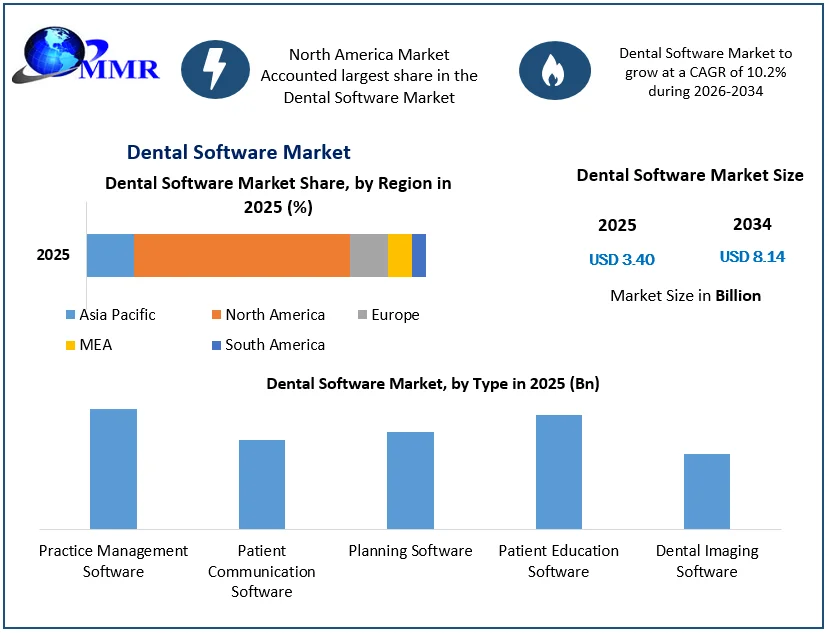
Dental Software Market Forecast 2034: USD 3.40 Billion in 2025 to USD 8.14 Billion by 2034 at 10.2% CAGR.
Dental Software Market Forecast 2034: USD 3.40 Billion in 2025 to USD 8.14 Billion by 2034 at 10.2% CAGR.
The global dental software market was valued at USD 3.40 billion in 2025 and is projected to reach USD 8.14 billion by 2034, expanding at a compound annual growth rate (CAGR) of 10.2% during 2026–2034, according to Maximize Market Research. Increasing dental practice digitalization, demand for efficient clinic management, cloud-based software adoption, and advances in digital imaging are reshaping the global dental technology landscape.
Dental clinics and hospitals are increasingly adopting software platforms to streamline appointments, manage electronic patient records, automate billing, coordinate treatment plans, and improve communication with patients. As dental practices expand and patient expectations evolve, integrated digital systems are becoming important tools for operational efficiency and patient-centered care.
The transition toward connected dental ecosystems is also creating opportunities for technology providers to deliver scalable solutions that combine practice administration, clinical workflows, imaging, and financial management within a unified platform.
Request a Free Sample of Full Market Report Link: https://www.maximizemarketresearch.com/request-sample/187455/
AI-Driven Dentistry and Cloud Technology Reshape Dental Practice Management
Cloud computing is a major driver of the dental software market, offering remote access, scalable infrastructure, and reduced dependence on local IT systems. Software-as-a-Service platforms can help practices coordinate operations, access patient information securely, and manage multiple locations through centralized systems.
Artificial intelligence, digital imaging integration, and data analytics are creating additional opportunities for modern dental workflows. AI-assisted image analysis may support clinical assessment, while automated scheduling, patient reminders, and revenue-cycle tools can help reduce administrative workloads. Clinical decisions, however, continue to require appropriate professional judgment and validated technologies.
Digital dentistry is also becoming increasingly interconnected with intraoral scanning, computer-aided design and manufacturing, three-dimensional imaging, and treatment-planning tools. This convergence supports more coordinated workflows between clinicians, laboratories, and patients.
For dental software vendors, future differentiation will depend on interoperability, cybersecurity, ease of use, regulatory compliance, and the ability to demonstrate measurable operational value.
Get Free Sample of Full Market Report Link: https://www.maximizemarketresearch.com/market-report/dental-software-market/187455/
Dental Software Market Segmentation: Key Growth Opportunities
According to Maximize Market Research, the market is segmented by type and end user.
-
By Type
-
Practice Management Software
-
Patient Communication Software
-
Planning Software
-
Patient Education Software
-
Dental Imaging Software
Practice management software is the leading type segment. The report projects this segment to grow at a CAGR of 9.1% and reach USD 3.8 billion by 2034. Demand is supported by appointment scheduling, patient-record management, billing automation, reporting, and practice-performance analytics.
-
-
By End User
-
Dental Clinics
-
Hospitals
Dental clinics represent a core customer group as independent practices and multi-location dental organizations seek to improve efficiency, patient engagement, and administrative coordination. Hospitals also use dental software to support clinical documentation and integrated care workflows.
-
Cloud-based deployment, digital imaging integration, and automation are important cross-market opportunities as providers modernize existing systems and adopt connected dental technologies.
Industry Developments Accelerate Cloud-Based Dental Innovation
Recent developments highlighted by Maximize Market Research demonstrate the growing emphasis on integrated platforms, cloud adoption, and automated dental administration.
-
Planet DDS — January 2026: The company expanded enterprise adoption of its cloud-based dental platform, supporting standardized workflows and centralized management across multi-location practices.
-
Smile Partners USA — May 2026: The organization selected Planet DDS's Denticon platform across 120 locations, reflecting demand for centralized cloud-based practice management.
-
Carestream Dental — June 2026: The company expanded its partnership with Vyne Dental to integrate revenue-management and real-time eligibility capabilities, targeting more efficient insurance-related workflows.
These developments illustrate how dental software providers are competing through broader platform capabilities, operational automation, and partnerships that connect clinical systems with administrative processes.
Future innovation is likely to focus on AI-assisted workflows, interoperable patient records, integrated imaging, digital treatment planning, and tools that improve communication between dental teams and patients.
Regional Outlook: Seven Countries Shaping Dental Software Adoption
United States: North America held approximately 55% of the global dental software market in 2025 and is expected to grow at a CAGR of around 10.8%, according to MMR. The United States benefits from established dental software providers, cloud adoption, and demand for efficient practice management across independent clinics and dental support organizations.
United Kingdom: Digital practice management, patient communication, and imaging integration offer opportunities as dental providers seek more efficient administrative and clinical workflows. Data protection and system interoperability remain important considerations.
Germany: Germany's established healthcare and dental technology ecosystem supports opportunities for practice management platforms, digital imaging, and integrated clinical systems. Data security and compatibility with existing infrastructure influence purchasing decisions.
Japan: An aging population and increasing demand for efficient healthcare services create opportunities for digital dental records, appointment management, and connected treatment-planning systems.
South Korea: Advanced digital infrastructure and technology adoption provide opportunities for cloud-based dental administration, imaging integration, and patient engagement tools.
China: Expanding dental service infrastructure and increasing digitalization create potential opportunities for scalable clinic-management platforms and integrated dental imaging systems.
India: Growing private dental practice networks and increasing interest in digital healthcare create opportunities for affordable cloud software, appointment automation, and centralized patient records. Cost sensitivity, digital skills, and implementation support remain important adoption factors.
MMR identifies North America as the dominant regional market. The country trends above provide qualitative strategic context and should not be interpreted as independently quantified national market forecasts.
Challenges and Future Opportunities in Digital Dentistry
Despite its growth potential, the dental software market faces challenges related to implementation costs, cybersecurity, data migration, staff training, and limited awareness of digital tools among some providers. Smaller practices may face financial and technical barriers when upgrading legacy systems.
Vendors can address these challenges through flexible pricing, user-friendly interfaces, training programs, secure cloud infrastructure, and solutions that integrate with existing clinical equipment. Improved interoperability can also help reduce fragmented workflows and duplicated data entry.
Long-term opportunities include AI-assisted dental imaging, automated insurance processing, patient engagement platforms, digital treatment planning, and enterprise software for multi-location dental groups. Providers that combine reliable technology with practical implementation support will be better positioned to capture demand.
Competitive Landscape and Strategic Outlook
Maximize Market Research identifies Henry Schein One, Carestream Dental, Open Dental Software, Planet DDS, Curve Dental, CareStack, DentiMax, Patterson Companies, Practice-Web, ACE Dental Software, Software of Excellence, ABELDent, MOGO, Dental4Windows, and b-plus Dental Software among the market's key participants.
Competition is increasingly shaped by cloud capabilities, product integration, imaging functionality, automation, customer support, and scalability. As dental organizations modernize their operations, software providers have opportunities to strengthen market presence through product innovation, strategic partnerships, and solutions tailored to different practice sizes.
The future of dental software will be defined by connected workflows that help practices improve efficiency while supporting consistent, patient-focused care.
Nitromethane Market https://www.maximizemarketresearch.com/request-sample/318636/
Thermal Power Plant Market https://www.maximizemarketresearch.com/request-sample/318656/
About Maximize Market Research
Maximize Market Research Pvt. Ltd. (MMR) is a global market research and consulting firm known for delivering accurate, actionable, and data-driven insights. Our expertise spans diverse industries — including medical devices, pharmaceuticals, technology, automotive, electronics, chemicals, personal care, and consumer goods. We provide services such as market-validated forecasts, competitive intelligence, strategic consulting, and industry impact analysis, helping businesses navigate market complexities and achieve sustainable growth.
2nd Floor, Navale IT Park Phase 3
Pune Banglore Highway, Narhe
Pune, Maharashtra 411041, India
+91 9607365656
[email protected]

 English
 French
 Spanish
 Portuguese
 Deutsch
 Turkish
 Dutch
Dutch
 Italiano
 Russian
 Romaian
 Portuguese (Brazil)
 Greek
Greek