


CNC Machined Components for Precision Industrial Needs
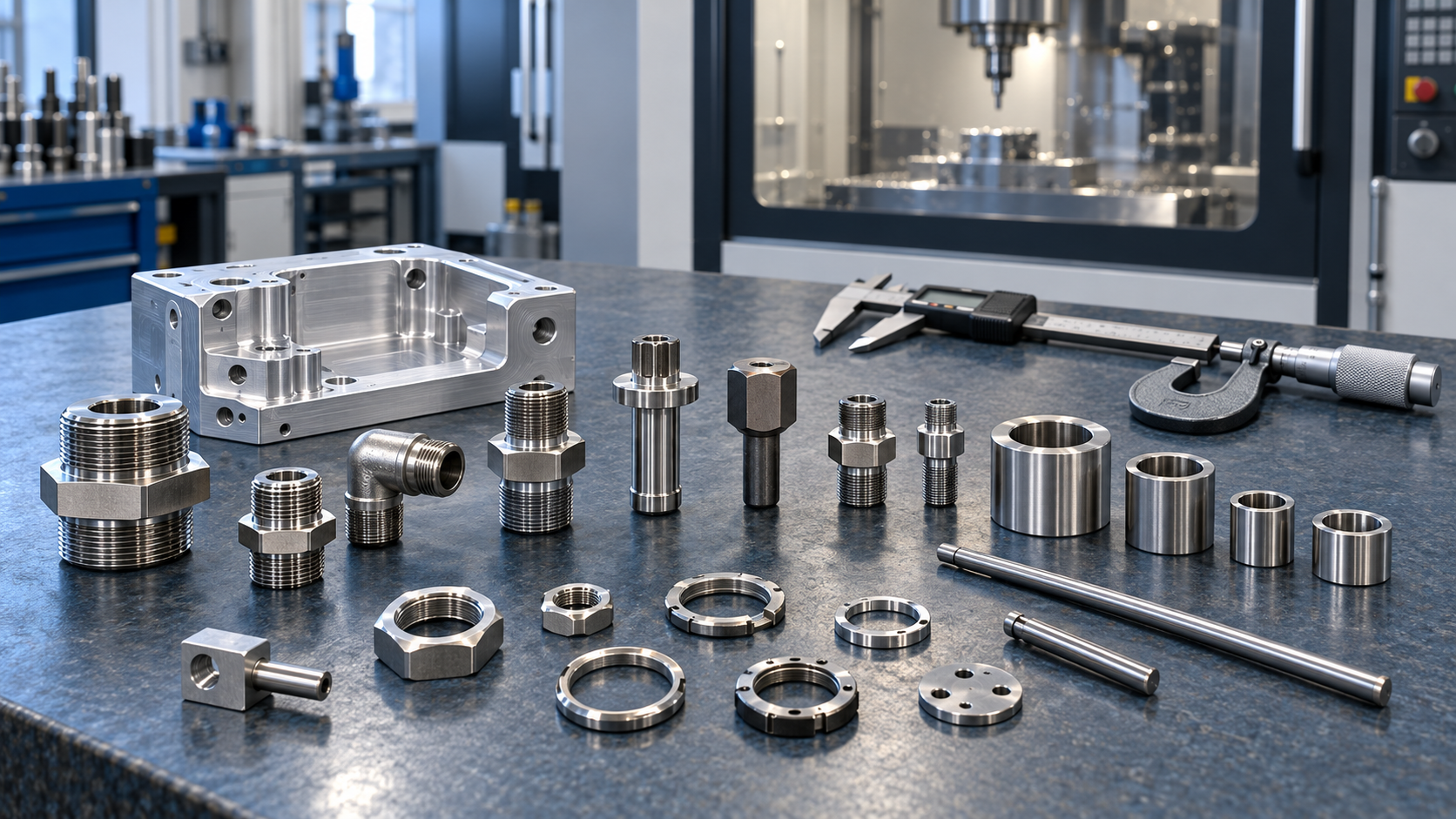
A shaft lands 0.04 mm over tolerance. Nobody catches it until assembly, when the bearing seat runs hot and the line stops. That's what bad CNC machined components cost you, and the invoice never shows it. For OEMs and machine builders, finding a supplier isn't hard. Finding one whose batch 40 measures like batch one is.
What CNC Machined Components Actually Need to Hold
Turned shafts, bushes, spacers, flanges, studs and milled brackets cover most OEM orders. Materials usually run from EN-series alloy steels to stainless 304 and 316, brass and aluminium. The drawing decides everything else.
Tolerances That Mean Something
General machining tolerance usually follows ISO 2768. Critical features, such as bearing seats, need a tighter fit called out on the drawing, typically IT6 or IT7 under ISO 286. Here's what buyers underestimate: thin-walled parts move when clamped and move again when released, so holding tolerance there is harder than any quote suggests.
The Detail Buyers Skip
Surface finish. Buyers specify diameter and forget Ra. A sealing face at 1.6 µm and one at 3.2 µm look identical in a photo. One of them leaks.
Five Questions That Separate a Machine Shop from a Broker
-
How do you inspect? Good: calibrated gauges or a CMM, with a dimensional report per batch. Bad: "Our operators check every piece by eye."
-
Can you prove the material? Good: a mill test certificate tied to the heat lot. Bad: certificates "available on request," after dispatch.
-
What do you do with an unclear drawing? Good: questions before cutting. Bad: yes to everything, then a rework quote.
-
What's your process capability on critical dimensions? Good: Cpk data from past runs. Bad: one sample piece and a smile.
-
What happens when parts fail? Good: a written replacement policy. Bad: "We'll work it out when it happens." That isn't a policy. It's a dispute waiting for your signature.
Buyers who compare quotes on per-piece price alone usually pay the difference later, in incoming inspection.
What Precision Saves You on the Shop Floor
-
Fewer line stoppages: parts fit first time, so assembly doesn't wait on rework.
-
Lower scrap: consistent dimensions mean fewer rejected assemblies, and your margin stays where you quoted it.
-
Interchangeable batches: one stock code, no sorting by lot.
-
Lighter incoming inspection: reliable supplier data lets you sample instead of checking every piece.
-
Fewer handoffs: turning and centerless grinding under one roof remove a freight leg and a blame-shifting call.
-
Predictable launches: first-article approval from your own drawing isn't a guessing game.
IATF 16949 is the quality standard automotive customers typically require, and its process-control demands pass down to machining vendors.
Why Sourcing in India Is a Logistics Decision
CNC Machined Components Manufacturers in India cluster near the same places your assembly lines sit: Pune, Chennai and the Delhi NCR belt. That's no accident. If you're comparing leading CNC machined components suppliers in India, start with distance, not price. A supplier a day's truck run away restocks you in days. An overseas one needs weeks, plus buffer stock that ties up cash. And you can walk a domestic floor in a single day and watch your first batch run. ISO 9001 certification is the baseline to ask for.
How We Run the Floor
We make turned and milled parts to customer drawings. We grind in-house on centerless machines, because a bar that's out of round wastes the first CNC operation. And we ask for the mating part's drawing whenever a tolerance looks tighter than the fit needs. Sometimes it is. Often it's copied from an older drawing, and we'd rather tell you before you pay for it.
What Comes Next
Precision isn't a line on a datasheet. It's whether batch 40 fits like batch one. CNC machined components that hold their dimensions protect your line, your margin and your launch dates. The buyers who audit before they order will still be shipping on schedule next year.
FAQs
What are CNC machined components used for?
Shafts, bushes, spacers, flanges and brackets in automotive assemblies and industrial machinery. Anywhere a part must fit its mate without adjustment.
How do I find reliable CNC machined components manufacturers?
Ask for inspection reports and material certificates before you order, not after. Genuine ones hand them over without fuss.
What tolerance can you hold?
On turned diameters, typically ±0.01 mm. Ground features go tighter. The catch: long slender shafts and thin walls flex, so we flag those at quote stage rather than promise a number we can't hold.
What do leading CNC machined components suppliers in India do differently?
They show process data, not just a clean sample. Ask for dimensional records from a past run of similar parts.
Do CNC machined components manufacturers in India work from customer drawings?
Good ones do. Send a drawing, ideally with a STEP file. We can work from a sample, but measuring a worn part gives you its wear, not its intended size, so we confirm dimensions with you first.

 English
 Arabic
 French
 Spanish
 Portuguese
 Turkish
 Dutch
Dutch
 Italiano
 Russian
 Romaian
 Portuguese (Brazil)
 Greek
Greek