


What Makes SCRs - Modules a Smart Choice for Industrial Power Management?
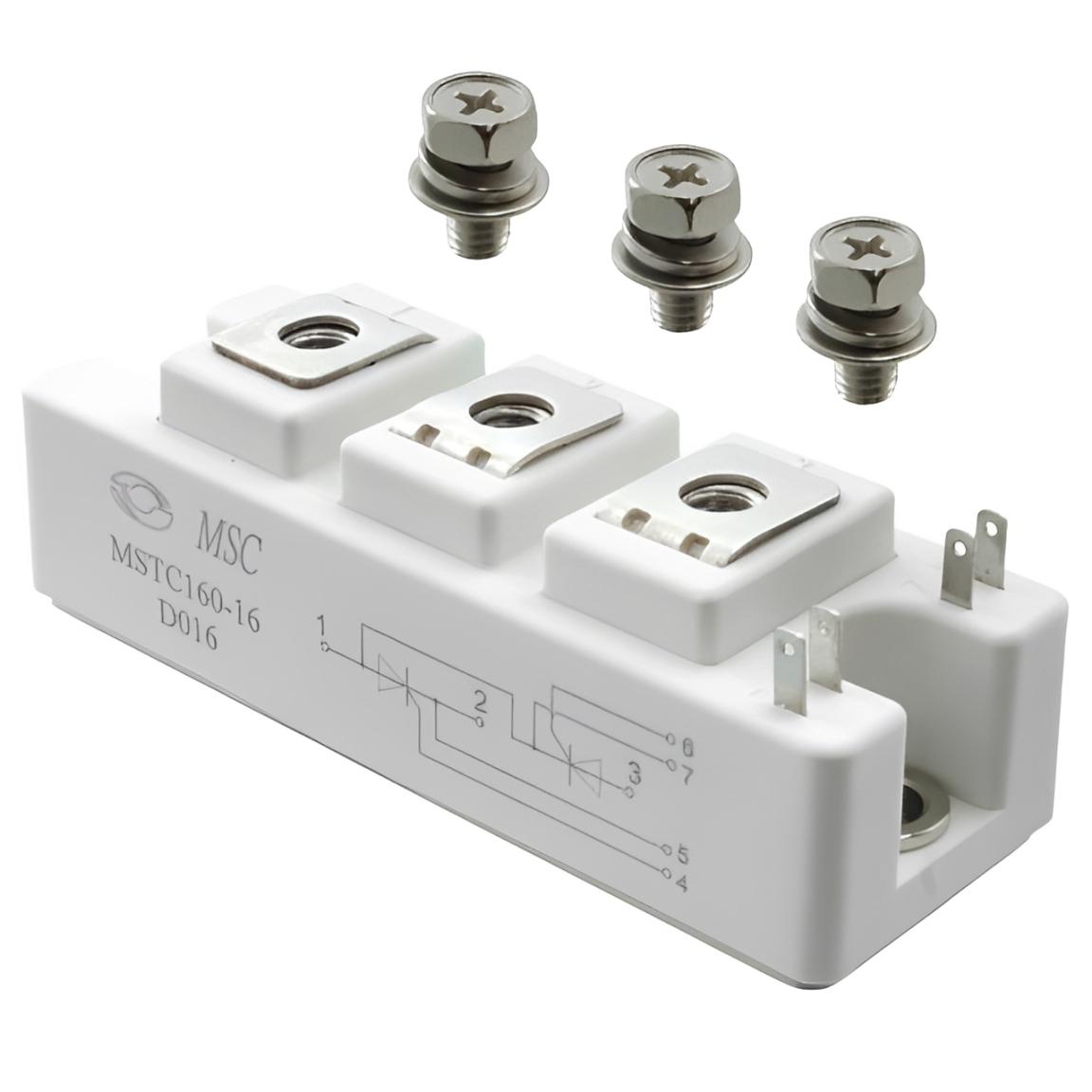
Managing substantial electrical power safely is a critical challenge in industrial electronics. Equipment such as manufacturing machines, thermal processing systems, large power supplies, and motor-driven installations often needs more than a basic switching device. It requires a solution capable of controlling significant electrical loads while maintaining stability and dependable operation. SCRs - Modules have become an established option for meeting these demanding requirements.
Built around silicon-controlled rectifier technology, these modules bring high-power semiconductor switching into a convenient packaged format. Their combination of electrical strength, controlled operation, and suitability for demanding environments makes them valuable across many branches of industrial power electronics.
What Exactly Makes SCRs - Modules Useful?
The primary purpose of SCRs - Modules is to provide controlled conduction in circuits handling substantial voltage and current.
An SCR does not simply behave like a standard mechanical switch. Instead, it remains in a blocking condition until the appropriate triggering signal is applied to its gate. After activation, current is allowed to pass through the main conduction path.
This operating principle allows designers to determine when electrical power reaches a connected load.
SCR modules are particularly useful where systems require:
- Controlled application of electrical power
- High-current switching capability
- Adjustable AC power delivery
- Regulated rectification
- Reliable operation under repetitive loads
- Compact high-power semiconductor assemblies
- Integration into automated control equipment
Their versatility allows the same underlying semiconductor technology to serve many different industrial functions.
Why Is Solid-State Power Switching Valuable?
Traditional electromechanical switches and contactors remain useful in many applications, but physical contacts experience wear each time they operate.
High-current switching can also create electrical arcs and mechanical deterioration over repeated operating cycles.
SCRs - Modules perform switching without moving contacts. This makes them attractive for applications requiring frequent and repeatable control.
Solid-state operation offers advantages such as:
- No mechanical contact bounce
- Reduced physical wear
- Quiet switching
- Fast response to electronic controllers
- High repeatability
- Compatibility with automated systems
For production environments that operate continuously, reducing mechanical switching can help simplify maintenance requirements.
How Do SCR Modules Fit Into Automated Equipment?
Modern factories rely heavily on electronic controllers, sensors, programmable systems, and automated process equipment.
SCR modules can serve as the power-handling stage between low-power control electronics and high-power loads.
A controller may determine that a heater requires additional output, for example. The control circuitry then generates the required gate signals, while the SCR module manages the substantially larger electrical current flowing to the heater.
This separation allows low-voltage electronic systems to influence powerful industrial loads without directly carrying their current.
Applications include:
- Process heating machines
- Automated production lines
- Temperature-controlled chambers
- Industrial drying equipment
- Electrical test systems
- Material-processing machinery
- Power-regulation cabinets
This makes SCR technology suitable for integration into broader industrial control architectures.
How Can SCRs - Modules Help Manage Heating Loads?
Resistive heating systems require accurate management of electrical energy to maintain desired process temperatures.
Simply connecting and disconnecting full power can produce wider temperature variations than some industrial processes allow.
SCR-based controllers can regulate the proportion of electrical power delivered to the heaters. This gives temperature-control electronics greater authority over the heating process.
Potential benefits include:
- More consistent process temperatures
- Controlled heating rates
- Reduced repetitive mechanical switching
- Responsive adjustment to changing thermal demand
- Better integration with temperature sensors
Applications may range from moulding machinery and industrial dryers to ovens, furnaces, environmental chambers, and laboratory equipment.
Why Are SCR Modules Suitable for High-Current Applications?
One reason SCR technology remains widely recognised is its ability to control substantial current.
Power semiconductor systems may operate under very different conditions from ordinary low-voltage electronics. Conductors, terminals, insulation, thermal design, and surge capability all become increasingly important as electrical power rises.
SCR modules are designed with these requirements in mind.
Their construction may include:
- Heavy-duty power terminals
- Thermally conductive baseplates
- Electrically isolated mounting structures
- High-current internal semiconductor connections
- Robust industrial housings
This packaging provides a practical method of incorporating thyristor technology into high-power equipment.
What Is the Importance of the SCR Firing Point?
In many AC power-control applications, the precise moment an SCR begins conducting determines how much energy reaches the load.
This moment is commonly associated with the firing angle.
Triggering earlier during the relevant AC half-cycle allows a greater portion of the waveform to reach the load. Triggering later provides a smaller portion.
Adjusting the firing angle can therefore influence effective power without physically changing the load itself.
This principle supports functions such as:
- Heater regulation
- Controlled illumination
- AC voltage adjustment
- Industrial power control
- Selected motor-control functions
The ability to vary power electronically is one of the characteristics that makes SCR technology useful in mains-frequency applications.
Which SCR Module Configuration Should Be Chosen?
Not every module contains the same internal arrangement.
Manufacturers offer different configurations to support various circuit designs. Selecting the correct topology can simplify wiring and reduce the number of separate semiconductor packages required.
Available arrangements may include:
- Individual SCR devices
- Two SCRs within one module
- SCR and diode combinations
- Common-cathode circuits
- Common-anode circuits
- Series arrangements
- Controlled rectifier configurations
Designers should examine the internal circuit diagram rather than assuming modules with similar packages are electrically interchangeable.
What Electrical Specifications Require Attention?
Correct component selection requires matching the module to both normal operation and foreseeable abnormal conditions.
Important specifications include:
- Rated operating current
- Repetitive peak voltage
- Surge-current capability
- Forward voltage drop
- Gate trigger requirements
- Holding-current value
- Thermal resistance
- Maximum junction temperature
- Electrical isolation rating
- Package and terminal arrangement
Designing solely around nominal operating current may produce inadequate reliability.
Suitable safety margins are generally required to account for temperature, load variation, electrical transients, and startup conditions.
How Does the On-State Voltage Affect Efficiency?
No practical semiconductor switch is completely lossless.
When current flows through an SCR, a voltage remains across the device. The resulting electrical loss becomes heat inside the module.
Power dissipation becomes particularly significant at high current.
For this reason, system efficiency depends partly on:
- SCR on-state characteristics
- Average load current
- Conduction period
- Cooling performance
- Ambient temperature
Understanding these relationships helps engineers determine appropriate thermal solutions and operating margins.
Why Is Heatsink Selection Critical?
An SCR may be electrically rated for a substantial current, yet it cannot operate safely at that current unless generated heat is removed effectively.
The module is commonly attached to a heatsink that transfers heat away from its base.
A suitable thermal arrangement should consider:
- Module power losses
- Heatsink thermal resistance
- Maximum ambient temperature
- Natural or forced airflow
- Thermal interface quality
- Mounting method
- Required operating margin
In higher-power installations, fans or other cooling techniques may supplement passive heatsinks.
Maintaining acceptable semiconductor temperature contributes directly to dependable service life.
What Can Cause SCR Module Failure?
SCR modules can deliver long service when used within their specified limits, but incorrect circuit design or installation may expose them to damaging conditions.
Potential causes of failure include:
- Excessive current
- High junction temperature
- Severe voltage transients
- Incorrect gate triggering
- Poor heatsink contact
- Loose power connections
- Inadequate ventilation
- Unsuitable protective devices
Understanding the complete operating environment is therefore more important than considering a single data-sheet value.
Which Protection Components Can Support SCR Modules?
Industrial designs commonly combine SCRs with supporting protection circuits.
Depending on the application, these may include:
- Semiconductor-rated fuses
- RC snubbers
- Surge suppression components
- Overtemperature protection
- Current sensing circuits
- Gate isolation
- Voltage protection devices
Protection should be coordinated with the electrical behaviour of both the SCR and the connected load.
For example, an inductive circuit may create different transient conditions from a purely resistive heater.
How Do SCRs Compare With Mechanical Contactors?
Both technologies can control substantial electrical loads, but they serve different operating requirements.
Mechanical contactors provide physical circuit isolation when opened and may be appropriate for infrequent switching.
SCR modules provide electronic switching and can operate repeatedly without mechanical contact wear.
SCR-based control becomes particularly useful when a process requires:
- Frequent power adjustment
- Rapid repetitive switching
- Electronic regulation
- Reduced contact maintenance
- Integration with automated controllers
In many installations, SCRs and contactors may even be used together, with each providing a different system function.
Why Are SCRs - Modules Still Important Today?
Power semiconductor technology now offers many alternatives, yet SCRs continue to perform effectively in applications aligned with their strengths.
They can handle demanding electrical power levels while providing efficient conduction and straightforward triggering.
Established industrial applications continue to benefit from their:
- High power capability
- Proven operating characteristics
- Strong overload performance
- Straightforward control
- Durable module construction
- Suitability for mains-frequency systems
Newer semiconductor technologies do not automatically make SCRs obsolete. Component choice depends on the requirements of the application rather than on technology age alone.
Conclusion
SCRs - Modules provide an effective bridge between electronic control systems and high-power electrical loads. By combining silicon-controlled rectifiers with robust module packaging, they support reliable power management across heating equipment, rectification systems, industrial controllers, power supplies, and other demanding applications.
Their successful use depends on more than selecting a high current rating. Designers must consider circuit configuration, voltage capability, triggering requirements, thermal performance, surge conditions, installation quality, and appropriate protection.
When these factors are properly addressed, SCR modules can provide efficient, repeatable, and dependable high-power control, helping industrial systems operate with the precision and durability required by modern electrical applications.

 English
 Arabic
 French
 Spanish
 Portuguese
 Turkish
 Dutch
Dutch
 Italiano
 Russian
 Romaian
 Portuguese (Brazil)
 Greek
Greek