


Why Wired Doorbell Cameras Lead Market Revenue
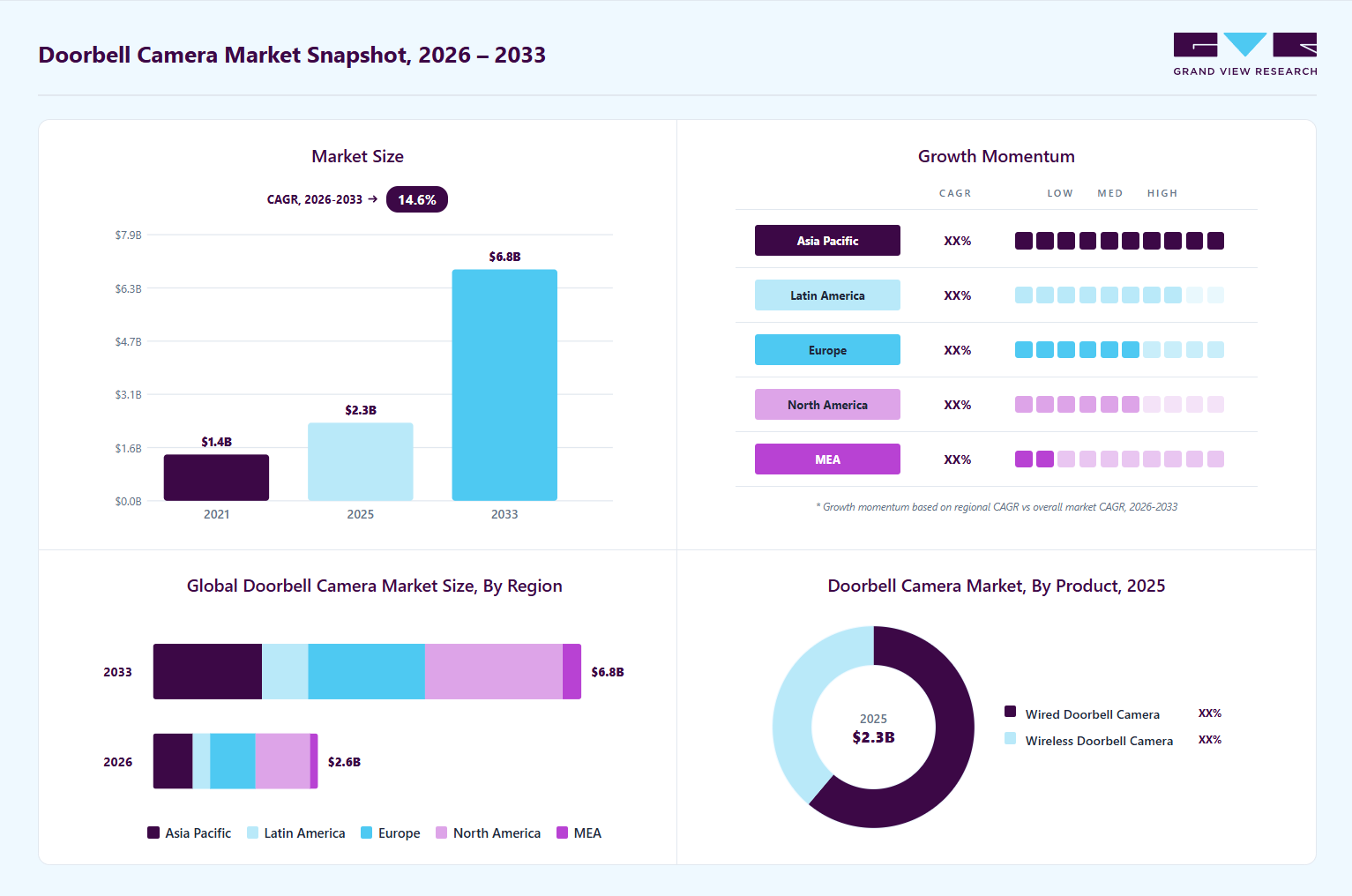
A front door is becoming more than an entry point as homeowners increasingly adopt connected devices to monitor visitors, receive alerts, and manage access remotely. Doorbell cameras combine video surveillance, two-way communication, and motion detection in a compact device designed for everyday security. The doorbell camera market was valued at USD 2.3 billion in 2025 and is projected to grow from USD 2.6 billion in 2026 to USD 6.8 billion by 2033, registering a CAGR of 14.6% from 2026 to 2033. Rising interest in smart homes, demand for remote monitoring, and advances in artificial intelligence are helping expand the market.
Wired Cameras Maintain a Strong Market Position
Wired doorbell cameras accounted for 61.1% of market revenue in 2025, supported by their continuous power supply and suitability for long-term monitoring. These systems can provide reliable operation without frequent battery charging, making them attractive to households seeking consistent surveillance.
Product development is increasingly focused on improving image clarity, motion detection, and compatibility with connected home systems. Features such as customizable activity zones, computer vision, and two-way audio help users distinguish relevant activity and communicate with visitors without opening the door.
Wireless doorbell cameras, however, are projected to grow at the fastest CAGR of 14.9% from 2025 to 2033. Their flexible placement and relatively simple installation appeal to renters and homeowners who prefer not to modify existing electrical wiring. Battery-powered designs also provide installation options where conventional doorbell wiring is unavailable.
Offline Retail Remains Important as Online Sales Expand
Offline channels held 67.4% of market revenue in 2025. Physical stores allow customers to compare devices, assess product features, and receive installation or compatibility guidance before purchasing. In-store demonstrations can also help buyers understand differences in video quality, connectivity, and smart-home integration.
Online distribution is expected to grow at a CAGR of 15.0% from 2025 to 2033. E-commerce platforms offer a wider selection of models and price points, supported by product specifications, customer reviews, promotions, and bundled offers. As consumers become more familiar with connected security devices, online purchasing is creating additional opportunities for manufacturers and retailers.
AI Is Making Home Monitoring More Intelligent
Artificial intelligence is becoming a major source of product differentiation. Person recognition, package detection, intelligent motion alerts, and improved video processing can help users focus on relevant events rather than receiving notifications for every movement. High-resolution cameras, wider fields of view, and enhanced low-light performance further improve doorstep visibility.
Smart-home compatibility is also influencing purchasing decisions. Doorbell cameras can connect with mobile applications, voice assistants, lighting systems, and other security devices to create a more integrated home monitoring experience.
In September 2025, Ring introduced an upgraded lineup of home security cameras and doorbells featuring 2K and 4K models with Retinal Vision technology and improved low-light performance. In August 2025, Philips Hue introduced its first video doorbell, featuring a 2K image sensor and integration with Hue lighting. That same month, Aqara unveiled its Doorbell Camera G400, featuring 2K resolution, broad doorstep coverage, and on-device facial recognition.
Privacy and Subscription Costs Influence Adoption
Despite growing interest, doorbell cameras face barriers related to upfront device costs, cloud-storage subscriptions, privacy, and cybersecurity. Consumers may hesitate to install devices that continuously record activity around private residential spaces, particularly when data handling and access controls are unclear.
Reliable internet connectivity is another consideration because weak connections can delay alerts or reduce video quality. Compatibility between different smart-home ecosystems can also complicate installation and integration.
Manufacturers have an opportunity to address these concerns through affordable products, stronger privacy controls, local-storage options, energy-efficient designs, and improved interoperability. Subscription services for cloud storage and advanced analytics can create recurring revenue, but providers must demonstrate clear value to sustain customer engagement.
Smart-Home Integration Creates Further Growth Opportunities
The market's next phase is likely to be shaped by connected security ecosystems rather than standalone devices alone. Doorbell cameras are increasingly relevant to apartment buildings, rental properties, gated communities, hospitality businesses, and property management operations where remote visibility can improve access monitoring.
Asia Pacific is projected to be the fastest-growing regional market, with a CAGR of 15.5% from 2025 to 2033. Urbanization, rising middle-class incomes, and demand for affordable connected security products are supporting adoption.
FAQs
1. What is driving growth in the doorbell camera market?
Increasing smart-home adoption, demand for remote home monitoring, AI-powered detection, improved video quality, and growing interest in connected security systems are supporting market growth.
2. Which segment leads the doorbell camera market?
Wired doorbell cameras led the product segment with a 61.1% revenue share in 2025, while offline distribution accounted for 67.4% of market revenue in the same year.
Key Doorbell Camera Companies:
· ASSA ABLOY
· AUXTRON
· Hangzhou Hikvision Digital Technology Co. Ltd.
· IFI Techsolutions
About us:
Grand View Research, a market research and consulting company, provides syndicated research reports, customized research reports, and consulting services. Grand View Research database is used by the world's renowned academic institutions and Fortune 500 companies to understand the global and regional business environment. Our database features thousands of statistics and in-depth analysis on 46 industries in 25 major countries worldwide.

 English
 Arabic
 French
 Spanish
 Portuguese
 Deutsch
 Turkish
 Dutch
Dutch
 Italiano
 Russian
 Romaian
 Portuguese (Brazil)