


إعلان مُمول
United States Meat Market Size Projected to Reach USD 489.9 Billion by 2034 with a CAGR of 3.17%
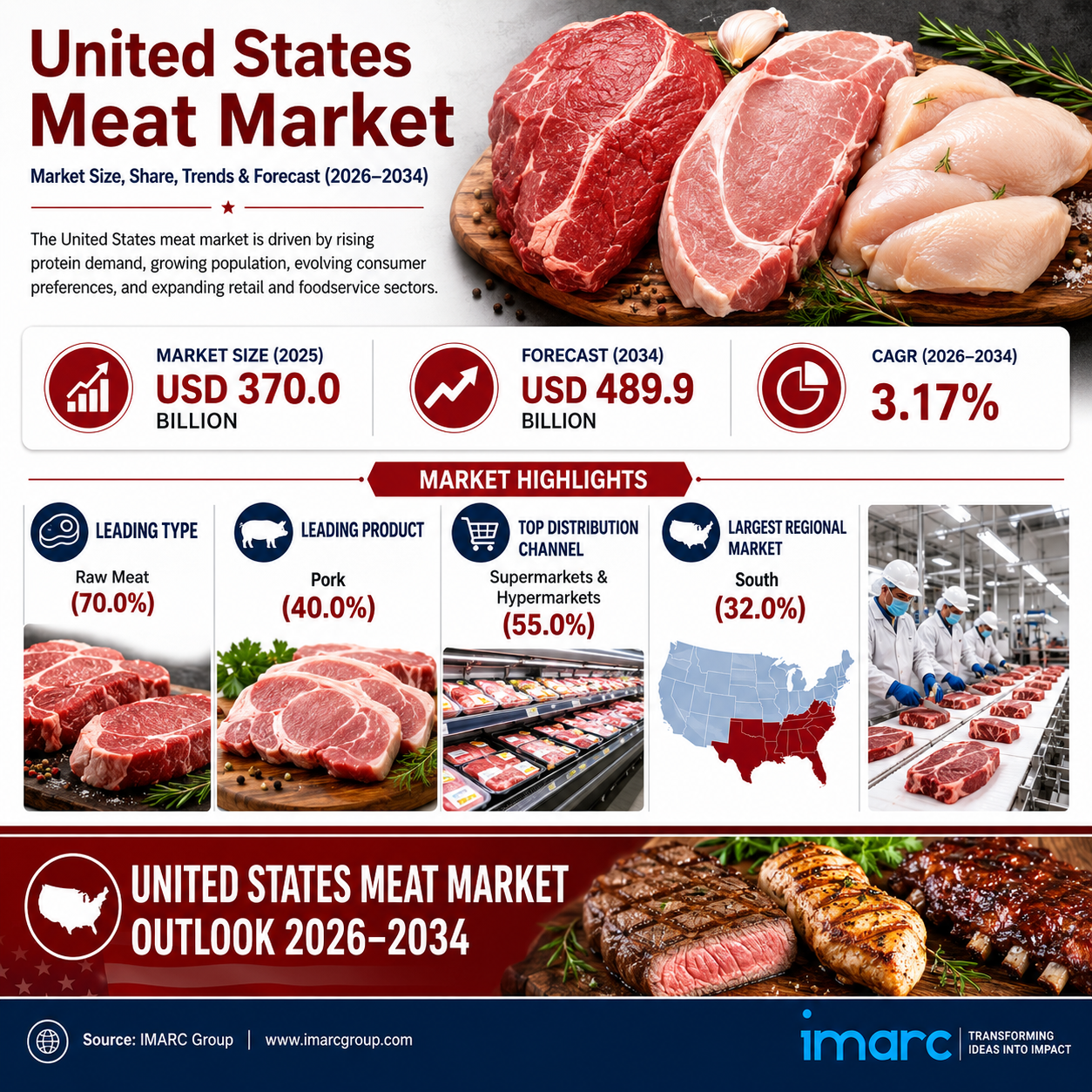
IMARC Group has recently released a new research study titled “United States Meat Market Size, Share, Trends and Forecast by Type, Product, Distribution Channel, and Region, 2026-2034”, offers a detailed analysis of the market drivers, segmentation, growth opportunities, trends and competitive landscape to understand the current and future market scenarios.
United States Meat Market Size, Growth, and Forecast (2026-2034)
The United States meat market size reached USD 370.0 Billion in 2025 and is projected to reach USD 489.9 Billion by 2034, growing at a CAGR of 3.17% during 2026-2034. Sustained consumer appetite for protein-rich diets, growing preference for premium and organic meat products, and expanded retail distribution infrastructure are the key factors driving the market.
The United States is one of the world's largest meat producers and consumers, producing approximately 96 billion pounds of red meat and poultry annually. The market spans the full supply chain from livestock production, slaughtering, and processing through cold chain logistics, wholesale distribution, and retail and foodservice delivery.
According to the Power of Meat 2025 report, retail meat sales reached a record high of USD 104.6 Billion in 2024, a 2.3% increase year-on-year. Organic meat sales surpassed USD 3 Billion for the first time in 2024, representing a 14.3% year-on-year increase, signaling a strong premiumization wave across the industry.
Raw meat commands a dominant 70.0% share in 2025, reflecting consumer preference for fresh cuts at retail butchery counters. Pork leads the product segment at 40.0%, while the South region accounts for 32.0% of total market revenue in 2025, the largest regional share driven by population growth and a deeply embedded meat-centric food culture.
Explore Growth Opportunities in the United States Meat Market - Grab Your Sample Report for Evaluation: https://www.imarcgroup.com/united-states-meat-market/requestsample
Key Trends Driving the United States Meat Market
-
Rising demand for clean-label and traceable meat products: Consumers increasingly demand full transparency in meat production, from farm origin and animal welfare standards to antibiotic use and processing methods. QR-code-enabled supply chain traceability is being adopted by leading retailers and processors, allowing consumers to verify product provenance through mobile applications at point of purchase.
-
Expansion of e-commerce meat delivery and subscription services: Online meat retail is growing at a significantly higher rate than conventional channels. Subscription-based direct-to-consumer services are capturing health-conscious and premium-oriented consumer segments. Cold chain logistics innovation, including insulated packaging and next-day delivery capabilities, is extending the geographic reach of online meat retail beyond major urban centers.
-
Value-added product portfolio expansion: Meat processors are expanding into higher-margin categories including pre-seasoned proteins, stuffed cuts, fully cooked entrees, and refrigerated meal kit components. These products reduce consumer preparation time and command 20-40% price premiums over equivalent unprocessed cuts, representing a significant margin-accretive growth opportunity for major processors.
-
Premiumization and organic meat growth: Consumers demonstrate strong willingness to pay premium prices for antibiotic-free, grass-fed, and humanely raised certifications. Organic meat sales surpassed USD 3 Billion in 2024 for the first time, growing 14.3% year-on-year. This premiumization wave is creating a structurally higher-value product mix across both retail and foodservice channels.
-
Sustainability and regenerative agriculture integration: Leading meat companies are committing to sustainability targets including reduced emissions, water use reduction, and responsible land management. Regenerative agriculture practices that sequester carbon, restore soil health, and improve watershed management are gaining traction among producers and retailers as a differentiating environmental narrative aligned with ESG investment criteria.
-
Foodservice and restaurant sector recovery driving demand: The post-pandemic recovery of the U.S. foodservice sector continues to generate incremental meat demand. Quick-service restaurants, casual dining chains, and food delivery platforms are expanding premium protein offerings. Beef, chicken, and specialty pork cuts are gaining prominence on menu innovation platforms as consumers seek restaurant-quality protein experiences.
United States Meat Market Report Segmentation:
The United States Meat Market report provides a detailed segmentation analysis to help businesses identify key growth segments and evolving consumer preferences. The market is categorized based on type, product, distribution channel, and region, offering insights into demand patterns and growth drivers across the U.S. meat industry.
Type Insights:
-
Raw: Raw meat commands a dominant 70.0% share in 2025, reflecting deeply embedded consumer preference for fresh, unprocessed cuts purchased at retail butchery counters, supermarket fresh departments, and direct-from-producer channels. USDA grading standards, expanding in-store butchery infrastructure, and the growth of direct farm-to-table sourcing models all underpin this segment's dominance through the forecast period.
-
Processed: Processed meat accounts for 30.0% of the market in 2025, encompassing cooked and cured products such as hot dogs, bacon, deli meats, sausages, and ham. Value-added innovation within this segment, including protein-enriched, clean-label, and reduced-sodium variants, is the primary growth driver, with major brands like Hormel Applegate and Smithfield leading new product development.
Product Insights:
-
Pork: Pork leads the product segment at 40.0% in 2025. Its dominance reflects multi-format versatility across fresh cuts (chops, tenderloin, ribs), cured products (bacon, ham, prosciutto), and value-processed formats (sausage, hot dogs). A cost advantage versus beef and widespread use across both retail and foodservice channels further reinforces pork's leading market position.
-
Chicken: Chicken follows at 28.0% share in 2025, driven by strong health positioning as a lean protein source and sustained demand from quick-service and casual dining foodservice operators. Chicken is the fastest-growing mainstream protein category, supported by rapid innovation in ready-to-cook, pre-seasoned, and convenience product formats targeting time-pressed households.
-
Beef: Beef accounts for 20.0% in 2025 and retains strong premium positioning, particularly for high-grade steaks, ground beef, and specialty cuts. U.S. beef benefits from a premium global reputation that supports robust export demand to Japan, South Korea, and Mexico, and from domestic consumer willingness to pay for premium USDA Choice and Prime grades.
-
Mutton and Others: Mutton and other protein categories collectively represent 12.0% of the market, supported by ethnic cuisine demand growth and specialty retail expansion in urban metropolitan areas with diverse demographic compositions. Growing interest in lamb, goat, and alternative proteins supports steady niche market expansion within this segment.
Distribution Channel Insights:
Supermarkets and Hypermarkets: The dominant distribution channel with a 55.0% share in 2025, retained through broad consumer reach, comprehensive refrigeration infrastructure, and competitive pricing across all protein categories. Ongoing investment in upgraded in-store butchery counters with display technologies and on-demand custom cutting services continues to strengthen supermarket relevance for fresh meat purchases.
Online Stores: E-commerce is the fastest-growing distribution channel, driven by subscription-based direct-to-consumer meat delivery services and the expansion of cold chain logistics enabling next-day delivery. Online channels attract health-conscious and premium-oriented millennial and Gen Z households seeking convenience, specialty product access, and transparency in sourcing.
Specialty Stores: Specialty butcher shops and natural food retailers are growing in urban and suburban markets, serving consumers who prioritize premium quality, artisanal cuts, and direct relationships with sourcing-transparent producers. This channel commands significantly higher average transaction values than mass retail channels, supporting a premium business model.
Departmental Stores: Departmental store meat departments serve as a convenience-oriented purchase point for standard fresh and packaged meat products. While facing competitive pressure from supermarket and e-commerce channels, departmental stores maintain relevance through bundled grocery shopping convenience and established shopper loyalty programs.
Regional Insights:
South (32.0%): The South leads at 32.0% in 2025, reflecting its position as the largest U.S. region by population growth rate, combined with a deeply embedded barbecue and grilling culture and rapid foodservice expansion across Florida and Texas. Major processing hubs in Arkansas and North Carolina further anchor the South's dominant position across both production and consumption.
Midwest (26.0%): The Midwest holds a 26.0% share, reflecting its dual role as both a major production and consumption market. Its proximity to the Iowa-Kansas-Nebraska feedlot corridor and large-scale pork and beef processing facilities ensures competitive retail pricing. Strong retail penetration in Chicago and Detroit metro areas supports steady consumer demand.
West (22.0%): The West accounts for 22.0% of the market, characterized by premium and organic product demand particularly in California. Sustainability credentials, antibiotic-free products, and grass-fed certification drive above-average per-unit retail prices. Affluent consumer segments across the Pacific Coast are leading the premiumization trend in meat purchasing.
Northeast (20.0%): The Northeast holds a 20.0% share, with dense urban populations in New York City, Boston, and Philadelphia supporting both premium retail and specialty ethnic protein formats. Growing halal and other culturally specific protein demand in diverse metropolitan areas creates niche market opportunities for specialty processors and importers.
United States Meat Market Recent News and Developments:
-
July 2025: Tyson Foods launched innovative protein-packed chicken nuggets with 23 grams of protein per serving, made from 100% all-natural white meat chicken. The launch reflects the industry's strategic focus on convenient, nutrition-forward products aligned with modern dietary preferences and the growing consumer appetite for high-protein convenience foods across retail channels.
-
March 2026: JBS USA and the National 4-H Council announced a USD 750,000 partnership to expand hands-on agricultural education, science-based learning, and leadership development opportunities for young people across rural America, underscoring the sector's commitment to investing in the next generation of agricultural talent.
-
March 2026: Hormel Foods announced leadership changes in global food safety, appointing a new head to strengthen quality and compliance functions. The company also continued product innovation through new collaborations and flavor launches across retail and foodservice segments, reinforcing its commitment to brand-led growth in value-added protein categories.
Challenges Impacting the United States Meat Market
Sustained cost inflation in feed grains, energy, and processing labor has increased production costs for meat processors, placing upward pressure on retail prices. Prolonged affordability pressure may trigger protein substitution toward lower-cost alternatives, particularly among price-sensitive consumer segments during periods of economic uncertainty.
Environmental and sustainability concerns represent a growing challenge for the industry. Animal agriculture accounts for approximately 14.5% of global greenhouse gas emissions, and increasing regulatory scrutiny around livestock methane emissions, water use, and manure management is raising operational compliance costs for large-scale producers across beef, pork, and poultry sectors.
Supply chain vulnerabilities remain a structural concern following the COVID-19 pandemic, which exposed critical fragility in the highly consolidated meat processing sector. Recurring risks from labor disruptions, disease outbreaks such as avian influenza, and extreme weather events continue to pose intermittent disruption risks across production and distribution operations.
Labor shortages in processing plants are a persistent challenge, as meat processing operations are labor-intensive with demanding working conditions. Ongoing workforce recruitment and retention difficulties increase per-unit operating costs and constrain peak production capacity, prompting major processors to accelerate investment in automation and robotics to reduce labor dependency.
Investment Opportunities in the United States Meat Market
Premium and organic meat represents the highest near-term investment opportunity, with organic sales growing at 14.3% year-on-year in 2024 and surpassing USD 3 Billion for the first time. Companies investing in certified organic, antibiotic-free, and grass-fed production programs can access structurally higher margin segments and growing consumer demand for sustainably produced protein.
E-commerce and direct-to-consumer meat delivery platforms represent a compelling growth opportunity, capturing millennial and Gen Z households seeking convenience and premium product access. Subscription models generate predictable recurring revenue, and digital channel infrastructure enables premium pricing, customer data collection, and targeted marketing capabilities unavailable through traditional retail formats.
Processing automation and technology investment offers significant returns for meat processors seeking to reduce labor dependency, improve yield efficiency, and lower per-unit costs. Robotics-enabled deboning, AI-powered quality inspection, and IoT-monitored cold chain systems are becoming strategically essential capabilities as labor costs rise and processing margins come under pressure.
Export market development to Japan, South Korea, Mexico, and Southeast Asia represents a meaningful volume growth lever for premium U.S. beef and pork producers. The United States holds a top global meat exporter position, and continued trade agreement expansion supports incremental volume growth in high-value international markets with strong premium beef demand.
Outlook of the United States Meat Market (2026-2034)
The United States meat market is projected to reach USD 489.9 Billion by 2034, growing at a CAGR of 3.17% from 2026. Structural growth drivers including sustained protein demand, premiumization of product portfolios, e-commerce channel expansion, and foodservice recovery are expected to sustain above-inflation revenue growth throughout the forecast period.
Technological disruption will reshape processing economics through 2034. Robotics, AI-powered quality inspection, and blockchain traceability are expected to become industry-standard capabilities across leading processors. Sustainability imperatives including scope 3 emissions reduction commitments and regenerative agriculture supply chain programs will increasingly influence purchasing decisions by institutional buyers and premium consumers.
The competitive landscape will continue to consolidate through further acquisition activity among mid-sized regional processors. Innovative direct-to-consumer meat brands and organic-focused regional processors will carve out defensible premium niches competing on quality, transparency, and sustainability credentials. By 2034, the U.S. meat industry is forecast to complete a meaningful transition toward a higher-value, premium-oriented market structure.
Author IMARC Group
IMARC Group is a leading global management consulting firm providing in-depth market research, strategic advisory services, and feasibility studies. The firm empowers organizations worldwide with actionable insights and data-driven strategies to support sustainable growth and informed decision-making.
Contact Us
IMARC Group
Email: [email protected]
Tel: +91 120 433 0800
United States: +1-201-971-6302

 English
 French
 Spanish
 Portuguese
 Deutsch
 Turkish
 Dutch
Dutch
 Italiano
 Russian
 Romaian
 Portuguese (Brazil)
 Greek
Greek