


Argentina Grain Market Size Trends & Industry Forecast 2034
IMARC Group has recently released a new research study titled "Argentina Grain Market Size, Share, Trends and Forecast by Product Type, Application, End User, Farm Type, and Region, 2026-2034", offers a detailed analysis of the market drivers, segmentation, growth opportunities, trends and competitive landscape to understand the current and future market scenarios.
Argentina Grain Market Outlook 2026–2034: Growth, Trends, and Investment Opportunities
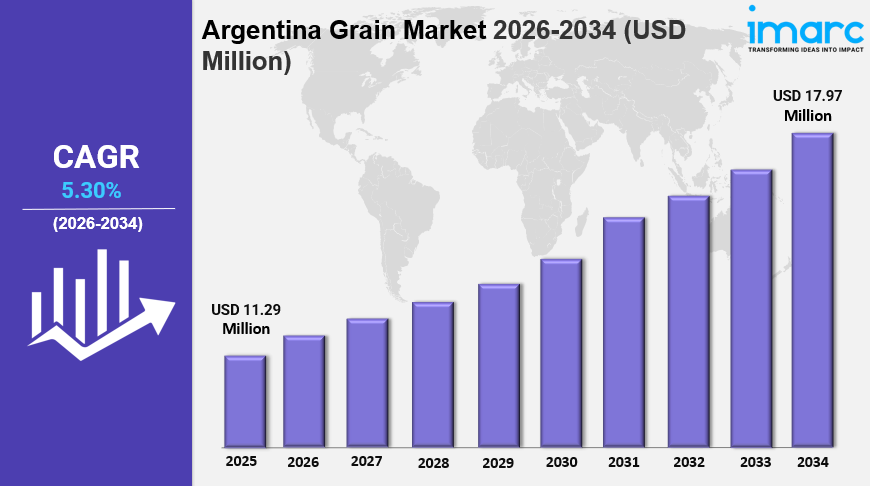
The Argentina grain market size is undergoing a steady structural expansion driven by supportive government policy reforms, rising multilateral infrastructure investment, and growing domestic processing capacity across the soybean value chain. The market was valued at USD 11.29 Million in 2025 and is projected to reach USD 17.97 Million by 2034, registering a CAGR of 5.30% during 2026-2034.
This growth reflects not only reduced agricultural export taxes that are improving farmer profitability, but also a strategic shift toward irrigation modernization, precision farming, and greater value-added grain processing across the country.
Key Market Statistics at a Glance
Base Year: 2025
Historical Years: 2020–2025
Forecast Period: 2026–2034
Market Size (2025): USD 11.29 Million
Projected Size (2034): USD 17.97 Million
Growth Rate: CAGR of 5.30%
Explore Growth Opportunities in the Argentina Grain Market – Grab Your Sample Report for Evaluation:
https://www.imarcgroup.com/argentina-grain-market/requestsample
Market Overview: Structural Expansion of the Argentina Grain Industry
The Argentina grain sector plays a critical role in the country's agricultural economy and global export competitiveness, contributing significantly to the broader food and beverages industry. The industry is broadly segmented into soybeans, corn, wheat, barley, and oats.
Key structural factors shaping the market include:
• Government policy reforms that have reduced agricultural export taxes and improved farmer profitability
• Multilateral infrastructure investment from institutions such as the World Bank and Inter-American Development Bank
• Expanding domestic soybean crushing and processing capacity
• Rising adoption of precision agriculture and AI-driven crop monitoring
The market is transitioning from raw commodity exports toward greater value-added processing and export diversification.
What's Driving Growth in the Argentina Grain Market? Key Insights for Investors
The growth of the Argentina grain market is being driven by a combination of favorable policy shifts and evolving production practices. One of the primary factors is the reduction in export taxes, which is strengthening farmer margins and encouraging forward sales and long-term investment in production capacity.
In addition, the modernization of irrigation networks and logistics infrastructure, including grain storage facilities, rail connectivity, and port capacity, is improving export efficiency and reducing post-harvest losses across major production regions.
Growing adoption of precision agriculture, GPS-guided equipment, drone-based crop monitoring, and AI-driven analytics is also playing a key role, as producers seek to optimize planting schedules, input use, and yields. At the same time, expanding domestic processing capacity in oils, flours, and biofuels is strengthening the agribusiness value chain and reducing reliance on raw commodity exports.
Furthermore, Argentina's growing focus on diversifying export markets toward Asia and Africa is reinforcing sustained investment and long-term resilience across the industry.
Investment Opportunities in the Argentina Grain Market: A Strategic Overview
The Argentina grain market offers diversified investment opportunities across multiple high-growth segments:
Soybean Value Chain
• Domestic crushing and processing facilities
• Soybean meal and oil export infrastructure
• Value-added biofuel production
Precision Agriculture and AgTech
• AI-driven crop monitoring and predictive analytics platforms
• GPS-guided farm equipment and drone-based field monitoring
• IoT-integrated soil and weather sensors
Irrigation and Infrastructure Modernization
• Drip and sprinkler irrigation systems
• Grain storage and silo development
• Rail and port logistics upgrades
Export Diversification
• New market development across Asia and Africa
• Cooperative and exporter-driven supply chain models
• Sustainable and climate-resilient production practices
These segments collectively provide long-term, stable returns for both domestic and international investors.
Argentina Grain Market: Detailed Segmentation Breakdown
Product Type Insights:
• Soybeans
Remains the leading category, supported by strong global demand for soybean meal and oil and Argentina's growing domestic crushing capacity.
• Corn
Sustained demand driven by both export competitiveness and rising domestic use in animal feed and industrial applications.
• Wheat
Growth supported by favorable growing conditions and steady international demand for high-quality grain exports.
• Barley
Growing relevance tied to malting and feed applications, supported by expanding regional cultivation.
• Oats
A smaller but stable category serving food, beverage, and specialty feed applications.
Application Insights:
• Animal Feed
Represents a major end-use category, supported by Argentina's large livestock sector and integrated feed production.
• Food and Beverages
Steady demand driven by both domestic consumption and export of processed grain-based food products.
• Industrial Use
Expanding gradually, supported by growing biofuel and industrial processing applications.
End User Insights:
• Commercial Farmers
The core production base of the market, benefiting from improved profitability following recent export tax reforms.
• Agricultural Cooperatives
Play an important role in aggregating output, supporting logistics, and improving market access for smaller producers.
• Exporters
Central to Argentina's position as a leading global grain and soybean product exporter, driving international market diversification.
Farm Type Insights:
• Small-scale Farms
Continue to contribute meaningfully to overall output, though they face greater exposure to climate and infrastructure-related risks.
• Large-scale Farms
Fastest-growing segment, supported by greater access to precision agriculture technologies, irrigation, and export infrastructure.
Regional Insights:
• Buenos Aires Region
The largest regional market, supported by strong agricultural infrastructure and proximity to major export ports.
• Litoral Region
A key production hub benefiting from favorable soil conditions and growing processing capacity.
• Northern Region
Growing steadily, supported by expanding irrigation coverage and rising investment in production capacity.
• Cordoba Region
An important grain-producing area supported by strong logistics connectivity and processing infrastructure.
• Cuyo Region
Smaller but developing production base, supported by targeted irrigation investment.
• Patagonia Region
Includes emerging production areas where growth is supported by improving distribution networks.
Argentina Grain Market Growth: Key Drivers Shaping the Industry's Future
The future growth of the industry is being shaped by several transformative trends:
• Continued government support through favorable export tax policies
• Expansion of irrigation coverage and climate-resilient infrastructure
• Rising adoption of AI-driven precision farming technologies
• Growing domestic processing and value-added export capacity
• Diversification of export destinations across Asia and Africa
These shifts are improving production efficiency, strengthening export competitiveness, and supporting overall category expansion across the sector.
Argentina Grain Market: Key Challenges, Trends, and Business Opportunities
Despite strong growth fundamentals, the Argentina grain market continues to face several structural challenges. A major constraint is climate variability and water scarcity, which disrupts crop yields and planting schedules, particularly across rainfed regions. In addition, ongoing economic volatility and policy uncertainty, including currency fluctuations and shifting export regulations, affect farmer profitability and long-term investment planning. The industry also faces infrastructure bottlenecks, including outdated road and rail networks, port congestion, and limited storage capacity, which raise transportation costs and reduce competitiveness.
At the same time, the market is witnessing several important emerging trends that are reshaping industry practices. There is a clear transition toward precision agriculture and AI-based crop monitoring, alongside growing investment in irrigation modernization and climate-resilient farming methods. The rise of value-added processing, particularly within the soybean value chain, is also gaining traction, while expanding export diversification into new international markets is further strengthening the industry's long-term resilience.
Competitive Landscape: Argentina Grain Market and Leading Players
The competitive landscape of the Argentina grain market is moderately consolidated, with a mix of large-scale agribusinesses, agricultural cooperatives, and mid-sized producers operating across production, processing, and export segments. Companies are increasingly focusing on vertical integration, precision agriculture adoption, and logistics modernization to strengthen margins and reduce exposure to global price volatility.
Argentina Grain Market: Latest News Updates
• Government reforms reducing agricultural export taxes are encouraging greater forward selling and investment among commercial farmers and exporters.
• Multilateral development institutions are financing irrigation and climate-resilience projects across key production regions.
• Domestic soybean crushing capacity continues to expand, reinforcing Argentina's position as a leading global exporter of soybean meal and oil.
Author: IMARC Group
IMARC Group is a leading global management consulting firm providing comprehensive market research, feasibility studies, and strategic advisory services. The firm supports organizations worldwide in identifying growth opportunities, mitigating risks, and making informed business decisions across industries.
Contact Us
IMARC Group
Email: [email protected]
United States: +1-201-971-6302

 English
 Arabic
 French
 Spanish
 Portuguese
 Turkish
 Dutch
Dutch
 Italiano
 Russian
 Romaian
 Portuguese (Brazil)
 Greek
Greek