


Threat Modeling Compared to Cyber Threat Intelligence
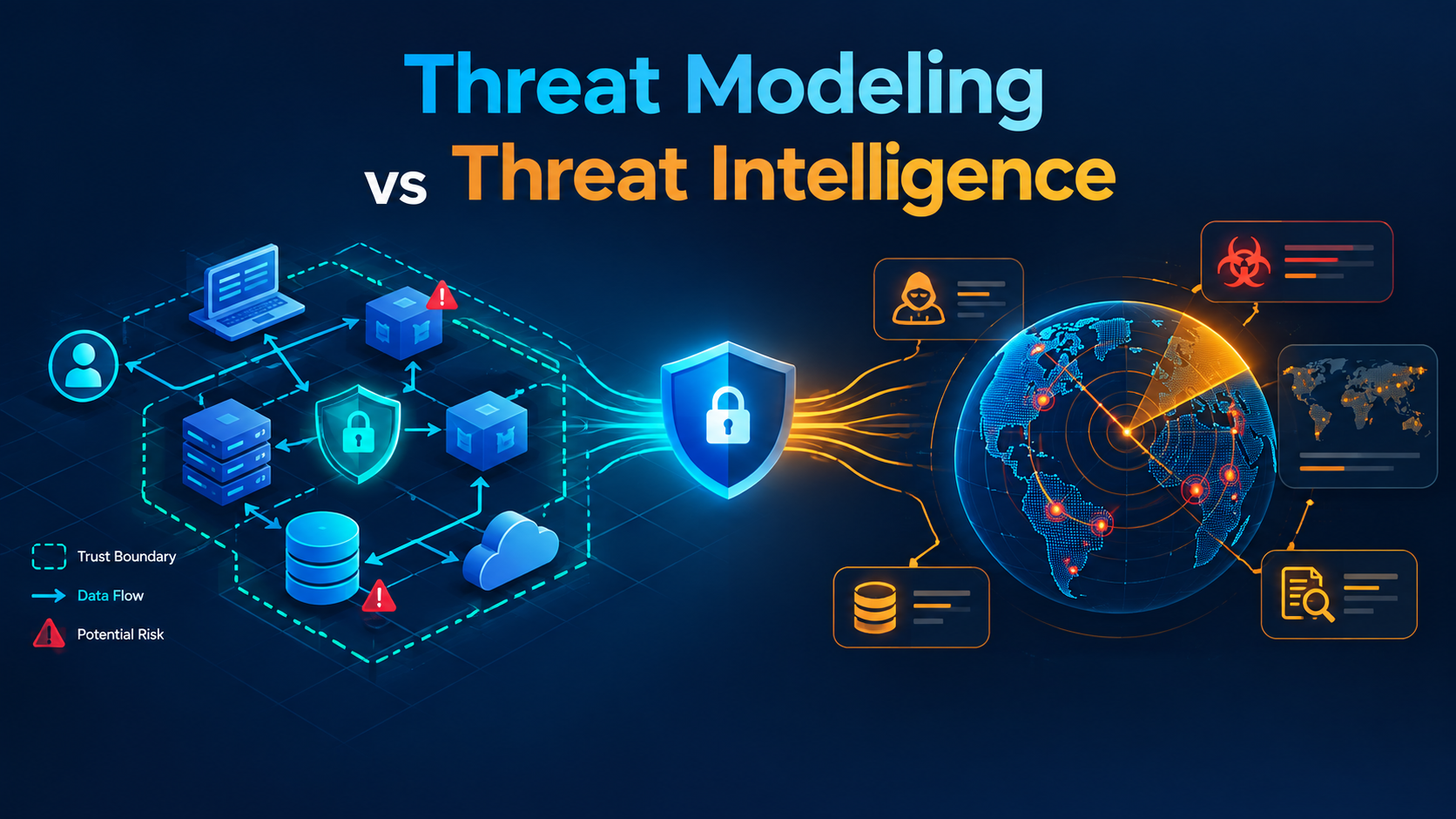
Threat modeling compared to cyber threat intelligence comes down to system versus adversary. Security threat modeling examines how a specific application could be attacked and which security controls should stop it. Cyber threat intelligence, or CTI, studies real attackers, their TTPs and their indicators of compromise to guide detection and prioritization. This guide follows one fictional web application through both processes so you can see exactly where each adds value and where they reinforce each other.
Learning the Difference by Following One Application
Definitions only go so far. Many people can recite that threat modeling is internal and threat intelligence is external, yet struggle to apply that distinction on a real project. So this guide takes a different route. We follow a fictional online ticketing platform from its first design sketch to its first major incident and at each stage we ask two questions: what does security threat modeling tell us and what does cyber threat intelligence tell us?
The platform is typical. It has a browser front end, an API gateway, a user account service, a payment integration, an order database and an admin dashboard. It stores personal data and payment references and it experiences traffic spikes whenever popular events go on sale. Those features make it attractive to attackers and good material for comparing the two practices.If you want a short conceptual summary to keep beside this walkthrough, our overview of threat modeling versus threat intelligence provides the essentials. The rest of this article puts the ideas to work.
Stage 1Design, Where Security Threat Modeling Leads
At the design stage, nothing has been built, so there are no logs, no incidents and almost no external evidence about this specific platform. This is the moment where threat modeling shines, because it needs only a design and a willingness to question it.
The team draws a data flow diagram showing the browser, the gateway, the services and the database, with trust boundaries between the public internet, the application tier and the data tier. They then apply STRIDE to each element. Spoofing appears at the login endpoint and the payment callback. Tampering appears in ticket price parameters and order status updates. Repudiation appears in the lack of audit logs for admin actions. Information disclosure appears in verbose error messages and in object identifiers that can be guessed. Denial of service appears at the on sale moment, when demand is high. Elevation of privilege appears wherever the admin dashboard shares an authentication path with regular users.
Next, the team ranks threats. Using a DREADstyle scoring approach, they judge damage potential, reproducibility, exploitability, affected users and discoverability. Price tampering and broken objectlevel authorization score highest because they are easy to exploit and damaging. The output is a prioritized list of mitigations, server side price validation, project authorization checks, separate authentication for administrators, structured audit logging and rate limiting around sale events.
Notice what threat intelligence could not have done here. No feed would have told the team that their order identifiers were guessable or that the admin dashboard shared a session store with customers. Those issues live in the design and only an inward looking review exposes them. Teams that want to build the habit of finding such design flaws can use threat modeling practice scenarios before their next real review.
Stage 2Prioritization, Where Cyber Threat Intelligence Adds Context
The model lists many threats and the team cannot address all of them before launch. This is where cyber threat intelligence earns its place. Instead of ranking purely by instinct, the team asks an intelligence analyst what adversaries are doing against ticketing and ecommerce platforms right now.
The analyst provides a short briefing. Several financially motivated threat actors are running automated campaigns that combine leaked credentials with bots to take over customer accounts and resell tickets. Their TTPs include distributed login attempts through residential proxy networks, headless browsers that mimic real users and rapid checkout flows that complete purchases within seconds of account access. The briefing also includes IOC's user agent patterns, request timing signatures and a list of infrastructure addresses associated with known campaigns.
This changes the ranking. Account takeover and bot abuse moved to the top, ahead of some threats the team had considered more severe in the abstract. The team adds step up authentication for purchases, behavioral bot detection and anomaly alerts for unusual login velocity. They also feed the IOCs into their detection tools, giving the security operations team immediate value from the briefing.
This is a clean illustration of what cyber threat intelligence contributes. It does not discover design flaws, but it tells you which flaws and exposures are most likely to be attacked. Understanding the common weaknesses behind these attacks is easier with a grounding in web application security fundamentals, which map many of these threat categories to specific coding errors.
Stage 3Build and Test, Where Both Practices Guide Validation
During development, the mitigations from the model become tickets and the security team designs tests to verify them. The model provides a checklistdoes the API reject modified prices, does each endpoint enforce objectlevel authorization, are admin actions logged?
Intelligence provides realism for testing. Penetration testers can emulate the TTPs described in the briefing, such as slow distributed login attempts and headless browser abuse, rather than running generic scans. Detection engineers can write rules around the observed behavior and test them against simulated traffic. A vulnerability assessment of the staging environment then checks both the structural controls the model demanded and the detection coverage that intelligence motivated.
At this stage, handson offensive knowledge is a major advantage. Engineers who have exploited common weaknesses themselves write sharper tests and spot subtle problems faster. Practicing input handling flaws in the crosssite scripting labs is an effective way to see why output encoding must be applied consistently, a point that often appears as a tampering or information disclosure threat in models.
Stage 4Operations, Where Intelligence Takes the Lead
After launch, the balance of effort shifts. The model is still valuable, but daytoday security depends on detecting and responding to real activity. Cyber threat intelligence now becomes the primary driver.
The security operations team uses a threat intelligence platform to ingest indicators, enrich alerts and track campaigns relevant to the sector. When a new report describes attackers abusing password reset flows, analysts search logs for matching behavior and they check whether the platform's reset process contains the described weakness. Each intelligence cycle moves through requirements, collection, processing, analysis, dissemination and feedback and the team refines its requirements based on what proves useful.
During a major on sale event, alerts fire for a burst of suspicious logins. Because the team has TTPbased detections rather than only IOC lists, they recognize the behavior even though the attackers have changed their infrastructure. This highlights a practical difference between indicator typesIOCs expire quickly, while TTPs describe habits that persist. The team blocks the activity, notifies affected users and records lessons learned.For a refresher on the modeling method itself, our threat modeling methodology guide walks through diagrams, frameworks and documentation in detail.
Stage 5Feedback, Where the Loop Closes
After the incident, the team conducts a review. This is the stage where the two practices truly meet. The investigation reveals that attackers also probed an older mobile API endpoint that was not covered in the original diagram. The threat model is updated, the endpoint is added, its trust boundary is clarified and new threats are identified. Attack surface analysis is repeated for all public interfaces and the team discovers two other undocumented routes.
The intelligence side also learns something. The analyst updates the campaign profile with newly observed behavior, adds fresh indicators and shares findings with a sector information sharing group. The next briefing for application teams includes a note about the mobile endpoint technique, which prompts other products to check for similar exposure.
This loop is the central lesson of the case study. Threat modeling gave the team structure and prevention. Cyber threat intelligence gave the team priority and detection. The incident review fed new facts back into both. Neither practice alone would have produced such a complete outcome.If you want to apply your growing skills to real targets, the bug bounty roadmap for beginners explains how to start responsibly.
Pitfalls the Case Study Helps Avoid
Three mistakes recur in real organizations and the ticketing platform story shows how to sidestep each. The first is running the model once and filing it away. The mobile endpoint that attackers probed was missing from the original diagram, which is exactly how stale models fail. Treat the diagram as a living asset and update it whenever interfaces are added.
The second mistake is collecting intelligence with no stated requirement. The analyst in the case study succeeded because the team asked a specific question about threats to ticketing platforms. Broad feeds without a question produce volume rather than insight and analysts end up chasing alerts that never affect a decision.The third mistake is letting the two groups work in isolation. When application security and intelligence analysts never talk, models rely on guesswork and briefings land without context. A short monthly review, where analysts share relevant campaigns and engineers share changes to the architecture, keeps both practices anchored to reality and costs very little time.When you are ready for a broader range of tasks, the AppSecMaster challenges provide a structured path through different vulnerability types and difficulty levels.
Lessons You Can Apply to Your Own Projects
The case study suggests several rules of thumb. First, begin modeling as early as possible, because design flaws are cheapest to fix before code exists. Second, bring intelligence into the ranking step so that your limited remediation capacity targets the threats most likely to be used against you. Third, convert TTPs into detections whenever possible, since behavior based detection outlasts indicator lists. Fourth, schedule a postincident update of both the model and the intelligence products so that every real event improves the next cycle.
A fifth lesson concerns vocabulary. In the case study, threat actor meant a category in the model, such as a malicious customer or an external bot operator and a tracked group in the intelligence briefing. "Attack vector" meant a route through the architecture in the model and a documented technique in the briefing. Keeping those meanings distinct avoids miscommunication when application and security operations teams meet.Finally, remember that cybersecurity risk assessment is the place where the two disciplines are combined formally. The model supplies exposure and impact and intelligence supplies likelihood. A security risk analysis that includes both is more defensible to executives because it connects architecture to realworld evidence.
Building the Skills to Do Both Well
Case studies are most useful when you can repeat them. Choose a small application, draw its diagram, apply STRIDE, rank the threats, then read a public advisory and see how it would change your ranking. Repeating that exercise builds the habit of thinking about systems and adversaries together.Offensive practice accelerates the process. Solving realistic problems in a web security CTF environment teaches how weaknesses chain into full attacks, which makes the attack scenarios in your models more convincing and your reading of intelligence reports more precise.
Conclusion
Threat modeling and cyber threat intelligence solve different halves of the same problem. Modeling gives you a systematic way to find and fix weaknesses in your own design, using frameworks like STRIDE and ranking methods like DREAD. Intelligence gives you a systematic way to understand attackers, their TTPs and their indicators of compromise, so you can focus effort where it counts. The ticketing platform case study shows that each practice leads at a different stage and that the strongest outcomes come from the handoffs between them.
To put this into practice, run a modeling session on your most sensitive feature, gather a short intelligence briefing on threats relevant to your sector and use the briefing to rerank the model. After your next incident or major change, update both. Repeating that cycle turns two separate disciplines into a single, continuous risk reduction process that improves with every iteration.You can also explore the full platform from the AppSecMaster homepage.
Frequently Asked Questions (FAQs)
How does threat modeling compare to cyber threat intelligence?
Threat modeling examines a specific system to find design weaknesses and decide on mitigations, usually during design. Cyber threat intelligence studies real adversaries, their TTPs and their IOCs to support detection and prioritization on a continuous basis. One is inwardlooking and preventive and the other is outwardlooking and evidencedriven.
When should I use threat intelligence instead of threat modeling?
Use threat intelligence when you need to know which attackers and techniques are active against your sector, when you are building detections or when you must prioritize patches. Use threat modeling when you are designing or changing a system and need to find structural weaknesses. Most organizations need both at different times.
Can cyber threat intelligence improve a threat model?
Yes. Intelligence about threat actors, attack vectors and TTPs helps modelers rank threats by realworld likelihood rather than guesswork. It also highlights techniques the team may not have considered, which can lead to new threats being added to the model.
Do threat models help threat intelligence teams?
They do. A current threat model shows which components, data flows and security controls exist, so analysts can quickly judge whether a newly reported technique applies to your environment. This turns a general report into a specific, actionable assessment.
Is STRIDE a threat intelligence framework?
No. STRIDE is a threat modeling framework that categorizes threats against system elements. Threat intelligence typically uses frameworks such as MITRE ATT&CK, the Cyber Kill Chain or the Diamond Model to describe adversary behavior. The two types of framework serve different purposes and can be used together.

 English
 Arabic
 Spanish
 Portuguese
 Deutsch
 Turkish
 Dutch
Dutch
 Italiano
 Russian
 Romaian
 Portuguese (Brazil)
 Greek
Greek