


Non-Voice BPO Services: How Businesses Can Improve Efficiency Through Outsourcing
In a competitive business environment, companies need efficient ways to manage customer communication, administrative tasks, and routine operational activities. While telephone-based customer support remains important, many business processes can be handled through written communication and digital workflows. This is where non-voice BPO projects become valuable.
Non-voice BPO projects allow businesses to outsource activities that do not primarily require voice calls. These services can include email support, live chat assistance, ticket management, document processing, order administration, and other back-office operations.
By outsourcing suitable non-voice activities, organizations can improve workflow management, allocate resources more effectively, and provide customers with convenient digital support channels.
What Are Non-Voice BPO Services?
Non-voice BPO services involve assigning selected business processes to an external service provider where communication and task execution primarily take place through written or digital channels rather than telephone conversations.
These services are commonly used by e-commerce companies, financial service providers, technology businesses, retailers, educational organizations, and other enterprises that manage regular volumes of digital requests and administrative work.
The exact scope varies according to the client's needs. Some businesses outsource a single activity, such as email management, while others use a combination of customer support and back-office services.
Common Types of Non-Voice BPO Services
1. Email Support Services
Email remains an important communication channel for customers who need assistance with orders, account information, product enquiries, service requests, or complaints.
Email support teams help manage incoming messages, categorize requests, prepare responses using approved guidelines, and escalate complex issues to the appropriate department.
A structured email support process can improve response consistency and help businesses track customer enquiries more effectively.
2. Live Chat Support
Live chat enables customers to communicate with support representatives through a website or digital platform.
Non-voice support teams can assist with product questions, order status enquiries, account navigation, troubleshooting instructions, and other routine requests.
When combined with clear response guidelines and an appropriate ticketing system, live chat can provide a convenient alternative to telephone support.
3. Ticket Management and Query Resolution
Many businesses use ticketing systems to record customer issues, assign responsibilities, track progress, and monitor resolution status.
Non-voice support professionals can categorize incoming tickets, update records, communicate progress, and route unresolved cases to specialized teams.
Clear escalation procedures and regular monitoring are important for ensuring that requests receive appropriate attention.
4. Back-Office Processing
Back-office operations support the administrative work behind everyday business activities. Depending on the organization, these tasks may include maintaining records, processing documents, updating customer information, reviewing order details, and organizing digital files.
Outsourcing suitable back-office processes can help internal teams concentrate on higher-priority responsibilities while maintaining structured workflows for routine tasks.
5. E-Commerce Customer Support
Online businesses often receive questions about product availability, shipping updates, returns, exchanges, payment status, and order modifications.
Non-voice teams can manage these enquiries through email, chat, and ticketing platforms. They may also update order records and coordinate with other departments according to established procedures.
The quality of this service depends on accurate information, clear communication, and access to the systems required to resolve customer requests.
6. Document and Information Processing
Some non-voice BPO assignments involve reviewing, organizing, categorizing, and updating digital documents or business records.
Examples include document classification, data validation, record maintenance, and administrative processing. Such work requires attention to detail, confidentiality, and adherence to the client's instructions.
Why Do Businesses Outsource Non-Voice Processes?
Outsourcing non-voice activities can offer several operational advantages when the service arrangement matches the organization's requirements.
Better resource allocation: Internal employees can devote more time to business-critical responsibilities when routine support activities are managed through a defined outsourcing process.
Flexible service capacity: Businesses can evaluate outsourcing arrangements according to enquiry volumes, seasonal demand, and changing operational requirements.
Consistent communication: Approved templates, documented workflows, and quality reviews can help maintain consistent responses across digital channels.
Improved request tracking: Ticketing tools and reporting procedures can make it easier to monitor outstanding enquiries, identify recurring issues, and review service performance.
Support for digital customer expectations: Email and chat channels give customers additional ways to contact businesses, particularly when they prefer written communication.
These benefits are not automatic. They depend on staff training, process design, technology, data security, and the quality standards agreed upon by the business and its service provider.
Important Factors When Selecting a Non-Voice BPO Provider
Choosing the right outsourcing partner requires careful evaluation. Businesses should consider the following factors before transferring operational responsibilities.
Understanding of the process: The provider should understand the nature of the work, the expected outputs, and the procedures for handling exceptions.
Communication standards: Response templates, escalation rules, language requirements, and reporting schedules should be documented clearly.
Quality monitoring: Businesses should agree on how work will be reviewed, how errors will be corrected, and how service performance will be measured.
Data protection: Access permissions, confidentiality agreements, secure systems, and appropriate data handling practices are essential when customer or business information is involved.
Technology compatibility: The provider should be able to work with the relevant email platforms, customer relationship management systems, ticketing tools, or other approved applications.
Scalability and transparency: The proposed arrangement should have clearly defined service scope, pricing, staffing expectations, and procedures for handling changes in workload.
A practical starting point is to define a small, measurable set of tasks, establish performance expectations, and review results before expanding the outsourced scope.
The Role of Automation in Non-Voice Operations
Automation is changing how businesses manage written customer communication and repetitive digital tasks.
Automated ticket classification, suggested responses, chatbots, workflow rules, and AI-assisted knowledge tools can help support teams organize enquiries and handle routine requests more efficiently.
However, automation needs appropriate oversight. Incorrect automated responses, incomplete information, or poorly routed enquiries can create additional work and negatively affect customer experience.
A balanced approach combines suitable technology with trained professionals who can review exceptions, handle complex cases, and maintain communication quality.
Businesses should evaluate automation according to the nature of their requests, data protection requirements, and the level of human judgment needed.
How Ascent BPO Supports Business Process Outsourcing
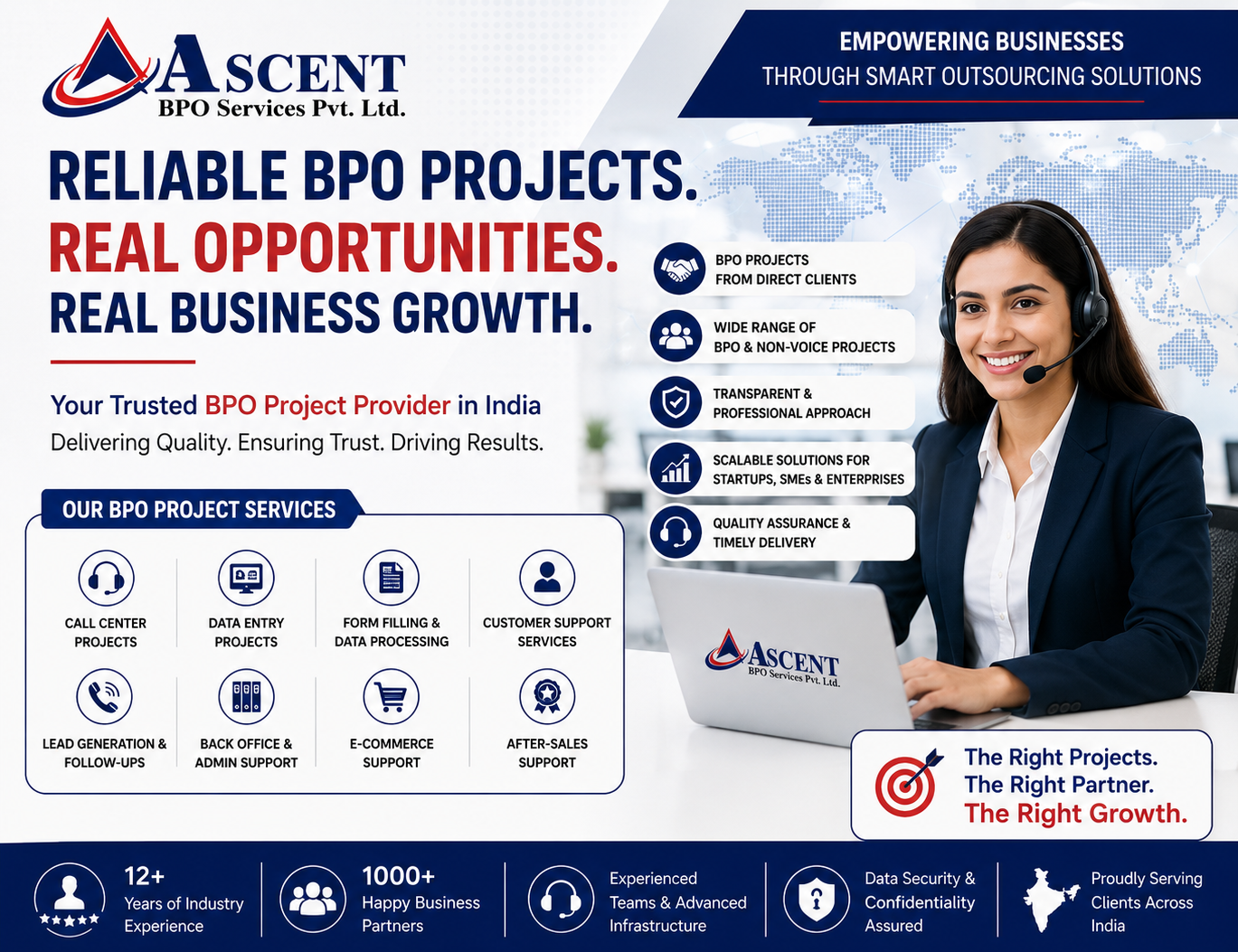
Ascent BPO Services Pvt. Ltd. offers business process outsourcing solutions that include non-voice processes, email and chat support, customer support, and back-office services.
For businesses considering outsourcing, the first step is to identify which activities can be handled externally and document the expected service levels, communication procedures, data access requirements, and reporting needs.
Learn more about BPO projects and outsourcing solutions from Ascent BPO.
Discussing these requirements with a service provider can help businesses determine a suitable service model and establish clear expectations before operations begin.
Conclusion
Non-voice BPO services have become an important part of modern business operations. From email and live chat support to ticket management, document processing, and back-office administration, these services help organizations manage digital workflows and customer enquiries.
Successful outsourcing depends on choosing the right processes, setting measurable standards, protecting information, and maintaining effective communication between the business and its service provider.
By evaluating their operational requirements and adopting a suitable combination of people, processes, and technology, businesses can build non-voice support operations that contribute to efficiency and a better customer experience.

 English
 Arabic
 French
 Spanish
 Portuguese
 Deutsch
 Turkish
 Dutch
Dutch
 Italiano
 Russian
 Romaian
 Portuguese (Brazil)