


BPO Data Entry Projects: A Complete Guide for Businesses and Growing BPO Companies
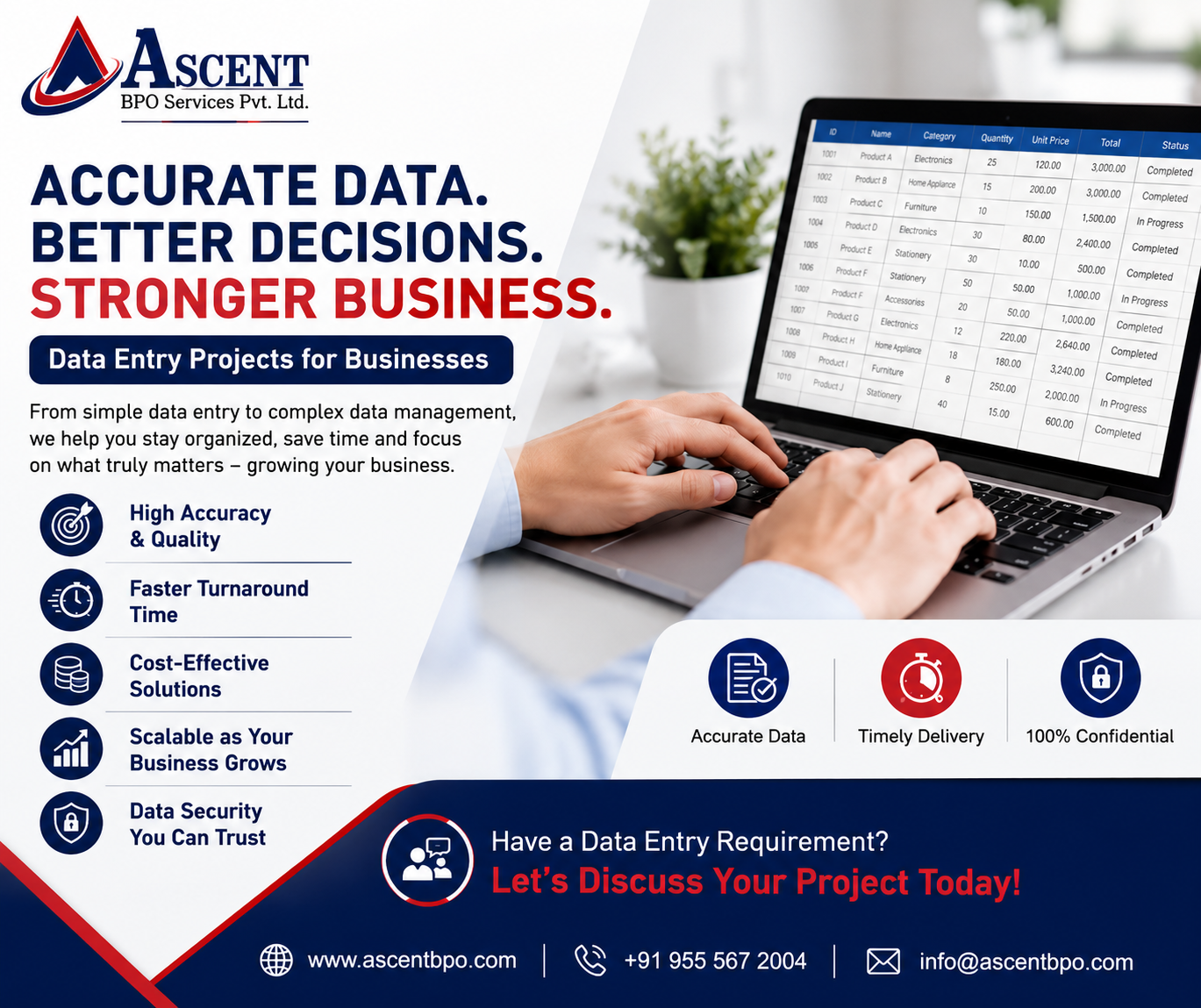
In today's digital business environment, accurate information management is essential for efficient operations. Companies across industries handle large volumes of customer records, invoices, product information, forms, and business documents every day. Managing this information internally can consume valuable time and resources, which is why many organizations rely on Business Process Outsourcing (BPO) providers for data entry and back-office support.
BPO data entry projects help businesses organize information, maintain digital records, improve data accessibility, and streamline routine administrative tasks. They also provide opportunities for BPO companies and outsourcing firms to expand their service portfolios and develop long-term business relationships.
Understanding the different types of data entry projects, their benefits, and the factors involved in selecting a reliable service provider can help businesses make better outsourcing decisions.
What Are BPO Data Entry Projects?
BPO projects involve outsourcing the collection, entry, conversion, validation, and organization of information to an external service provider. These projects may involve transferring information from physical documents, scanned files, spreadsheets, online forms, or other sources into digital databases and business applications.
Depending on the project requirements, data entry professionals may also perform data cleaning, record updating, document classification, and quality checks.
Businesses outsource these activities to improve workflow efficiency and allow their internal teams to concentrate on core responsibilities such as sales, customer relationships, product development, and business growth.
Types of BPO Data Entry Projects
Data entry outsourcing includes several categories of work. The specific requirements depend on the industry, the volume of information, the technology used, and the expected delivery standards.
1. Online Data Entry Projects
Online data entry projects involve entering or updating information through web-based platforms, content management systems, spreadsheets, or business databases.
Common tasks include updating customer records, entering product information, maintaining online catalogues, and updating CRM systems. These projects require familiarity with digital tools, attention to detail, and compliance with the client's instructions.
2. Offline Data Entry Projects
Offline data entry projects involve converting information from physical documents, scanned files, images, and PDFs into structured digital formats.
Examples include digitizing paper records, transferring invoice information into spreadsheets, converting documents into editable files, and organizing historical business records.
Accuracy is particularly important because unclear documents or incorrect entries can affect the usefulness of the resulting database.
3. Form Filling Projects
Form filling projects require information to be entered into predefined forms or templates. These assignments may involve survey responses, application records, registration forms, or administrative documents.
A structured workflow helps ensure that required fields are completed consistently and that missing or invalid information is identified according to the client's guidelines.
4. Data Processing and Data Cleaning
Data processing goes beyond basic typing. It can include sorting, categorizing, formatting, validating, and organizing information for further use.
Data cleaning may involve identifying duplicate entries, correcting formatting inconsistencies, and flagging incomplete records. These activities help businesses maintain more organized datasets and improve the reliability of their information.
5. E-Commerce Product Data Entry
Online retailers frequently need to manage product descriptions, stock details, specifications, prices, and catalogue information.
E-commerce data entry projects help maintain consistent product records across websites and sales platforms. Depending on the assignment, the work may also include product categorization, image mapping, and updating inventory information.
6. Back-Office Data Entry Projects
Back-office projects support the administrative activities that keep a business operating smoothly. These assignments may include invoice processing, order record management, document indexing, customer database maintenance, and updating internal reports.
Businesses can outsource suitable back-office activities to improve workflow organization without expanding every internal administrative function.
Why Do Businesses Outsource Data Entry Work?
Outsourcing data entry can provide several operational advantages when the arrangement is properly planned and managed.
Improved operational efficiency: External teams can handle defined data-related tasks while internal employees focus on activities that require their direct expertise.
Flexible processing capacity: Businesses can select an outsourcing arrangement that matches their workload, project duration, and expected output.
Consistent workflows: Documented procedures, standardized templates, and regular quality checks can help maintain consistency across large volumes of records.
Better resource allocation: Outsourcing may reduce the need to recruit, train, and manage additional in-house staff for specific data processing requirements.
Support for business expansion: As transaction volumes and administrative requirements grow, an appropriate outsourcing partner can help manage additional processing work.
The actual benefits depend on project complexity, data quality, security requirements, service-level agreements, and the capabilities of the selected provider.
How to Choose a Reliable BPO Data Entry Project Provider
Selecting a service provider requires more than comparing prices. Businesses should evaluate whether the provider can understand their requirements, protect sensitive information, and deliver work according to agreed standards.
Consider the following factors before entering into an outsourcing arrangement:
-
Project scope: Confirm the type of work, source documents, expected output, and responsibilities of each party.
-
Quality assurance: Ask about validation procedures, error reporting, sampling, and correction processes.
-
Data security: Review access controls, confidentiality provisions, secure file transfer methods, and applicable data protection requirements.
-
Technology and infrastructure: Determine whether the provider has the necessary systems, software, and operational capacity.
-
Communication: Establish reporting frequency, escalation procedures, and a clear point of contact.
-
Commercial terms: Review pricing, billing arrangements, payment milestones, service levels, and termination conditions.
-
References and verification: Check the provider's business credentials, relevant experience, and verifiable track record before committing.
Businesses should also be cautious of unrealistic guarantees, unclear project documentation, and requests for unexplained upfront payments. A transparent agreement and a clearly defined scope of work help both parties understand their obligations.
Important Skills for Successful Data Entry Operations
The quality of a data entry project depends on both the process and the people performing the work.
Important skills include:
Attention to detail: Employees must identify discrepancies and enter information accurately.
Computer proficiency: Familiarity with spreadsheets, document tools, databases, and relevant business applications is useful.
Time management: Teams need to meet deadlines while maintaining agreed quality standards.
Data confidentiality: Employees should follow access restrictions and handle client information responsibly.
Quality control: Reviewing completed records, tracking errors, and following documented procedures can reduce avoidable mistakes.
Training, supervision, and periodic performance reviews further support reliable project delivery.
The Role of Technology in Modern Data Entry Projects
Technology continues to change the way organizations manage information. Optical character recognition (OCR), workflow automation, validation rules, and AI-assisted document processing can help reduce repetitive manual work in suitable applications.
For example, OCR tools can extract text from scanned documents, while automated validation rules can flag missing fields or inconsistent formats. However, these tools may produce errors when documents are unclear, layouts are complex, or source information is incomplete.
Human review remains important for tasks requiring judgment, exception handling, or additional verification. A combination of suitable technology, trained professionals, and documented quality checks can help businesses build more reliable data management workflows.
How Ascent BPO Supports Data Entry and BPO Requirements
Businesses seeking external support for data-related operations should look for a provider that understands their workflow requirements and can explain the proposed service arrangement clearly.
Ascent BPO Services Pvt. Ltd. offers BPO-related services, including data entry, form filling, non-voice processes, back-office support, and call center services. Businesses can explore the company's service offerings to understand which solutions may align with their operational requirements.
Learn more about BPO projects and outsourcing services from Ascent BPO.
Before proceeding with any project, businesses should discuss the scope, expected volumes, quality standards, data handling requirements, timelines, and commercial terms with the provider.
Conclusion
BPO data entry projects play an important role in helping businesses manage information, organize records, and support everyday operations. From online data entry and form filling to document conversion, data processing, and back-office administration, these services cover a wide range of business requirements.
Successful outsourcing depends on clear project specifications, suitable technology, trained personnel, reliable communication, and effective quality control. By evaluating service providers carefully and establishing transparent agreements, businesses can build outsourcing arrangements that support operational efficiency and long-term growth.
For organizations planning to outsource data-related tasks, understanding the project requirements and selecting the right service model is the first step toward a more organized and efficient workflow.

 English
 Arabic
 French
 Spanish
 Portuguese
 Deutsch
 Turkish
 Dutch
Dutch
 Italiano
 Russian
 Romaian
 Greek
Greek