


Real Estate Software Market Outlook: Growth, Trends and Opportunities
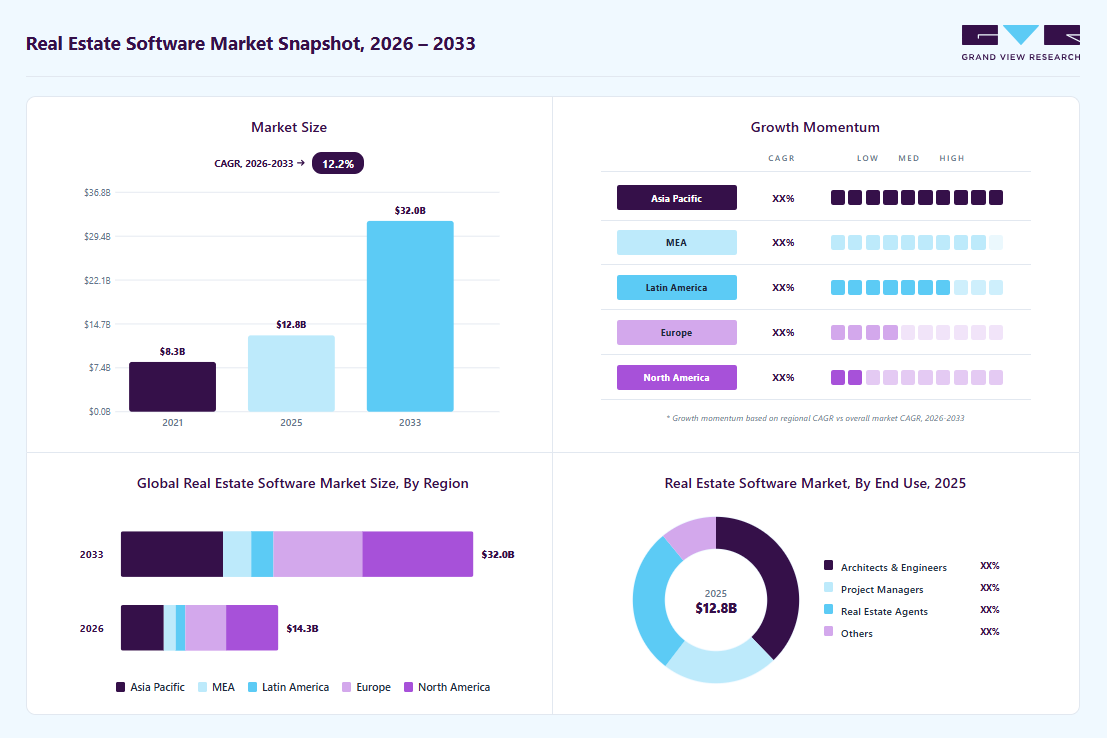
Property businesses are moving beyond traditional workflows as digital platforms reshape how properties, customers, transactions, and operational data are managed. The real estate software market was valued at USD 12.8 billion in 2025 and is estimated to reach USD 14.3 billion in 2026, with the market projected to reach USD 32.0 billion by 2033, expanding at a CAGR of 12.2% from 2026 to 2033. Increasing digitization, cloud adoption, artificial intelligence, automation, and demand for better data management are creating strong opportunities for software providers.
Digital Transformation Is Changing Property Operations
Real estate companies are increasingly adopting software to streamline property management, sales, marketing, client engagement, financial activities, and transaction workflows. The digitization of customer data and records is helping businesses analyze purchasing behavior and customer trends, while automation can reduce repetitive work and improve productivity.
Demand for stronger data management and protection is also encouraging organizations to adopt specialized software. Cloud and AI technologies are adding further capabilities, allowing businesses to manage large volumes of information, monitor performance, and make more informed decisions.
CRM Software Holds the Largest Market Position
Customer relationship management software accounted for 27.4% of revenue in 2025, making it the leading type segment. CRM platforms help real estate professionals organize relationships, follow up with prospective buyers and tenants, manage leads, and support property sales.
The segment is also benefiting from demand for improved productivity and security of sensitive customer information. Meanwhile, contract software is expected to record the fastest CAGR during the forecast period, supported by e-signatures, AI-assisted contract management, automated document tracking, centralized storage, and compliance requirements.
Cloud Platforms Become the Preferred Deployment Model
Cloud deployment held the largest market share in 2025 and is also expected to register the fastest CAGR through 2033. Cloud-based solutions provide faster data access and help companies manage large volumes of information while supporting workflow productivity.
Another advantage is scalability. Organizations can increase or reduce cloud storage according to their requirements without the hardware investments associated with traditional on-premise systems. Pay-as-you-go models can also make cloud platforms attractive to smaller businesses.
Residential Real Estate Creates a Broad Software Opportunity
The residential segment held the largest application share in 2025. Increasing adoption of digital platforms among property developers and agents is supporting software demand for listings management, documentation, customer communication, virtual property tours, online bookings, and digital payments.
Commercial applications, however, are expected to register the fastest CAGR during the forecast period. Software can help commercial property businesses manage transactions, property operations, legal documentation, accounts, and lease-related activities more efficiently.
AI and Virtual Reality Raise the Value of Real Estate Platforms
Artificial intelligence and machine learning are becoming important technologies within real estate software. They can automate time-consuming activities, support data analysis, monitor customer journeys, and improve workflow efficiency.
Virtual reality is creating another opportunity by enabling immersive property tours and remote viewing experiences. These technologies can help businesses reach prospective buyers who cannot physically visit properties while improving customer engagement.
Recent product activity illustrates this direction. In January 2026, RealEstate introduced a unified digital platform featuring website creation tools, AI-powered content and SEO features, integrated CRM, and mobile-optimized templates.
Real Estate Professionals Are Increasingly Embracing Automation
Architects and engineers represented the largest end-use segment in 2025. Real estate software helps these professionals generate feasibility reports and use interactive virtual property tours to communicate designs more effectively.
Real estate agents are expected to register the fastest CAGR during the forecast period. Adoption of VR, AI, blockchain, remote property viewing, digital marketing, and property management tools is helping agents manage listings, track leads, communicate with clients, and make data-driven decisions.
Innovation Comes With Cost and Training Challenges
Despite its growth potential, real estate software adoption can be constrained by high investments and workforce training requirements. Organizations may need to spend on implementation, employee skills, data migration, and ongoing technology management.
Property management businesses transitioning to online platforms may also face higher software costs. These challenges make scalability, ease of use, security, and return on investment important considerations for technology providers and users.
The Next Phase of Real Estate Software Growth
The market is moving toward integrated platforms that bring CRM, property management, analytics, marketing, financial management, automation, and customer engagement together. AI-powered workflows and cloud-based systems are likely to remain central to this transformation.
With the market forecast to reach USD 32.0 billion by 2033, software providers that combine automation, data intelligence, security, flexible deployment, and user-friendly digital experiences are positioned to benefit from the continued modernization of real estate operations.
FAQs
What is driving the real estate software market?
Growing digitization of real estate businesses, rapid urbanization, adoption of cloud and AI technologies, automation, demand for better data management, and the need to improve customer engagement are supporting market growth.
What is the real estate software market forecast through 2033?
The market is projected to increase from USD 14.3 billion in 2026 to USD 32.0 billion by 2033, registering a CAGR of 12.2% from 2026 to 2033.
Key Real Estate Software Companies:
· Accruent
· Altus Group
· Autodesk Inc.
· CoStar Realty Information Inc.
About us:
Grand View Research, a market research and consulting company, provides syndicated research reports, customized research reports, and consulting services. Grand View Research database is used by the world's renowned academic institutions and Fortune 500 companies to understand the global and regional business environment. Our database features thousands of statistics and in-depth analysis on 46 industries in 25 major countries worldwide.

 English
 Arabic
 French
 Spanish
 Portuguese
 Deutsch
 Turkish
 Dutch
Dutch
 Russian
 Romaian
 Portuguese (Brazil)
 Greek
Greek