


How to Choose the Right Food Enzyme Manufacturer in India: 9 Technical Factors Buyers Should Check Before Ordering
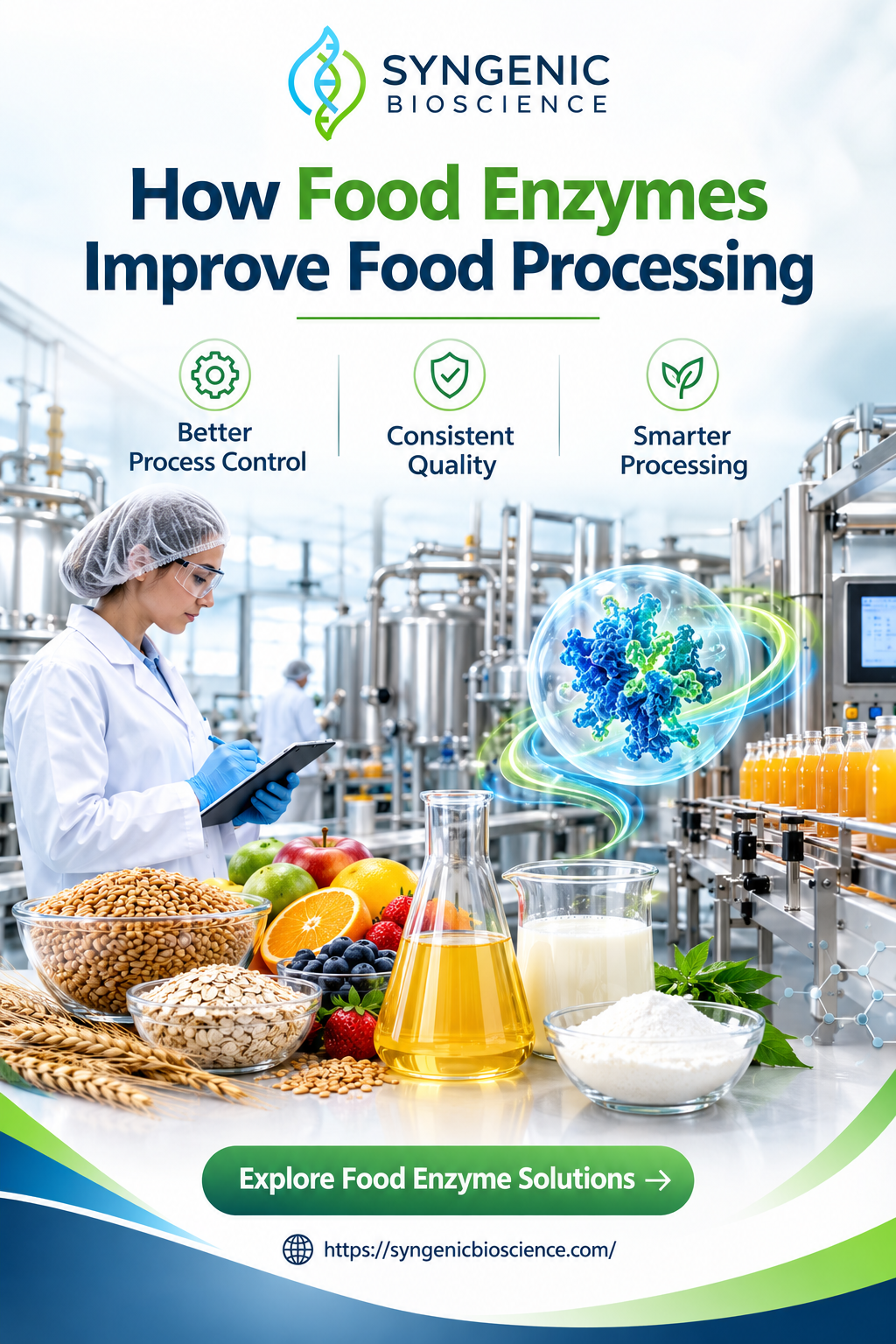
In commercial food processing, selecting an enzyme is not a simple matter of choosing the product with the highest concentration or the lowest price. A food enzyme has to work inside a real production process where raw-material variation, temperature, pH, processing time, substrate concentration and operating conditions can change the final result.
This is where the experience of a Food Enzyme Manufacturer becomes important.
A technically suitable enzyme can support consistent processing, while an unsuitable enzyme may create problems such as inconsistent results, higher dosage requirements, longer processing time or difficulty maintaining product quality. For this reason, food manufacturers should evaluate Food Enzyme Suppliers based on activity, application suitability, process compatibility, quality control and technical support rather than comparing product prices alone.
What Experienced Food Processors Look for in a Food Enzyme Manufacturer
Experienced purchasing and technical teams usually ask a different question from first-time buyers.
Instead of asking only:
“What is the enzyme concentration?”
they ask:
“How will this enzyme behave in our actual production process?”
That difference is important.
Enzyme preparations are characterized by their biological activity, and activity is generally measured according to the reaction catalyzed by the enzyme.
Therefore, a meaningful supplier evaluation should begin with the intended application and operating conditions.
1. Start With the Processing Problem, Not the Product Name
One of the most practical mistakes in enzyme selection is starting with a product catalogue instead of the production problem.
Before selecting an enzyme, a technical team should define:
- What raw material is being processed?
- What result needs to be improved?
- What is the current processing difficulty?
- What temperature is used?
- What is the process pH?
- How long is the enzyme allowed to act?
- What is the substrate concentration?
- What production volume is involved?
- What result is considered acceptable?
This information gives a Food Enzyme Manufacturer a much better technical starting point.
An enzyme should be selected around the process requirement rather than simply around a product description.
2. Do Not Compare Enzymes Only by Concentration
Concentration and activity are not the same measurement.
Two commercial enzyme preparations can have different formulation characteristics while still requiring evaluation based on their actual catalytic activity and application performance.
For buyers, the more useful questions are:
- What activity is specified?
- What assay method is used?
- Under which conditions is activity measured?
- What dosage is recommended?
- What substrate is being used?
- How does the enzyme perform under the intended process conditions?
FAO/JECFA documentation describes enzyme activities in terms of the reactions catalyzed and notes that activity is commonly expressed in activity units per weight of preparation.
This is why experienced Food Enzyme Suppliers discuss activity and application conditions rather than relying only on a concentration number.
3. Understand the Relationship Between pH and Enzyme Performance
pH is not a minor laboratory detail.
In industrial food processing, the operating pH can directly influence enzyme performance. Different enzymes have different activity profiles, and changing the processing environment can change how effectively an enzyme performs.
A practical supplier evaluation should therefore consider:
Actual process pH → enzyme activity range → exposure time → expected processing result
Food-processing references also identify pH and temperature among the major factors affecting enzyme activity.
A technically experienced Food Enzyme Manufacturer should be able to discuss these variables in the context of the customer's application.
4. Temperature Can Change the Entire Enzyme Response
Temperature is another critical process variable.
Increasing temperature does not simply mean that an enzyme will always work faster. Enzyme activity can increase within an appropriate operating range, but excessive heat can reduce or destroy activity depending on the enzyme and conditions.
This is particularly important when the enzyme is used in a process involving heating, cooling or temperature fluctuations.
Therefore, buyers should understand:
- Recommended operating temperature
- Temperature tolerance
- Exposure duration
- Process temperature changes
- Whether enzyme action is required before or after heating
- Whether the process eventually requires enzyme deactivation
In food processing, temperature and pH are recognized as important variables controlling enzyme activity.
5. Raw-Material Variation Is an Industry Reality
Laboratory trials often use controlled raw materials.
Commercial production does not always have that advantage.
Raw materials can vary in composition, maturity, moisture, substrate availability and other characteristics. These differences can affect how an enzyme performs.
That is why an experienced Food Enzyme Manufacturer should understand the customer's raw-material conditions rather than treating every production environment as identical.
For larger food processors, supplier discussions should include the expected range of raw-material variation and how that variation could affect enzyme dosage or processing performance.
6. Enzyme Dosage Should Be Based on the Application
More enzyme does not automatically mean better processing.
An appropriate dosage depends on the enzyme, substrate, processing conditions, target result and required reaction time.
A useful technical trial should therefore examine the relationship between:
Dosage → processing time → operating conditions → final result
Instead of increasing dosage whenever the desired result is not achieved, technical teams should first investigate whether the process conditions are suitable.
This application-based approach can prevent unnecessary enzyme consumption and provide a more realistic basis for comparing Food Enzyme Suppliers in India.
7. Batch-to-Batch Consistency Matters More Than a One-Time Trial
A supplier may provide a successful trial sample, but commercial production requires repeatable performance.
For a food manufacturer, the real question is not:
“Did the sample work once?”
The more important question is:
“Can the product deliver consistent performance across regular production batches?”
Buyers should therefore discuss:
- Batch testing
- Activity specifications
- Product identification
- Quality-control procedures
- Batch documentation
- Storage conditions
- Recommended handling
Consistency becomes especially important when an enzyme is integrated into a standardized production process.
8. Ask How Enzyme Activity Is Tested
This is one of the questions that separates a technical supplier evaluation from a price-based purchase.
An activity value is meaningful only when the measurement method and conditions are understood.
Buyers should ask:
- What assay is used?
- What substrate is used during testing?
- At what pH is activity measured?
- At what temperature?
- What does the reported activity unit represent?
- Is the same testing approach maintained between batches?
FAO/JECFA specifications include identification and test methods for enzyme activities, emphasizing the importance of defined analytical approaches.
A Food Enzyme Manufacturer that can clearly explain its activity testing gives buyers a stronger technical basis for supplier comparison.
9. Evaluate the Supplier's Technical Support
A good supplier relationship should continue after the purchase order.
During industrial trials, customers may need help understanding:
- Initial dosage
- Process conditions
- Reaction time
- Temperature effects
- pH effects
- Storage
- Handling
- Troubleshooting
This is particularly important when an enzyme is being introduced into an existing production line.
Technical support can help identify whether an unexpected result is caused by the enzyme itself or by another process variable.
10. Look at Total Processing Value, Not Just Purchase Price
Price is important, but it should not be the only comparison point.
Suppose Supplier A offers a lower-cost enzyme but requires a higher dosage or produces inconsistent results.
Supplier B may have a higher unit price but require less product per batch and provide more consistent processing.
The meaningful comparison is therefore:
Cost per effective production result
rather than simply:
Price per kilogram
This is one reason experienced buyers compare multiple Food Enzyme Suppliers using actual application data.
11. Storage and Handling Can Affect Commercial Performance
Enzymes are biological preparations, and their quality can depend on appropriate storage and handling.
Before ordering, buyers should understand:
- Storage temperature
- Moisture exposure
- Packaging requirements
- Shelf-life
- Transportation conditions
- Handling instructions
Poor storage can undermine the expected performance of a product even when the original material met its specifications.
Therefore, supplier selection should include both product quality and practical supply-chain requirements.
12. Manufacturer or Supplier? Ask Who Controls the Product
When evaluating Food Enzyme Suppliers in India, buyers should understand whether they are dealing directly with a manufacturer or with a distribution channel.
Useful questions include:
- Who manufactures the enzyme?
- Where is the product produced?
- Who performs activity testing?
- Who controls batch specifications?
- Who provides technical support?
- Can the same specification be maintained for repeat orders?
This does not mean that every distributor is unsuitable.
The important issue is transparency and technical accountability.
A Practical Food Enzyme Supplier Evaluation Checklist
Before finalizing a Food Enzyme Manufacturer in India, technical and purchasing teams can evaluate the supplier using the following checklist:
| Evaluation Area | What to Check |
|---|---|
| Enzyme activity | Defined activity and test method |
| Application | Suitability for the intended food process |
| pH | Recommended operating range |
| Temperature | Suitable processing conditions |
| Dosage | Application-specific recommendation |
| Consistency | Batch-to-batch quality |
| Documentation | Specifications and relevant test information |
| Storage | Handling and storage requirements |
| Technical support | Trial and troubleshooting assistance |
| Supply | Ability to support regular production |
| Commercial value | Cost relative to actual processing performance |
This type of evaluation is more useful than selecting a supplier based on a single specification.
What Makes a Food Enzyme Manufacturer Technically Reliable?
A technically reliable manufacturer should be able to connect the product with the customer's actual production conditions.
That means understanding the relationship between:
Enzyme activity + substrate + pH + temperature + dosage + reaction time + process objective
This is where industry experience becomes valuable.
Food enzymes are sensitive to processing conditions, and their performance can be influenced by temperature, pH, moisture and substrate-related factors.
Therefore, a manufacturer that understands application conditions can provide more useful guidance than one that only supplies a product specification sheet.
Final Thoughts
Selecting a Food Enzyme Manufacturer should be treated as a technical decision, not simply a purchasing decision.
The right evaluation starts with the food-processing application and then considers enzyme activity, dosage, pH, temperature, raw-material conditions, batch consistency, testing methods, storage and technical support.
For companies comparing Food Enzyme Suppliers in India, the most useful approach is to ask how the enzyme is expected to perform under real production conditions.
A supplier that can explain the science behind its enzyme, provide appropriate technical information and support application evaluation gives food manufacturers a stronger foundation for long-term process consistency.
In the end, the objective is not to find an enzyme with the biggest number on a specification sheet. The objective is to find an enzyme solution that delivers consistent, measurable and application-relevant performance in the real food-processing environment.

 English
 Arabic
 French
 Spanish
 Portuguese
 Deutsch
 Turkish
 Italiano
 Russian
 Romaian
 Portuguese (Brazil)
 Greek
Greek