


Home Decor Market 2026 | Industry Size, Share, Growth, Trends & Future Outlook Report by 2034
Market Overview
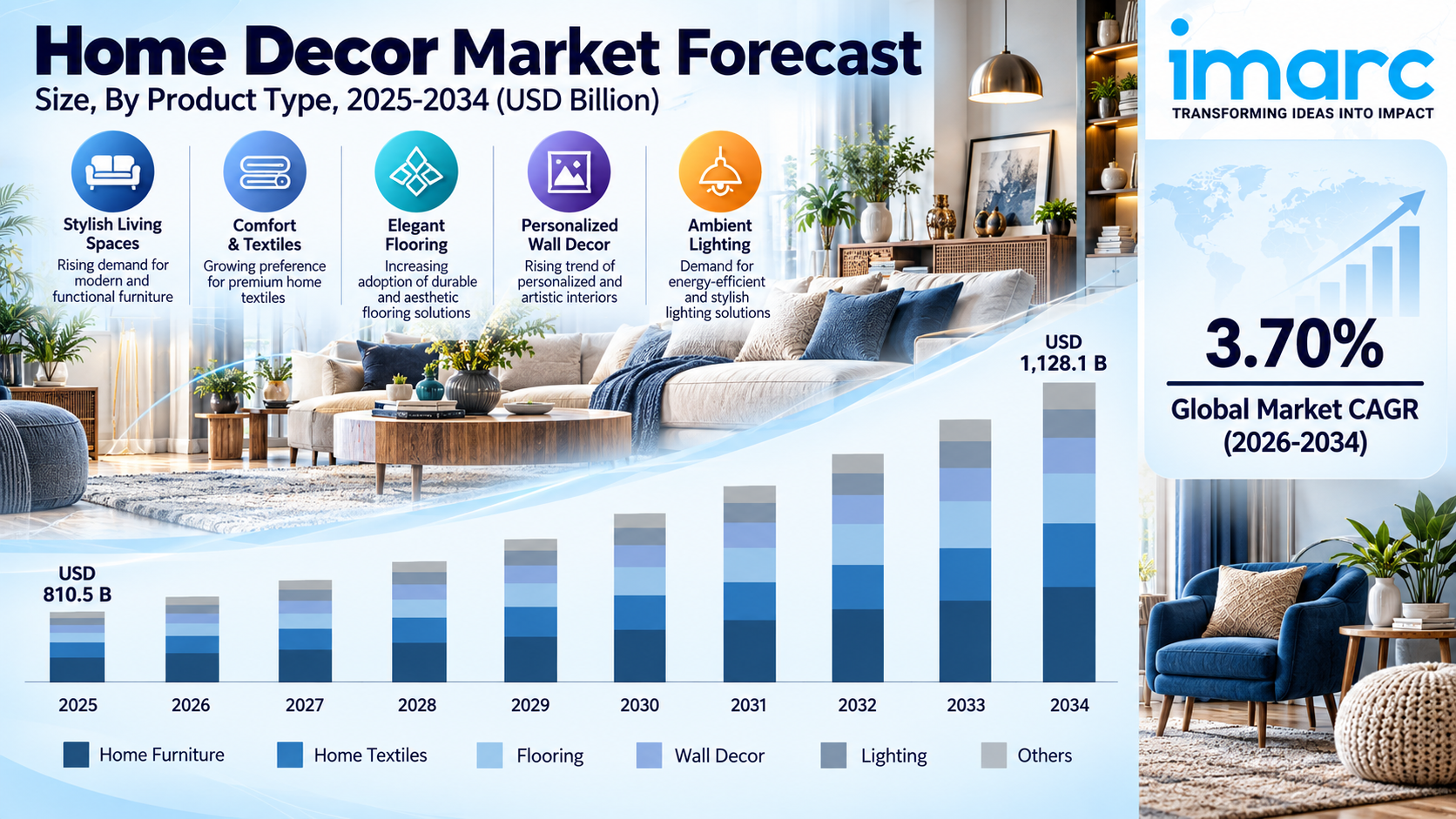
According to a research report by IMARC Group, the global home decor market size reached USD 810.5 Billion in 2025. Looking forward, IMARC Group expects the market to reach USD 1,128.1 Billion by 2034, exhibiting a growth rate (CAGR) of 3.70% during 2026-2034. The market is experiencing stable growth driven by the increasing focus on health and wellness, rising preferences for personalized and aesthetically pleasing interior designs, the growing demand for sustainable decor products, and the integration of smart technology into decor products to provide enhanced experiences to individuals.
Home Decor Market Key At a Glance
-
Base Year: 2025
-
Historical Period: 2020–2025
-
Forecast Period: 2026–2034
-
Market Size (2025): USD 810.5 Billion
-
Market Forecast (2034): USD 1,128.1 Billion
-
CAGR (2026–2034): 3.70%
-
Leading Region: North America
-
Dominant Product Type: Home Furniture
-
Dominant Distribution Channel: Home Decor Stores
Request for a Sample Report for Detailed Evaluation: https://www.imarcgroup.com/home-decorative-materials-market/requestsample
Home Decor Market Report: Key Highlights
-
Market Size & Growth: The global home decor market reached USD 810.5 Billion in 2025 and is projected to reach USD 1,128.1 Billion by 2034, registering a CAGR of 3.70% during 2026–2034, according to IMARC Group.
-
Regional Leadership: North America represents the largest regional market, supported by the rising focus on interior design and home improvement solutions and the increasing desire to create aesthetically pleasing and comfortable living environments.
-
By Product Type: The market is segmented into home furniture, home textiles, flooring, wall decor, lighting, and others, with home furniture representing the largest segment.
-
By Distribution Channel: The market covers home decor stores, supermarkets and hypermarkets, online stores, gift shops, and others, with home decor stores accounting for the largest share.
-
Key Market Drivers: Rising preferences for personalized and aesthetically pleasing interiors, increasing focus on health and wellness, growing demand for space-saving solutions, and the expanding do-it-yourself (DIY) trend.
-
Key Market Trends: Increasing adoption of sustainable materials, growing popularity of handmade and artisanal products, rising social media influence, and integration of smart technology into home decor products.
-
Technological Advancements: Innovations such as augmented reality (AR), virtual reality (VR), smart lighting, connected security products, and voice-controlled devices are enhancing consumer experiences.
-
Key Market Challenges: Increasing requirements to meet sustainability standards and the need for manufacturers to adopt eco-friendly materials and responsible production practices.
-
Emerging Opportunities: Rising demand for personalized decor products, sustainable solutions, smart home integration, online retail, and premium home furnishing products.
What Is Driving Home Decor Market Growth in 2026?
Rising Preferences for Personalization
The growing demand for home decor products, driven by evolving consumer preferences and lifestyles, represents a key factor supporting the expansion of the world market. Consumers are increasingly focused on creating personalized, comfortable, and aesthetically appealing living spaces that reflect their individual tastes, personalities, and lifestyles. This trend is contributing to rising demand for a diverse range of home goods, including furniture, decorative accessories, wall art, textiles, lighting products, and other interior furnishings.
The increasing popularity of handmade and artisanal products is further contributing to market growth. Consumers are showing a stronger preference for distinctive room decor products that offer unique designs, craftsmanship, and an element of exclusivity. At the same time, growing environmental awareness is encouraging demand for home goods manufactured using sustainable, recycled, and responsibly sourced materials, creating favorable opportunities for manufacturers and retailers.
Social media platforms are also playing an important role in shaping consumer purchasing behavior. Interior design inspiration, home makeovers, and lifestyle content are exposing consumers to emerging trends in home decoration and encouraging them to recreate visually appealing interiors in their own homes. The growing influence of these digital platforms, combined with rising interest in personalization, sustainability, and distinctive design, is expected to continue supporting the global home decor market.
Growing Focus on Health and Wellness
The increasing focus on health and wellness is supporting demand for home decor products made from natural and sustainable materials. Consumers are increasingly opting for bamboo, reclaimed wood, organic cotton, eco-friendly paints, and other materials that can reduce exposure to harmful chemicals and contribute to healthier indoor environments.
The adoption of biophilic design is another important trend. This approach incorporates natural elements such as plants, natural light, and natural textures into interior spaces and is associated with improved well-being and reduced stress. In addition, rising demand for ergonomic furniture and accessories designed to support good posture and reduce physical strain is contributing to market growth.
Furthermore, circadian lighting systems that mimic natural daylight patterns are gaining attention for their ability to support sleep patterns and mood. Smart lighting control systems are also enabling users to personalize lighting experiences according to their preferences.
Increasing Integration of Smart Technology
The increasing integration of smart technology into home decor products is providing enhanced experiences to individuals. Smart home technologies enable homeowners to manage lighting, thermostats, voice-activated assistants, motorized window shades, and other aspects of their living environments with greater convenience and control.
Smart decor products can also contribute to energy efficiency by enabling users to monitor and optimize energy consumption. Smart lighting systems can automatically adjust brightness according to natural light levels, potentially reducing electricity consumption. Furthermore, connected technologies allow users to customize lighting colors, brightness, and patterns according to their mood or occasion.
Smart technology is also being integrated into home security products, including connected cameras, doorbell cameras, and smart locks. These solutions enable homeowners to monitor their properties remotely and provide additional convenience and peace of mind.
Growing Demand for Space-Saving Solutions
The increasing demand for space-saving solutions is supporting the growth of the home decor market. As consumers seek to maximize the functionality of available living spaces, demand is rising for furniture and decor products that combine functionality with attractive designs.
Multifunctional and compact solutions can help individuals maintain organized living environments while reducing visual clutter. This trend is particularly relevant as consumers increasingly prioritize practical, comfortable, and aesthetically pleasing interiors.
Rising Influence of Social Media and DIY Trends
The growing influence of social media platforms is contributing to changing consumer preferences for home decor products. Online platforms showcase interior design inspiration, minimalist aesthetics, vintage styles, sustainable products, and other decor trends, encouraging individuals to recreate similar environments in their homes.
At the same time, the increasing popularity of do-it-yourself (DIY) activities is supporting demand for decor products as consumers take greater interest in personalizing and improving their living spaces.
Home Decor Market Segmentation Analysis
By Product Type
-
Home Furniture
-
Home Textiles
-
Flooring
-
Wall Decor
-
Lighting
-
Others
Home furniture accounts for the largest share of the home decor market. It includes sofas, chairs, tables, beds, cabinets, and other furniture pieces that serve both functional and decorative purposes. Consumers are increasingly investing in high-quality furniture to improve the aesthetics, comfort, and functionality of their homes.
Home textiles include curtains, drapes, bedding, cushions, rugs, towels, and other products that add texture, color, and warmth to interior spaces. Growing demand for attractive and comfortable home textiles is supporting segment growth.
Flooring includes hardwood flooring, carpeting, tiles, laminate, vinyl, and other flooring solutions. Flooring plays an important role in defining the overall style and ambiance of residential interiors.
Wall decor includes artwork, mirrors, wall clocks, decals, wallpaper, and other decorative products. These products enable consumers to personalize their living spaces and create focal points within rooms.
Lighting includes chandeliers, pendant lights, floor lamps, table lamps, LED lighting, and other lighting solutions. In addition to serving functional purposes, lighting contributes to the ambiance and aesthetic appeal of interior spaces.
By Distribution Channel
-
Home Decor Stores
-
Supermarkets and Hypermarkets
-
Online Store
-
Gift Shops
-
Others
Home decor stores hold the largest share of the market by distribution channel. These specialized retail outlets offer a wide range of furniture, textiles, wall decor, lighting, and other products, allowing consumers to physically inspect products before making purchasing decisions. They may also provide expert assistance and design consultations.
Supermarkets and hypermarkets feature dedicated sections for home decor products and provide convenience for consumers seeking budget-friendly options while completing regular shopping activities.
Online stores provide consumers with access to a broad range of home decor products from the comfort of their homes. The online channel enables shoppers to browse and compare products and access reviews and recommendations.
Gift shops offer a selection of unique and artisanal decor items and cater particularly to consumers looking for distinctive and handcrafted products.
By Region
-
North America
-
Europe
-
Asia Pacific
-
Middle East and Africa
-
Latin America
North America holds the largest share of the global home decor market. The region's leadership is supported by the rising focus on interior design and home improvement solutions and the increasing desire to create aesthetically pleasing and comfortable living environments. The presence of well-established online retail platforms offering extensive selections of decor products is also supporting market growth.
Asia Pacific represents another important regional market, supported by its rich heritage of craftsmanship and artisanal traditions. Rising income levels and increasing focus on improving living spaces are contributing to market growth. Growing consumer preference for online platforms and increasing demand for environmentally responsible and ethically sourced decor products are further supporting the regional market.
Europe maintains a strong presence in the market, supported by increasing consumer focus on sustainable and eco-friendly products. The region has a well-developed retail infrastructure comprising boutique stores, designer showrooms, and established e-commerce platforms. Growing adoption of aesthetically pleasing decorative products is also supporting demand.
The Middle East and Africa represents a developing market, driven by increasing spending on luxury and high-quality decor products. The growing focus on stylish and functional living spaces, along with demand for decor products in hotels, resorts, and luxury accommodations, is supporting regional growth.
Latin America exhibits growing potential due to the wide availability of decor products through online and offline distribution channels. Rising consumer preferences for sustainable and eco-friendly decor options are also supporting market expansion.
Key Regional Insight: North America's Strategic Position
North America's leading position in the global home decor market is anchored in the growing focus on interior design and home improvement. Consumers are increasingly seeking aesthetically pleasing, comfortable, and personalized living environments, supporting demand across furniture, textiles, lighting, wall decor, flooring, and other categories.
The region also benefits from well-established online retail platforms and the presence of key manufacturers, retailers, and designers. These factors are contributing to product accessibility and supporting continued market development.
Competitive Landscape in the Home Decor Industry
Leading companies in the global home decor market are focusing on expanding their product portfolios to cater to the diverse preferences of consumers. Manufacturers and retailers are introducing new designs, styles, and categories, including sustainable products and smart home-integrated solutions.
Companies are increasingly focusing on sustainability by using eco-friendly materials, reducing waste, and adopting responsible manufacturing practices. They are also expanding their online presence through user-friendly websites, mobile applications, and online marketplaces to reach broader consumer bases and provide convenient shopping experiences.
In addition, major manufacturers are offering personalized products with different colors, patterns, and design options. The integration of smart lighting, thermostats, voice-controlled devices, and other connected technologies is also enabling companies to address growing consumer demand for convenience and modernity.
Key Home Decor Market Players Include:
-
Ashley Global Retail, LLC
-
Duresta Upholstery Limited
-
Forbo Holding AG
-
Hanssem Co. Ltd.
-
Herman Miller, Inc.
-
Inter IKEA Systems B.V.
-
Kimball International Inc. (HNI Corporation)
-
Mannington Mills, Inc.
-
Mohawk Industries Inc.
-
Samson Holding Ltd
-
Shaw Industries Group Inc. (Berkshire Hathaway Inc.)
-
Signify Holding
-
Sophia Home
-
Springs Window Fashions
-
Suofeiya Home Collection Co., Ltd.
-
and others
Note: The above represents a partial list of companies covered in the report. The complete competitive landscape is provided in the full report.
Recent Developments:
-
In September 2024, IKEA announced the launch of PAX wardrobe with a recyclable and innovative frame designed for quicker assembly and enhanced access.
-
On August 21, 2023, Herman Miller Inc. introduced the Fuld nesting chair, designed in collaboration with Stefan Diez. The chair features a sleek design that enables flexible configurations for workspaces and is available in dipped-in-color and dual-color combinations.
-
In July 2022, Inter IKEA Systems B.V. announced plans to open its third store in Mumbai at R CITY, Ghatkopar (W), strengthening its presence in India and making the brand more accessible to a larger consumer base.
-
In March 2021, Ashley Furniture Industries Inc. announced plans to open a new facility near Pottsville, Pennsylvania. The 1.7 million-square-foot complex was planned to produce stationary upholstery furniture, with the company also investing in machinery, equipment, and facility updates.
Market Drivers, Challenges & Opportunities
Major Market Drivers:
-
Rising Personalization: Increasing consumer demand for unique, customized, and aesthetically pleasing decor products is supporting market growth.
-
Health and Wellness Focus: Growing preference for natural, sustainable, ergonomic, and wellness-oriented decor products is creating additional demand.
-
Smart Technology Integration: Integration of smart lighting, connected security systems, voice assistants, and other technologies is enhancing the functionality of decor products.
-
Space-Saving Solutions: Increasing demand for compact and multifunctional products is supporting innovation in home furniture and decor.
-
Social Media Influence: Interior design inspiration shared across social media platforms is influencing consumer purchasing preferences.
Key Challenges:
-
Sustainability Requirements: Companies face increasing pressure to meet sustainability standards and adopt environmentally responsible production practices.
-
Changing Consumer Preferences: Manufacturers and retailers need to continuously adapt product designs and offerings to changing aesthetic and lifestyle preferences.
Emerging Opportunities:
-
Personalized Decor Products: Rising demand for customized furniture, textiles, wall decor, and other products is creating opportunities for manufacturers.
-
Sustainable Materials: Growing consumer preference for environmentally responsible products is encouraging the development of eco-friendly decor solutions.
-
Smart Home Integration: The increasing integration of connected technologies into decor products is opening new opportunities for innovation.
-
Online Retail Expansion: Growing consumer preference for online shopping is enabling companies to reach wider customer bases and provide broader product selections.
-
Premium and Artisanal Products: Increasing interest in luxury, handmade, and distinctive decor products is creating opportunities across premium market segments.
Home Decor Market FAQs
1. What is the current size of the home decor market?
The global home decor market reached USD 810.5 Billion in 2025 and is expected to grow at a CAGR of 3.70% during 2026-2034, reaching USD 1,128.1 Billion by 2034.
2. What is driving the growth of the home decor market?
The market is driven by rising preferences for personalized and aesthetically pleasing interior designs, increasing focus on health and wellness, growing demand for space-saving solutions, the rising DIY trend, social media influence, and increasing integration of smart technology into decor products.
3. Which region dominates the home decor market?
North America leads the global home decor market, supported by the rising focus on interior design and home improvement, increasing demand for comfortable and aesthetically pleasing living environments, established online retail platforms, and the presence of key manufacturers, retailers, and designers.
4. Which segment holds the largest share in the home decor market?
Home furniture represents the largest segment by product type, while home decor stores account for the largest share by distribution channel.
5. What are the key trends in the home decor market?
Key trends include increasing demand for personalized and artisanal products, growing focus on health and wellness, rising adoption of sustainable materials, increasing integration of smart technologies, growing influence of social media, and expanding demand for space-saving and multifunctional decor solutions.
Conclusion: Home Decor Market Outlook to 2034
The global home decor market is set for steady growth through 2034, underpinned by rising preferences for personalized and aesthetically pleasing interiors, increasing focus on health and wellness, growing demand for sustainable products, and continued integration of smart technology into decor items.
While sustainability requirements and changing consumer preferences present ongoing challenges, the market offers significant opportunities through personalized products, eco-friendly materials, smart home integration, online retail, and premium and artisanal decor. With North America maintaining its position as the leading regional market and Asia Pacific offering strong growth potential, the outlook through 2034 remains positive.
Companies that focus on sustainable materials, innovative designs, personalization, digital retail experiences, and smart technology integration will be well positioned to capture value as consumer expectations surrounding home environments continue to evolve.
About the Author:
IMARC Group is a leading global market research company providing data-driven insights and expert consulting services to businesses seeking to achieve their strategic objectives. With a multi-disciplinary team of industry experts, IMARC delivers thorough, reliable market intelligence across sectors including Energy and Mining, Construction and Manufacturing, Automotive, Chemicals and Materials, and more.
Media & Sales Contact:
IMARC Group
United States: +1-201-971-6302
India: +91-120-433-0800
United Kingdom: +44-753-714-6104

 English
 Arabic
 French
 Spanish
 Portuguese
 Deutsch
 Dutch
Dutch
 Italiano
 Russian
 Romaian
 Portuguese (Brazil)
 Greek
Greek