


Fitness App Market Outlook 2026-2034: Size, Share, Trends, Demand and Forecast
Market Overview
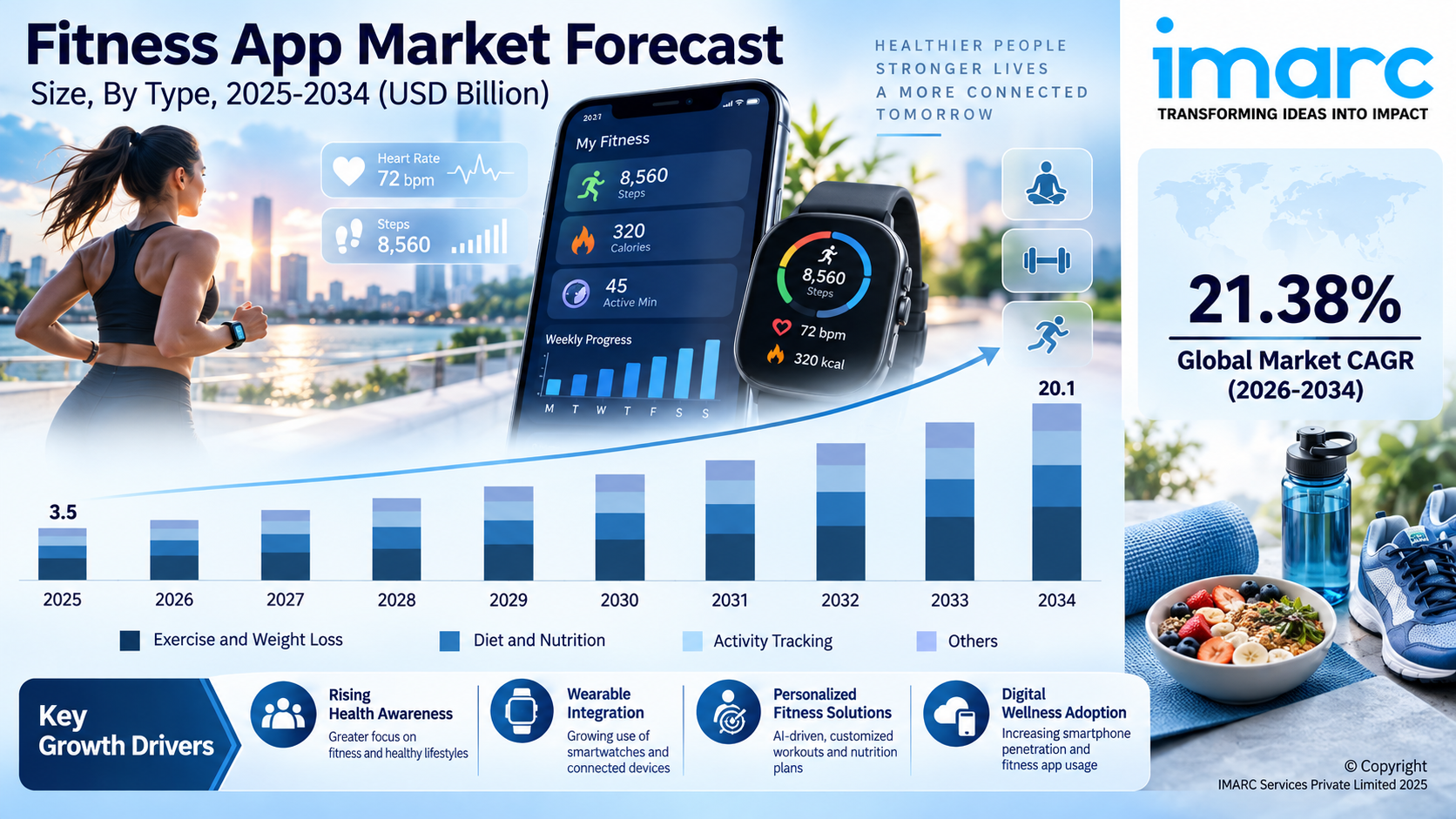
According to a research report by IMARC Group, the global fitness app market size was valued at USD 3.5 Billion in 2025. Looking forward, IMARC Group expects the market to reach USD 20.1 Billion by 2034, exhibiting a growth rate (CAGR) of 21.38% during 2026-2034. North America currently dominates the market, holding a significant market share of 36.8% in 2025. Market growth is primarily driven by increasing health consciousness, rising adoption of smartphones and wearable devices, technological advancements in fitness applications, and growing demand for flexible and easily accessible solutions for achieving health and fitness goals.
Fitness App Market Key At a Glance
-
Base Year: 2025
-
Historical Period: 2020–2025
-
Forecast Period: 2026–2034
-
Market Size (2025): USD 3.5 Billion
-
Market Forecast (2034): USD 20.1 Billion
-
CAGR (2026–2034): 21.38%
-
Leading Region: North America
-
North America Market Share (2025): 36.8%
-
Dominant Type: Exercise and Weight Loss
-
Leading Platform: iOS
-
Leading Device: Smartphones
Request for a Sample Report for Detailed Evaluation: https://www.imarcgroup.com/fitness-app-market/requestsample
What Is Driving Fitness App Market Growth in 2026?
Increasing Health Consciousness
The rising health consciousness among consumers represents one of the key factors positively influencing the fitness app market. As individuals become increasingly aware of the importance of physical fitness and overall well-being, they are seeking convenient and accessible solutions to maintain healthier lifestyles. Fitness apps provide personalized workouts, nutrition guidance, progress tracking, and other features that allow users to manage their fitness routines conveniently.
The growing prevalence of chronic and lifestyle-related diseases, including obesity and diabetes, is further encouraging individuals to adopt proactive approaches toward health management. Fitness apps are increasingly being used as tools to support exercise routines, monitor progress, and establish healthier habits. The increasing preference for alternatives to crowded gyms and fitness centers is also contributing to market growth.
Digital Transformation of the Fitness Industry
The ongoing digital transformation of the fitness industry is creating significant growth opportunities for the global fitness app market. Traditional fitness models are increasingly integrating digital and mobile technologies to provide consumers with more accessible, personalized, and flexible fitness experiences beyond conventional gyms and fitness centers. Fitness providers are launching branded applications that offer workout programs, class schedules, progress tracking, personalized recommendations, and other digital services, enabling users to manage their fitness routines conveniently through their smartphones.
Fitness trainers and instructors are also increasingly adopting digital platforms to deliver virtual coaching, personalized training programs, and live workout sessions, allowing them to reach a wider consumer base without being restricted by geographical limitations. This shift is contributing to greater adoption of the fitness app segment as consumers seek convenient solutions for exercising at home, outdoors, or on the go.
The growing adoption of wearable technologies, including fitness trackers and smartwatches, is further accelerating the digitalization of fitness services. These devices enable users to synchronize activity, health, and performance data with fitness applications, providing deeper insights into exercise patterns and supporting personalized fitness management. As consumers increasingly search for the best application for workout, best fitness app, and free fitness apps, app developers and fitness providers are expanding their offerings with personalized training, nutrition guidance, activity tracking, and connected-device integration to meet evolving consumer expectations.
Growth in Accessibility and Convenience
The accessibility and convenience offered by fitness apps are supporting their widespread adoption. Consumers can access workouts, nutrition plans, wellness content, and fitness tracking features without being restricted by gym schedules or physical locations. This 24/7 accessibility makes fitness applications suitable for individuals with different lifestyles and fitness levels.
The ability to customize workouts and establish personal fitness goals further enhances their appeal. From beginners starting their fitness journeys to experienced athletes pursuing specialized training, users can select programs according to their individual requirements. Real-time feedback and progress tracking also help users remain motivated and committed to their fitness routines.
Social Connectivity and Community Building
Social connectivity and community-building capabilities are strengthening demand for fitness apps. Many applications enable users to connect with friends, family members, trainers, and other individuals who share similar fitness goals. Users can participate in challenges, monitor progress, exchange encouragement, and engage in virtual activities.
Virtual fitness classes and live-streamed workouts are further helping users participate in group activities from their homes. These features create a sense of community while improving motivation and accountability, thereby supporting greater engagement with fitness applications.
Growing Adoption of Wearable Devices
The increasing utilization of fitness trackers, smartwatches, and other wearable devices is contributing to the expansion of the fitness app market. Wearables provide users with continuous access to activity, health, sleep, and other performance-related information, while fitness apps can aggregate and analyze this information.
Technological developments are also enabling more personalized health and fitness insights. For instance, on 21st October 2024, Samsung Gulf Electronics launched Galaxy Ring in the UAE, a wearable focused on 24/7 health monitoring and sleep analysis. Equipped with Galaxy AI, the device provides personalized insights related to sleep, activity, and vital signs.
Fitness App Market Segmentation Analysis
By Type
-
Exercise and Weight Loss
-
Diet and Nutrition
-
Activity Tracking
-
Others
Exercise and weight loss represents the largest segment, accounting for around 54.8% of the market in 2025. These applications provide users with workout routines, exercise plans, and training programs designed to support fitness and weight loss goals.
Exercise and weight loss apps commonly include video demonstrations, guided workout sessions, progress-tracking capabilities, and different exercise options. Their flexibility allows users to participate in cardiovascular workouts, strength training, and other forms of exercise according to their individual requirements.
Diet and nutrition applications provide users with tools for monitoring dietary habits and supporting nutritional goals, while activity-tracking applications focus on monitoring physical activity and related performance indicators.
By Platform
-
Android
-
iOS
-
Others
iOS leads the market, accounting for around 60.0% of the market share in 2025. Fitness applications developed for iOS benefit from the platform's substantial user base and strong engagement levels. Users on the platform often demonstrate a willingness to invest in premium digital experiences and subscription-based fitness applications.
The seamless integration of iOS with Apple Health further supports the segment by enabling users to synchronize health and fitness information and obtain a more comprehensive digital health experience. Fitness application developers also benefit from the platform's established ecosystem and user engagement characteristics.
By Device
-
Smartphones
-
Tablets
-
Wearable Devices
Smartphones represent the leading device segment, accounting for 64.6% of the market share in 2025. Their widespread availability, portability, and convenience make them an important platform for accessing fitness applications.
Smartphone-based fitness applications offer workout plans, exercise videos, nutrition tracking, progress monitoring, and other features. Their larger screens compared with many wearable devices also enable users to access detailed workout content and visualize fitness data more conveniently.
Wearable devices are gaining importance as they increasingly integrate with fitness applications and provide users with real-time health and activity information.
By Region
-
North America
-
United States
-
Canada
-
-
Asia Pacific
-
China
-
Japan
-
India
-
South Korea
-
Australia
-
Indonesia
-
Others
-
-
Europe
-
Germany
-
France
-
United Kingdom
-
Italy
-
Spain
-
Russia
-
Others
-
-
Latin America
-
Brazil
-
Mexico
-
Others
-
-
Middle East and Africa
North America holds the largest share of the global fitness app market, accounting for 36.8% in 2025. The region benefits from a strong culture of health and fitness, high smartphone penetration, advanced digital infrastructure, and growing adoption of wearable devices.
The North American market also benefits from the availability of diverse fitness app offerings, including premium and subscription-based applications. The adoption of artificial intelligence and machine learning technologies is further enhancing personalization and user experiences.
Asia Pacific represents another important growth market, supported by rising disposable incomes, increasing health awareness, growing smartphone adoption, and expanding access to digital fitness solutions. Europe is benefiting from rising concerns regarding obesity and unhealthy lifestyles, while Latin America is experiencing greater access to fitness applications alongside increasing smartphone penetration. In the Middle East and Africa, improving digital infrastructure and growing health awareness are supporting the adoption of fitness applications.
Key Regional Insight: North America's Strategic Position
North America's leading position in the global fitness app market is supported by high smartphone penetration, a strong health and fitness culture, and robust digital infrastructure. The region also benefits from growing consumer demand for personalized health and wellness solutions.
The integration of artificial intelligence, machine learning, wearable devices, and health monitoring technologies is further strengthening the region's position. Partnerships between application developers and fitness equipment manufacturers are also contributing to the development of innovative solutions and expanding the overall fitness ecosystem.
Key Regional Takeaways
United States Fitness App Market Analysis
The United States represents a major market within North America, accounting for 78.70% of the North American fitness app market in 2025. Increasing emphasis on maintaining healthier lifestyles and participating in physical activities is supporting demand for fitness applications.
The growing popularity of sports and physical activities is encouraging consumers to use applications for personalized workout plans, step tracking, progress monitoring, and wearable integration. The increasing focus on holistic wellness is also expanding application functionality to include meditation, nutrition tracking, and other health-related features.
On 12th September 2024, Tempus AI, Inc. announced the beta launch of olivia, an AI-powered health concierge application designed to assist users in managing and organizing health data. The application aggregates records from multiple providers, tracks symptoms, assists with appointment preparation, and uses generative AI to provide personalized health insights.
Asia Pacific Fitness App Market Analysis
In Asia Pacific, rising disposable incomes are supporting greater consumer spending on health and wellness products and services. The region is experiencing increasing health consciousness, while smartphones are providing consumers with convenient access to fitness applications.
Fitness apps offer exercise routines, diet plans, virtual coaching, and other tools that enable users to manage their health and fitness goals. The growing availability of advanced smartphones and increasing popularity of fitness-oriented lifestyles are further supporting adoption across the region.
Europe Fitness App Market Analysis
In Europe, concerns regarding obesity and unhealthy lifestyles are supporting demand for digital fitness solutions. The prevalence of overweight and obesity is encouraging individuals to take a more proactive approach toward managing their health and physical activity.
Fitness applications allow users to track daily activity, establish goals, access workout programs, and obtain health and fitness guidance. Their flexibility and accessibility also make them attractive alternatives or complements to traditional gym memberships and fitness facilities.
Latin America Fitness App Market Analysis
In Latin America, increasing smartphone penetration is supporting the adoption of fitness applications. The growing availability and affordability of mobile technologies are providing consumers with greater access to digital health and wellness services.
Fitness applications offer relatively convenient and flexible solutions for individuals seeking to incorporate exercise into their daily routines. Their ability to provide workout content, progress tracking, and motivational features through smartphones is supporting their popularity, particularly in urban areas.
Middle East and Africa Fitness App Market Analysis
In the Middle East and Africa, improving digital infrastructure and smartphone accessibility are contributing to the growing adoption of fitness apps. Better connectivity is making digital fitness solutions more accessible to consumers across the region.
Increasing awareness of healthy lifestyles and preventive healthcare is also encouraging individuals to use applications for tracking health goals, accessing workout routines, and receiving personalized fitness guidance. The expansion of digital ecosystems is expected to further support the role of fitness applications in promoting healthier lifestyles.
Competitive Landscape in the Fitness App Industry
The competitive landscape of the global fitness app market is characterized by continuous technological innovation, expanding content offerings, strategic partnerships, and efforts to improve user engagement. Leading companies are increasingly incorporating artificial intelligence and machine learning to provide personalized workout and nutrition recommendations.
Market participants are also expanding their fitness content across categories such as yoga, HIIT, strength training, and dance. Partnerships with wearable device manufacturers are enabling deeper integration of fitness data and helping companies deliver more comprehensive health and wellness experiences.
Marketing and promotional activities through social media and influencer partnerships are also being used to strengthen brand awareness and expand user bases. Subscription-based models, community features, virtual coaching, and interactive experiences are further being adopted to improve customer engagement.
Key Fitness App Market Players Include:
-
Aaptiv Inc. (Pear Sports LLC)
-
ASICS Runkeeper
-
Azumio Inc.
-
Google LLC
-
MyFitnessPal, Inc.
-
Nike, Inc.
-
Noom Inc.
-
Polar Electro
-
runtastic GmbH (Adidas AG)
-
Samsung Corporation
-
Sweat
-
Wahoo Fitness
Recent Developments:
-
December 2024: HIGH Fitness unveiled a revamped app combining 80s-inspired aerobics with cardio, strength, and stretch workouts. The application offers no-equipment workouts ranging from 10 to 60 minutes and aims to provide accessible fitness solutions for users across different fitness levels.
-
December 2024: FlexIt launched FlexTogether™, a platform designed to promote global wellness engagement. Powered by proprietary AI Class Creator™ Technology, the platform personalizes workouts and social interactions and incorporates partnerships with Samsung and LG Electronics.
-
December 2024: Ginkgo Health Inc. launched Ginkgo Active, an all-in-one application designed around holistic health. The app features an AI health expert that provides personalized exercise prescriptions while integrating physical, mental, and social well-being.
-
December 2024: Peloton launched its Strength+ app, priced at USD 1, expanding its digital offering into the strength-training segment. Initially available in the United States, the application provides features designed to support strength training for users across fitness levels.
-
August 2024: Reebok launched its subscription-based Reebok Fitness app, offering on-demand workouts, nutritional guidance, wellness content, workout tracking, GPS functionality, community features, and challenges.
Market Drivers, Challenges & Opportunities
Major Market Drivers:
-
Increasing Health Consciousness: Growing awareness regarding physical fitness, preventive healthcare, and healthy lifestyles is encouraging consumers to adopt fitness applications.
-
Wearable Device Adoption: Increasing use of fitness trackers and smartwatches is creating demand for applications capable of integrating and analyzing wearable health data.
-
Digital Transformation: The transformation of traditional fitness models is encouraging gyms, trainers, and fitness companies to offer digital workout and coaching solutions.
-
Technological Advancements: AI, machine learning, virtual coaching, and personalized health insights are improving application functionality and user engagement.
-
Growing Accessibility: Smartphones and improved internet connectivity are making fitness applications accessible to a wider consumer base.
Key Challenges:
-
User Engagement and Retention: Maintaining long-term user engagement in a highly competitive application environment remains an important consideration for market participants.
-
Data and Technology Integration: The increasing integration of wearable devices, health data, AI, and other technologies requires continuous technological development.
-
Competitive Market Environment: The presence of numerous fitness applications and expanding digital offerings is increasing competition among market participants.
Emerging Opportunities:
-
AI-Powered Personalization: Growing demand for individualized workout, nutrition, and wellness recommendations is creating opportunities for AI-enabled applications.
-
Wearable Integration: Increasing use of smartwatches and fitness trackers is creating opportunities for deeper integration between fitness apps and connected devices.
-
Corporate Wellness Programs: Companies are increasingly incorporating fitness applications into employee wellness initiatives to encourage healthier lifestyles.
-
Subscription-Based Models: Premium content, virtual coaching, and real-time interaction with fitness experts are creating opportunities for recurring-revenue models.
-
Holistic Wellness: Growing consumer interest in physical fitness, mental health, nutrition, and overall well-being is supporting comprehensive fitness applications.
-
Hybrid Workout Models: The combination of in-person and app-based training is creating flexible solutions for consumers with diverse fitness preferences.
Fitness App Market FAQs
1. What is the current size of the fitness app market?
The global fitness app market was valued at USD 3.5 Billion in 2025 and is expected to grow at a CAGR of 21.38% during 2026-2034, reaching USD 20.1 Billion by 2034.
2. What is driving the growth of the fitness app market?
The market is driven by increasing health consciousness, growing adoption of smartphones and wearable devices, rising demand for personalized health tracking, technological advancements such as AI-driven insights and virtual coaching, increasing prevalence of lifestyle diseases, and growing demand for convenient fitness solutions.
3. Which region dominates the fitness app market?
North America leads the global fitness app market, accounting for 36.8% of the market share in 2025. The region benefits from high smartphone penetration, strong health and fitness awareness, advanced digital infrastructure, and widespread adoption of wearable technologies.
4. Which segment holds the largest share in the fitness app market?
Exercise and weight loss represents the largest type segment, accounting for around 54.8% of the market in 2025. iOS leads by platform with around 60.0%, while smartphones represent the largest device segment with 64.6% of the market share.
5. What are the key trends in the fitness app market?
Key trends include increasing health consciousness, digital transformation of the fitness industry, growing accessibility and convenience, rising integration with wearable devices, AI-powered personalization, social connectivity and community features, subscription-based fitness services, and the growing adoption of hybrid workout models.
Conclusion: Fitness App Market Outlook to 2034
The global fitness app market is set for significant growth through 2034, underpinned by increasing health consciousness, rising smartphone and wearable adoption, technological advancements, and growing demand for flexible and accessible health and fitness solutions. The integration of AI-driven insights, virtual coaching, wearable data, gamification, and community features is further enhancing the functionality and appeal of fitness applications.
While exercise and weight loss, iOS, and smartphones currently represent the leading segments, emerging technologies and changing consumer preferences are creating opportunities across other categories. With North America maintaining its position as the leading regional market and Asia Pacific, Europe, Latin America, and the Middle East and Africa offering further growth avenues, the outlook through 2034 remains highly positive. Companies that invest in AI-powered personalization, wearable integration, holistic wellness, subscription services, and engaging digital experiences will be well positioned to capture value as the fitness industry continues its digital transformation.
About the Author:
IMARC Group is a leading global market research company providing data-driven insights and expert consulting services to businesses seeking to achieve their strategic objectives. With a multi-disciplinary team of industry experts, IMARC delivers thorough, reliable market intelligence across sectors including Energy and Mining, Construction and Manufacturing, Automotive, Chemicals and Materials, and more.
Media & Sales Contact:
IMARC Group
United States: +1-201-971-6302
India: +91-120-433-0800
United Kingdom: +44-753-714-6104

 English
 Arabic
 French
 Spanish
 Portuguese
 Deutsch
 Turkish
 Dutch
Dutch
 Italiano
 Russian
 Romaian
 Portuguese (Brazil)