


AI and AR Convergence Opens New Growth Pathways for Smart Glasses
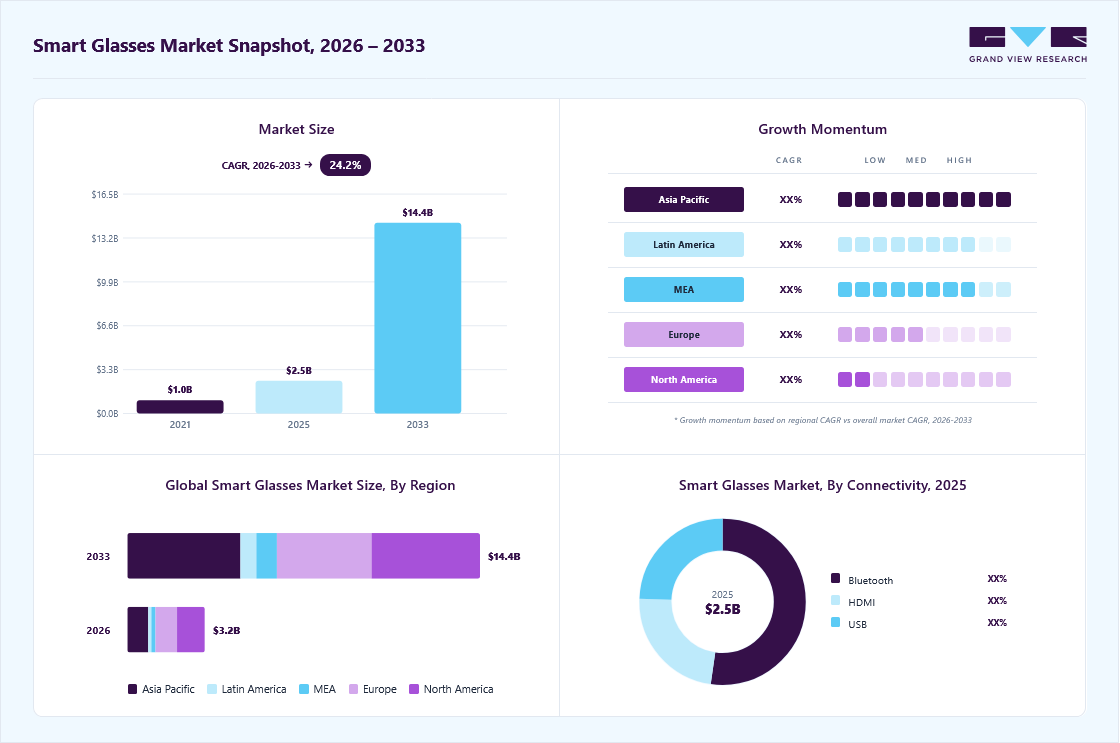
The way people access information is changing as computing moves closer to the human experience. The smart glasses market was valued at USD 2.5 billion in 2025 and is estimated to reach USD 3.2 billion in 2026, before expanding to USD 14.4 billion by 2033, registering a 24.2% CAGR from 2026 to 2033. Growing adoption of augmented reality and artificial intelligence, demand for hands-free connected devices, and expanding enterprise applications are fueling this rapid growth.
From Wearable Gadget to Connected Computing Platform
Smart glasses are increasingly being developed as more than visual accessories. AI-powered features, voice assistants, real-time information access, navigation, remote communication, and translation are broadening their potential uses. Advances in miniature sensors, low-power processors, displays, Bluetooth, and 5G are improving functionality while supporting lighter and more practical designs.
The market is also benefiting from stronger software ecosystems. AR platforms, cloud infrastructure, developer tools, and software development kits are allowing manufacturers and developers to create applications tailored to professional and consumer requirements. This ecosystem development is helping move smart glasses from isolated hardware products toward connected wearable platforms.
Enterprise Applications Are Giving the Market a Practical Foundation
Industrial users are emerging as an important source of demand. The industrial application segment accounted for 27.0% of the market in 2025, supported by Industry 4.0 initiatives and the need for real-time data, remote assistance, and improved operational efficiency. Manufacturing, logistics, maintenance, and field services can use smart glasses to provide workers with hands-free information and interactive digital overlays.
Healthcare is another promising application area and is expected to record the fastest CAGR from 2026 to 2033. Remote consultations, clinical workflows, patient monitoring, and AR-assisted visualization are creating opportunities for wearable technology within healthcare environments.
Audio Smart Glasses Capture the Current Consumer Opportunity
The audio segment held the largest share among smart glasses types, accounting for 28.0% in 2025. Demand for hands-free communication, voice assistants, music streaming, navigation, and open-ear listening is supporting adoption. Improvements in sound quality, battery life, noise reduction, and Bluetooth connectivity are making audio-enabled glasses increasingly attractive to consumers and professional users.
Immersive smart glasses, meanwhile, are expected to grow at more than 26% CAGR from 2026 to 2033. AR and mixed-reality applications in gaming, entertainment, education, training, product visualization, and remote collaboration are creating opportunities for more advanced devices.
Operating Systems and Connectivity Matter to Adoption
Android held the largest operating-system share at 48.0% in 2025, supported by its broad application ecosystem, flexibility, hardware compatibility, and integration capabilities. Linux is expected to register the fastest CAGR during the forecast period, particularly as enterprises seek customizable and secure platforms for industrial and mission-critical applications.
Bluetooth remained the leading connectivity technology in 2025. Its compatibility with smartphones, wireless audio, and IoT devices supports convenient connections between smart glasses and other devices. USB connectivity is expected to record the fastest CAGR from 2026 to 2033 as professional applications increasingly require reliable data transfer and stable connections.
Cost Remains a Barrier to Wider Adoption
Despite strong growth prospects, smart glasses face challenges related to production and component costs. Advanced displays, waveguides, optical modules, sensors, cameras, and specialized chips increase manufacturing complexity. Significant investment in miniaturization, AI integration, and software ecosystems can also contribute to higher retail prices.
The industry is still operating at lower production volumes than mature consumer electronics categories, limiting economies of scale. This creates a challenge for companies seeking to bring advanced functionality to broader consumer markets while maintaining accessible pricing.
Regional Adoption Shows Where the Next Opportunities Lie
North America dominated the market with a 34.4% revenue share in 2025, supported by strong technology companies, AR and AI investment, and enterprise digital transformation. Healthcare, manufacturing, defense, and logistics are important application areas across the region.
Asia Pacific is expected to be the fastest-growing regional market, with a 27% CAGR from 2026 to 2033. Expanding consumer electronics adoption, urbanization, rising disposable incomes, digital infrastructure investment, and industrial transformation are supporting demand. Europe is also expected to grow at more than 23% CAGR during the same period.
Smart Glasses Move Toward a More Connected Future
With the market projected to reach USD 14.4 billion by 2033, smart glasses are moving into a high-growth phase shaped by AI, AR, enterprise digitization, immersive experiences, and hands-free computing. Continued advances in hardware and supporting ecosystems could broaden their role across industrial, healthcare, consumer, and professional environments.
FAQ
What is driving smart glasses market growth?
Growing adoption of AR and AI, demand for hands-free connected devices, enterprise digital transformation, advances in displays and sensors, and increasing applications across industrial and healthcare environments are supporting market growth.
Which segment leads the smart glasses market?
The audio type segment led with 28.0% of the market in 2025, while Android led operating systems with 48.0%, industrial applications held 27.0%, and Bluetooth was the leading connectivity segment.
Key Smart Glasses Companies:
· Amazon.com, Inc.
· Vuzix Corporation
· Bose Corporation
· Flows Bandwidth
About us:
Grand View Research, a market research and consulting company, provides syndicated research reports, customized research reports, and consulting services. Grand View Research database is used by the world's renowned academic institutions and Fortune 500 companies to understand the global and regional business environment. Our database features thousands of statistics and in-depth analysis on 46 industries in 25 major countries worldwide.

 Arabic
 French
 Spanish
 Portuguese
 Deutsch
 Turkish
 Dutch
Dutch
 Italiano
 Russian
 Romaian
 Portuguese (Brazil)
 Greek
Greek